Failed to mention yesterday that the instructions for MFP were issued timely. Signup opened yesterday, and the notice providing the instructions was issued at 1:00 am. Sept. 4.
Never let it be said that FSA bureaucrats were asleep on the job.
Wednesday, September 05, 2018


Tuesday, September 04, 2018
CCC-910 for Market Facilitation Program
FSA now has the form approved by OMB and up and operational on its website. (Or, actually on the farmers.gov website.)
Since I've started off nitpicking the program and it's a convenient subject to blog about, some more comments. (And there aren't many people left at FSA from my time there, which is a consideration--don't want to be unfair to friends, but unfair to strangers is another matter.)
I wonder why the producer's certification only notes that failure to certify production accurately will result in loss of benefits. I'm too lazy to check, but didn't FSA used to note penalties for false certification--18 U.S.C. something or other? I also wonder why there's no language either tying the production to the producer's farm(s) or certifying that it is the total production from all farms in which the producer has an interest. Don't know if there's an appendix to this contract. Nor do I know the significance of the "adjusted production" column.
I'm a bit disappointed that FSA asks for a producer's fax number, but not her email address.
I note with some bemusement that the nondiscrimination statement has been modified since my time--I've bolded the changes.
"In accordance with Federal civil rights law and U.S. Department of Agriculture (USDA) civil rights regulations and policies, the USDA, its Agencies, offices, and employees, and institutions participating in or administering USDA programs are prohibited from discriminating based on race, color, national origin, religion, sex, gender identity (including gender expression), sexual orientation, disability, age, marital status, family/parental status, income derived from a public assistance program, political beliefs, or reprisal or retaliation for prior civil rights activity, in any program or activity conducted or funded by USDA (not all bases apply to all programs). Remedies and complaint filing deadlines vary by program or incident."
I note the farmers.gov website promises the ability to file electronically. Maybe I've found another area to nitpick.
Since I've started off nitpicking the program and it's a convenient subject to blog about, some more comments. (And there aren't many people left at FSA from my time there, which is a consideration--don't want to be unfair to friends, but unfair to strangers is another matter.)
I wonder why the producer's certification only notes that failure to certify production accurately will result in loss of benefits. I'm too lazy to check, but didn't FSA used to note penalties for false certification--18 U.S.C. something or other? I also wonder why there's no language either tying the production to the producer's farm(s) or certifying that it is the total production from all farms in which the producer has an interest. Don't know if there's an appendix to this contract. Nor do I know the significance of the "adjusted production" column.
I'm a bit disappointed that FSA asks for a producer's fax number, but not her email address.
I note with some bemusement that the nondiscrimination statement has been modified since my time--I've bolded the changes.
"In accordance with Federal civil rights law and U.S. Department of Agriculture (USDA) civil rights regulations and policies, the USDA, its Agencies, offices, and employees, and institutions participating in or administering USDA programs are prohibited from discriminating based on race, color, national origin, religion, sex, gender identity (including gender expression), sexual orientation, disability, age, marital status, family/parental status, income derived from a public assistance program, political beliefs, or reprisal or retaliation for prior civil rights activity, in any program or activity conducted or funded by USDA (not all bases apply to all programs). Remedies and complaint filing deadlines vary by program or incident."
I note the farmers.gov website promises the ability to file electronically. Maybe I've found another area to nitpick.
Monday, September 03, 2018
Alex Haley and Cornell
It turns out that Alex Haley, the author of "Roots" was born in Ithaca, NY, while his father Simon was getting his Masters in agriculture at Cornell.
Over the first hundred years of Cornell's existence it educated some African-Americans, though a man from Haiti was the first student of African descent in 1869.
IMO because of its different colleges, partly due to its land-grant status, Cornell had an easier time with diversity than did its competitors over that period. For blacks the record was tokenism, a few students every year at best. Cornell did better with Asian students, enrolling its first in 1870 along with its first woman. But notoriously, when the civil rights movement started impacting colleges in the 1960's, it didn't do any better than other schools.
Over the first hundred years of Cornell's existence it educated some African-Americans, though a man from Haiti was the first student of African descent in 1869.
IMO because of its different colleges, partly due to its land-grant status, Cornell had an easier time with diversity than did its competitors over that period. For blacks the record was tokenism, a few students every year at best. Cornell did better with Asian students, enrolling its first in 1870 along with its first woman. But notoriously, when the civil rights movement started impacting colleges in the 1960's, it didn't do any better than other schools.
Sunday, September 02, 2018
Canada and Supply Management for Dairy
One of the biggest issues in the renegotiation of NAFTA with Canada is their desire to maintain their system of supply management for dairy. Here's a site with statistical data on the industry. The two big provinces are Ontario and Quebec. As one can see from this chart there's little variation in cow numbers over the last 15 years (2004-2018). But if you look at the number of farms, there has been roughly 1/3 reduction in farm numbers over the same period (17,000 to 11,000).
From ERS (the copy and paste process loses the formating. I've bolded the two big points): Midpoints increased for each commodity over 1987-2012, but the rate of increase varies widely, with dramatic long-term changes in egg, hog, and dairy production (table 9). The midpoint flock size in egg layers increased to 925,975 birds in 2012 from 117,839 in 1987 (and just over 62,000 in 1982); the midpoint for hog removals rose to 40,000 in 2012 from 1,200 in 1987; and the midpoint dairy cow herd rose to 900 cows in 2012 from 80 in 1987. The broiler and fed cattle industries show continued consolidation, with 2012 midpoints a bit more than double their values in 1987. However, each underwent striking changes in organization and technology well before the series starts in 1987 (MacDonald and McBride, 2009). Table 9 Consolidation in livestock sectors, 1987-2012 Commodity 1987 1997 2007 2012 Change (percent) 1987-2012 2007-2012 Sales midpoint: Number of head sold or removed Broilers 300,000 480,000 681,600 680,000 127 -0.1 Fed cattle 17,532 38,000 35,000 38,369 119 10 Hogs and pigs 1,200 11,000 30,000 40,000 3,233 33 Turkeys 120,000 137,246 157,000 160,000 33 2 Inventory midpoint: Number of head in herd/flock Beef cows 89 100 110 110 24 0 Egg layers 117,839 300,000 872,500 925,975 686 6 Milk cows 80 140 570 900 1,025 58 Source: USDA, Economic Research Service, compiled from census of agriculture data.
Bottom line: while Canadian dairy farms have declined in number, the rate of decline in the US is higher.
I'm reminded of the supply management system the US used to have for tobacco, now ended. It had a similar effect: slowing the transformation of the industry.
From ERS (the copy and paste process loses the formating. I've bolded the two big points): Midpoints increased for each commodity over 1987-2012, but the rate of increase varies widely, with dramatic long-term changes in egg, hog, and dairy production (table 9). The midpoint flock size in egg layers increased to 925,975 birds in 2012 from 117,839 in 1987 (and just over 62,000 in 1982); the midpoint for hog removals rose to 40,000 in 2012 from 1,200 in 1987; and the midpoint dairy cow herd rose to 900 cows in 2012 from 80 in 1987. The broiler and fed cattle industries show continued consolidation, with 2012 midpoints a bit more than double their values in 1987. However, each underwent striking changes in organization and technology well before the series starts in 1987 (MacDonald and McBride, 2009). Table 9 Consolidation in livestock sectors, 1987-2012 Commodity 1987 1997 2007 2012 Change (percent) 1987-2012 2007-2012 Sales midpoint: Number of head sold or removed Broilers 300,000 480,000 681,600 680,000 127 -0.1 Fed cattle 17,532 38,000 35,000 38,369 119 10 Hogs and pigs 1,200 11,000 30,000 40,000 3,233 33 Turkeys 120,000 137,246 157,000 160,000 33 2 Inventory midpoint: Number of head in herd/flock Beef cows 89 100 110 110 24 0 Egg layers 117,839 300,000 872,500 925,975 686 6 Milk cows 80 140 570 900 1,025 58 Source: USDA, Economic Research Service, compiled from census of agriculture data.
Bottom line: while Canadian dairy farms have declined in number, the rate of decline in the US is higher.
I'm reminded of the supply management system the US used to have for tobacco, now ended. It had a similar effect: slowing the transformation of the industry.
Friday, August 31, 2018
No Instructions or Form for MFP
At least, I can't find any at the appropriate places on the fsa.usda website or on the farmers.gov website. That site provides links to the other forms which are required or may be used.
Thursday, August 30, 2018
Any Double-Dipping on MFP
Still no FSA notice on the MFP, but there is a notice on the Dairy Margin Protection Program. I have not kept up with program, but from the following Background paragraphs my guess is it's a revenue insurance type program, but run by FSA and not RMA.
"MPP-Dairy payments are triggered when the difference between the National all milk price and the National average feed cost (the margin) falls below the producer-selected margin trigger, ranging from $4 to $8, calculated monthly. USDA prices for milk and feed components required to determine the National average margin for July were released on August 29, 2018. The actual National average margin for July is $6.71815/cwt. As a result, dairy operations that elected margin coverage of $7.00, $7.50 and $8 will be issued a payment.
Payments for margins triggered will be issued directly to producers. MPP-Dairy payments issued will not be offset by premium balances due. The full balance of the premium is due September 28, 2018."It raises the question to me, which I may have mentioned before, of whether there will be double-dipping under the MFP. In other words, crop insurance has products, on which I'm not expert, which can cover loss of revenue from a base, a loss which might be caused by production losses and/or market price dips. Producers have to sign up for such products and pay premiums. MFP is essentially a free one-shot policy covering market price dips. So producers who signed up for the DMPP or a revenue crop insurance policy will receive two payments for the same loss. That doesn't seem right, but from a program administration standpoint it immensely simplifies the operation.
Wednesday, August 29, 2018
MFP Form Is Missing?
USDA now has some material on the MFP other than the press release up its website, farmers.gov.
They give the name of the application form, CCC-910, but it's not available in the FSA Forms database. Nor is there any notice on MFP listed in FSA notices. I assume any training for administering the program would also show up in a notice there.
They give the name of the application form, CCC-910, but it's not available in the FSA Forms database. Nor is there any notice on MFP listed in FSA notices. I assume any training for administering the program would also show up in a notice there.
Tuesday, August 28, 2018
MFP Notice of Funds Availability
As usual, I'm fast and sloppy. OFR has the NOFA for MFP here.
OMB gave FSA a 6-month emergency approval for the paperwork. (Why didn't they do that for ASCS back in the day when I was handling them.)
The NOFA does have the Catalog of Federal Domestic Assistance number for MFP--10.123.
I have to carp at this paragraph: "If supporting documentation is required for the amount of actual production and for ownership share, it needs to be verifiable records that substantiate the reported amounts. The participant’s production for the commodity is based on verifiable or reliable production records. Examples of reliable production records include evidence provided by the participant that is used to substantiate the amount of production reported when verifiable records are not available, including copies of receipts, ledgers of income, income statements of [? shouldn't it be "or,"]deposit slips, register tapes, invoices for custom harvesting, and records to verify production costs, contemporaneous measurements, truck scale tickets, or contemporaneous diaries that are determined acceptable by the county committee."
The first sentence and second sentences seem to be at odds--my guess is the intention is clarified by the definitions of "verifiable" and "reliable" (but not verifiable) evidence in the next paragraphs, but that isn't what the first sentence says.
OMB gave FSA a 6-month emergency approval for the paperwork. (Why didn't they do that for ASCS back in the day when I was handling them.)
The NOFA does have the Catalog of Federal Domestic Assistance number for MFP--10.123.
I have to carp at this paragraph: "If supporting documentation is required for the amount of actual production and for ownership share, it needs to be verifiable records that substantiate the reported amounts. The participant’s production for the commodity is based on verifiable or reliable production records. Examples of reliable production records include evidence provided by the participant that is used to substantiate the amount of production reported when verifiable records are not available, including copies of receipts, ledgers of income, income statements of [? shouldn't it be "or,"]deposit slips, register tapes, invoices for custom harvesting, and records to verify production costs, contemporaneous measurements, truck scale tickets, or contemporaneous diaries that are determined acceptable by the county committee."
The first sentence and second sentences seem to be at odds--my guess is the intention is clarified by the definitions of "verifiable" and "reliable" (but not verifiable) evidence in the next paragraphs, but that isn't what the first sentence says.
Where Are the Regulations and the Forms?
USDA has officially announced Sept. 4 as the beginning date to sign up for the Market Facilitation Program. That's the press release.
What I, as an old FSA bureaucrat, am wondering is:
What I, as an old FSA bureaucrat, am wondering is:
- when will FSA issue a directive, presumably a notice, on the MFP?
- when will the regulations (presumably an interim final reg) be published by the Office of the Federal Register. Note: I typed the previous sentence, then did a search on the OFR site. The regulation was filed with OFR this morning. It has this notation: "This document is scheduled to be published in the Federal Register on 08/30/2018 and available online at https://federalregister.gov/d/2018-18842, and on govinfo.gov"
- when will the signup form(s) be available? They have to be cleared by OMB.
Some comments on the regulations, written as I scan it.
- USDA OGC and OMB have come up with a dodge which is new to me--a "Notice of Funds Availability". I've not seen such a document before, but Googling shows it's been used by other departments. My guess is the lawyers approved (lawyers can approve anything if the pressure is on) this as a measure to work around existing rules in the Administrative Procedure Act and Trump's EEO--I'd bet a fair amount that NOFA's aren't considered "regulations" for those purposes. Note: There's some logic to the step--the "regulations" which get conservatives upset usually shape behavior: OSHA and EPA type regs. The regulations for farm program payments used to be considered "regulations", but no body was forced to take the payments--the regulations were really the conditions for receiving the payment.
- I'm waiting with bated breath to see whether the applications for payment get OMB clearance. Seems to me they have to, but the MFP regs say the form will be specified in the NOFA.
- Turns out OMB has a category of "transfer rules" which are not covered by the two for one Trump rule (doing away with two old regulations for each new regulation). That dates back to April 2017.
- I see one glitch here: "The title and number of the Federal Domestic Assistance Program found in the Catalog of Federal Domestic Assistance to which this rule applies is TBD – Market Facilitation Program and number". The number wasn't assigned.
- I think it's fair to assume that eligibility and payments are on a farm basis, rather than an operator.
I never was an expert on the price support side of FSA; they are the people who dealt with production evidence. With that said, where could a dishonest producer game the program? The incentive for fraud would be to exaggerate one's production, by duplicating evidence to multiple county offices, forging evidence, or having different producers claiming ownership of the same production. FSA has long experience with production evidence, so existing validation checks and spotchecks will likely work. However, as a cynic, I'm sure a few farmers will try to get more than they should.
Monday, August 27, 2018
Market Facilitation Program--Signup Sept. 4
Here's the USDA press release on the programs to offset the impacts of Trump's trade war on farmers.
Some things strike me, though my information is 20 years out of date.
The MFP (administered by FSA) covers pork and milk, as well as the commodities: cotton, corn, wheat, soybeans, and sorghum (not sure if ELS cotton is covered); oats, rice, and barley are not. While FSA is used to collecting production data for the commodities, it has less experience with pork and milk.
Applications for the "first payment period" starts Sept. 4 (actually presumably the later of Sept 4 and the completion of harvest for the commodities), but it's not clear to me what the payment period means--presumably the 2018 harvest for the commodities, while pork and milk are based on snapshot data as of August 1 and June 1, respectively.
Payment's on 50 percent of actual production, with the second payment period beginning Dec. 2018 to cover the remaining 50 percent. Presumably that will be announced if there's no end to the war or farm prices don't bounce back.
[Addition: not clear whether application is on a farm basis, or the entire farming operation. Possibly could be either, but the entire operation would limit the possibility of moving production evidence from one farm to another.]
Some things strike me, though my information is 20 years out of date.
The MFP (administered by FSA) covers pork and milk, as well as the commodities: cotton, corn, wheat, soybeans, and sorghum (not sure if ELS cotton is covered); oats, rice, and barley are not. While FSA is used to collecting production data for the commodities, it has less experience with pork and milk.
Applications for the "first payment period" starts Sept. 4 (actually presumably the later of Sept 4 and the completion of harvest for the commodities), but it's not clear to me what the payment period means--presumably the 2018 harvest for the commodities, while pork and milk are based on snapshot data as of August 1 and June 1, respectively.
Payment's on 50 percent of actual production, with the second payment period beginning Dec. 2018 to cover the remaining 50 percent. Presumably that will be announced if there's no end to the war or farm prices don't bounce back.
[Addition: not clear whether application is on a farm basis, or the entire farming operation. Possibly could be either, but the entire operation would limit the possibility of moving production evidence from one farm to another.]
Sunday, August 26, 2018
Honor the Silent Generation
Ross Douthat had a nice tweet on Sen. McCain, but he led off by calling him a member of the Boomer generation. He was quickly corrected, by many, including me.
We Silents get no respect--we're stuck between the so-called "Greatest Generation" and the big Boomers. We got no president--all our candidates lost (Mondale, Dukakis, McCain), and we lost or drew our wars: Korea and Vietnam. But for all that, we survived and so did the country.
We Silents get no respect--we're stuck between the so-called "Greatest Generation" and the big Boomers. We got no president--all our candidates lost (Mondale, Dukakis, McCain), and we lost or drew our wars: Korea and Vietnam. But for all that, we survived and so did the country.
Saturday, August 25, 2018
Ceremonies Where America Comes Together
One of the few times when America comes together, other than the Super Bowl, is funerals, specifically funerals of ex-Presidents and a select few other public figures (MLK, RFK). We can foresee three such ceremonies in the relatively near future. The first will be Sen. McCain who, though not a figure comparable to MLK, has a life story which attracts sympathy from different elements of America. The second and third are less, clear, but neither Jimmy Carter nor George H.W. Bush can be expected to live many more years.
IIRC correctly President Clinton's remarks at Nixon's funeral was praised. That's just an example of the close scrutiny we give to the pageantry and words at such funerals.
IIRC correctly President Clinton's remarks at Nixon's funeral was praised. That's just an example of the close scrutiny we give to the pageantry and words at such funerals.
Monday, August 20, 2018
Puzzles of Human Society I Don't Understand
Two things about human society I don't understand:
- Sometimes things change fast. I'm thinking of things like the change in the US in attitudes towards homosexuals, particularly gay marriage. Or the changes in Ireland in social attitudes generally. Or the changes in Chinese society over the last 40 years or so.
- Sometimes things change slow. I'm thinking of things like Gregory Clarks research on the long lasting effects of social position in British society. Or things like the research on the effects of the slave trade on African countries which were or weren't affected by the trade. Or things like the beer/wine divide in Europe. Or the effects of Roman roads on subsequent development.
If I weren't lazy at the moment I could provide links, but as I am you'll just have to trust me.
I suppose there's some logic to the differences, but I've not seen it addressed anywhere.
Sunday, August 19, 2018
USDA and Amazon Search for Locations
USDA has issued their request for proposals from cities for facilities for ERS and NIFA. (For those like me who might be confused by some of the publicity around the proposal: no, NIFA is not ARS (the Agricultural Research Service based in Beltsville), they're something else.
The request is for 70,000 sq ft for ERS and 90,000 sq. ft. for NIFA, total of 620 employees, deadline for "expressions of interest" is Sep. 14.
Now I hope that Amazon makes up their mind about their second headquarters by late September so the losing cities will have a chance at ERS/NIFA. Actually, my guess would be Ft. Collins and Ames, IA might be choices.
620 mostly professional employees might be close to $100 million.
The request is for 70,000 sq ft for ERS and 90,000 sq. ft. for NIFA, total of 620 employees, deadline for "expressions of interest" is Sep. 14.
Now I hope that Amazon makes up their mind about their second headquarters by late September so the losing cities will have a chance at ERS/NIFA. Actually, my guess would be Ft. Collins and Ames, IA might be choices.
620 mostly professional employees might be close to $100 million.
Saturday, August 18, 2018
The Ants Say: Pareto Was Wrong
I've always believed the Pareto 80/20 rule had broad applicability. But now scientists report it's even broader than I knew, but Pareto had the numbers wrong--it's really 70/30. It turns out 70 percent of ants let the others do the digging of tunnels, which is important because otherwise you violate the "too many cooks in the kitchen" rule--the extra workers just run into each other.
Monday, August 13, 2018
Sometimes I'm Stupid
Although I'm not sure whether it's plain stupidity, impatience, or stress.
As I posted yesterday, I bought a new PC on Saturday, since the old one was giving the blue screen of death. What I missed, what was stupid, was the fact that the good people at Microsoft had a QR code (like a 2d bar code) associated with the blue screen and error message. Finally woke up to the fact today. I had, fortunately, taken a picture of the screen and QR code on Friday, so I did a google search for the image--found it and an explanation of the error code.
Now I'm not sure when I follow up on the error code I'll find a cause which shows I was too hasty in buying the new PC. But it does make me feel stupid.
As I posted yesterday, I bought a new PC on Saturday, since the old one was giving the blue screen of death. What I missed, what was stupid, was the fact that the good people at Microsoft had a QR code (like a 2d bar code) associated with the blue screen and error message. Finally woke up to the fact today. I had, fortunately, taken a picture of the screen and QR code on Friday, so I did a google search for the image--found it and an explanation of the error code.
Now I'm not sure when I follow up on the error code I'll find a cause which shows I was too hasty in buying the new PC. But it does make me feel stupid.
Sunday, August 12, 2018
New Computer
Bought a new PC yesterday, as my old desktop was displaying multiple blue screens of death. The process of setting it up and moving from the old one is familiar, yet a bit different. In the old days you'd be told about moving files from old to new, because everyone upgraded their PC to the newest and greatest version. No such instructions these days, perhaps because they know the likely reason for a new purchase is the old PC is dead? Or perhaps they figure the newbies are not buying desktops, but tablets or laptops or whatever, and the old timers who are stuck in a rut with desktops can figure out what to do.
Friday, August 10, 2018
USDA Reorganization--ERS
Government Executive has a good piece on the USDA announcement of a reorganization of the economics people, including a move of ERS outside of the DC area. I've no expertise in this area, but when has that kept me from commenting?
My first reaction to the move was negative, but then I read the rationale in the piece: the difficulty of getting professionals to move to the high-cost DC area. That makes sense to me. I remember the problems we had back in the 80's and 90's in getting people to move--one reason why we ended up hiring program technicians from county offices under SCOAP. Single women had less difficulty moving than did married men with families, the usual targets for hiring as program people in DC.
My third reaction is triggered by the discussion in the piece. Distance in bureaucracy is critical. The problem in attracting professionals to DC is not limited to ERS or USDA. Apparently the locality pay differential doesn't work at these levels, and also USDA hasn't gotten the authority to offer bigger money for such positions (like doctors in HHS/NIH or attorneys elsewhere get).
My first reaction to the move was negative, but then I read the rationale in the piece: the difficulty of getting professionals to move to the high-cost DC area. That makes sense to me. I remember the problems we had back in the 80's and 90's in getting people to move--one reason why we ended up hiring program technicians from county offices under SCOAP. Single women had less difficulty moving than did married men with families, the usual targets for hiring as program people in DC.
My third reaction is triggered by the discussion in the piece. Distance in bureaucracy is critical. The problem in attracting professionals to DC is not limited to ERS or USDA. Apparently the locality pay differential doesn't work at these levels, and also USDA hasn't gotten the authority to offer bigger money for such positions (like doctors in HHS/NIH or attorneys elsewhere get).
Bureaucrat Gets a Bust
Not many bureaucrats get immortalized in bronze, but Pearlie Reed did. The piece has a reference to his founding the National Association of Professional Black NRCS Employees. When you search that website it seems that Louis E. Wright may also have been a founder, or maybe "the" founder.
Wednesday, August 08, 2018
Comparative Advantage in People
The economists have an ancient law which they call "comparative advantage". Essentially it says a country should do whatever it does best at, even if its best is poor, poorer than other countries. If countries follow the rule, they'll end up trading goods at the lowest possible price. For example, American workers are good at assembling stuff, but they're also good at creating Disney films. Chinese workers are pretty fair at assembling stuff, but they aren't not good at creating Disney films. So the answer is obvious.
The NYTimes has an op-ed today which (mis)applies, without saying so, the theory to people. Barbara Oakey notes that academically girls are good at reading and writing, better than boys. But tests show that girls and boys have roughly equal aptitudes for math. She argues that girls, finding that they do better than boys at reading/writing will think they're less good at math and so choose to focus on reading/writing and slight their math. Her answer is to resist this, and to push girls to study math more.
Now Prof. Oakey is more focused on choices before college, not the ultimate choice of occupation. But drawing on the comparative advantage idea, she may be pushing a rock up the hill. She ignores the psychology on the other side: boys will find themselves outclassed at reading and writing by the girls, so will tend to focus on math.
[Caveats: all this is very general, phrased in ideal types, not real people.]
The NYTimes has an op-ed today which (mis)applies, without saying so, the theory to people. Barbara Oakey notes that academically girls are good at reading and writing, better than boys. But tests show that girls and boys have roughly equal aptitudes for math. She argues that girls, finding that they do better than boys at reading/writing will think they're less good at math and so choose to focus on reading/writing and slight their math. Her answer is to resist this, and to push girls to study math more.
Now Prof. Oakey is more focused on choices before college, not the ultimate choice of occupation. But drawing on the comparative advantage idea, she may be pushing a rock up the hill. She ignores the psychology on the other side: boys will find themselves outclassed at reading and writing by the girls, so will tend to focus on math.
[Caveats: all this is very general, phrased in ideal types, not real people.]
Tuesday, August 07, 2018
Jimmy Carter Reconsidered I
I'm reading "President Carter: the White House Years" by Stuart Eizenstat, who was Carter's main policy adviser in the White House. So far about a quarter through. It's well written, although it could use closer editing--in a couple places there's near repetition of content/points just pages apart.
That's not really important. The big issue in the early days was energy, which Eizenstat claims Carter changed national energy policy drastically and permanently. I'm not convinced yet, but I did run across this graph from AEI, which shows a dramatic drop in energy imports spanning 10 years from Carter's term through the end of Reagan's.
I may post more later on Carter.
That's not really important. The big issue in the early days was energy, which Eizenstat claims Carter changed national energy policy drastically and permanently. I'm not convinced yet, but I did run across this graph from AEI, which shows a dramatic drop in energy imports spanning 10 years from Carter's term through the end of Reagan's.

I may post more later on Carter.
Monday, August 06, 2018
Upward Mobility Revisited
Robert Samuelson has a column in the Post on the decline of upward mobility in America.
What's being measured is inflation-adjusted incomes, comparing children and parents. So the percentages of children who exceed their parents income has declined. A Brookings study tries to parse out which classes and which age cohorts see the change.
A couple of observations strike me: it's (relatively) easy for poor kids to beat their parents; it's hard for rich kids to beat their parents. The child of a welfare mother with no job only has to make it into a lasting job while the child of Warren Buffett or Bill Gates will never beat her parents.
The 1940 cohort has the greatest success, so using it as the baseline for comparison skews the results. People like me profited by the post-war boom, the increase in productivity, which hasn't been matched in later years.
One thing the discussions, particularly Samuelson's, don't approach is a hobbyhorse of mine: in a steady-state economy every person who is upwardly mobile has to be matched by another who is downwardly mobile. That's apparent when, as here, you use inflation-adjusted income as your measure; it's less apparent when you talk about people moving from one level (decile, quartile) to another.
With dollars of income, it's possible for everyone to out earn their parents, provided only that the economy grows enough. (Think of China, where the income measure means everyone is upwardly mobile.)
What's being measured is inflation-adjusted incomes, comparing children and parents. So the percentages of children who exceed their parents income has declined. A Brookings study tries to parse out which classes and which age cohorts see the change.
A couple of observations strike me: it's (relatively) easy for poor kids to beat their parents; it's hard for rich kids to beat their parents. The child of a welfare mother with no job only has to make it into a lasting job while the child of Warren Buffett or Bill Gates will never beat her parents.
The 1940 cohort has the greatest success, so using it as the baseline for comparison skews the results. People like me profited by the post-war boom, the increase in productivity, which hasn't been matched in later years.
One thing the discussions, particularly Samuelson's, don't approach is a hobbyhorse of mine: in a steady-state economy every person who is upwardly mobile has to be matched by another who is downwardly mobile. That's apparent when, as here, you use inflation-adjusted income as your measure; it's less apparent when you talk about people moving from one level (decile, quartile) to another.
With dollars of income, it's possible for everyone to out earn their parents, provided only that the economy grows enough. (Think of China, where the income measure means everyone is upwardly mobile.)
Sunday, August 05, 2018
White Anxiety and Spelling Bees, etc.
Usually discussion of white anxiety focuses on growing economic inequality, the decline of the middle class, and the influx of immigrants resulting in a minority-majority country (not that I necessarily agree with these). But I think there's another source of anxiety which isn't often discussed: white stupidity.
What I mean is whites look around and see that South Asians are dominating the National Spelling Bee (19 of the last 23). I don't have an article to link to but I believe that students with immigrant backgrounds are also out competing "whites" in what used to be the Westinghouse Science Competition. The new suit charging Harvard discriminates against Asian students forces "whites" to recognize their grip on claims to superiority in test-taking is slipping away.
To rub salt into "white" dreams of superiority Asian women have dominated the LGPA.
What I mean is whites look around and see that South Asians are dominating the National Spelling Bee (19 of the last 23). I don't have an article to link to but I believe that students with immigrant backgrounds are also out competing "whites" in what used to be the Westinghouse Science Competition. The new suit charging Harvard discriminates against Asian students forces "whites" to recognize their grip on claims to superiority in test-taking is slipping away.
To rub salt into "white" dreams of superiority Asian women have dominated the LGPA.
Friday, August 03, 2018
"Milk", by Mark Kurlansky
I got this book from the library, not Amazon, so I wouldn't feel right reviewing it there. But I think the "critical" reviews on Amazon are generally on point.
For someone who grew up on a dairy farm the subject is interesting. For someone who doesn't cook all the recipes aren't interesting. The coverage is wide and broad, but not deep. He tries to cover milk from a variety of species around the world, tossing in recipes every two or three pages. He wraps up with a brief look at modern US farming. The book started as a magazine article, and it still retains some of that character. The author leans somewhat to the side of organic/locavore dairy, finding farms which are trying to find a niche where they can charge high enough prices to stay in business.
But the author is a bit credulous, I think, in accepting some of the claims. For example, that one Holstein could outproduce 50 Jerseys. Not possible--the farmer must have been pulling his leg.
There's also the claim cows stay in the herd until 3 or 4. Seemed incredible to me--3 means one lactation, which isn't enough to cover the cost of rearing the calf. I know we had cows in our herd aged 9 or 10, because they were still productive milkers. Did some superficial googling and found 4 or 5 is a common figure. Still seems low to me, but then I remembered what we did with our calves: the males went for veal, of course; some of the females we kept and others we sold (depending on whether chance had given us a run of females). The selling is the key--dad could sell calves because there were other dairies in the region, and his herd was respected. Today, I'd assume there's no market for female calves, so they all go into the herd. If the cow has two pregnancies, chances are she's borne her replacement. So the economic calculation for the herd is the cost of rearing the calf until it can be bred and give birth, versus the cow's production over that time. (I'd also assume because of better breeding the calf has a greater potential than its mother had.)
For someone who grew up on a dairy farm the subject is interesting. For someone who doesn't cook all the recipes aren't interesting. The coverage is wide and broad, but not deep. He tries to cover milk from a variety of species around the world, tossing in recipes every two or three pages. He wraps up with a brief look at modern US farming. The book started as a magazine article, and it still retains some of that character. The author leans somewhat to the side of organic/locavore dairy, finding farms which are trying to find a niche where they can charge high enough prices to stay in business.
But the author is a bit credulous, I think, in accepting some of the claims. For example, that one Holstein could outproduce 50 Jerseys. Not possible--the farmer must have been pulling his leg.
There's also the claim cows stay in the herd until 3 or 4. Seemed incredible to me--3 means one lactation, which isn't enough to cover the cost of rearing the calf. I know we had cows in our herd aged 9 or 10, because they were still productive milkers. Did some superficial googling and found 4 or 5 is a common figure. Still seems low to me, but then I remembered what we did with our calves: the males went for veal, of course; some of the females we kept and others we sold (depending on whether chance had given us a run of females). The selling is the key--dad could sell calves because there were other dairies in the region, and his herd was respected. Today, I'd assume there's no market for female calves, so they all go into the herd. If the cow has two pregnancies, chances are she's borne her replacement. So the economic calculation for the herd is the cost of rearing the calf until it can be bred and give birth, versus the cow's production over that time. (I'd also assume because of better breeding the calf has a greater potential than its mother had.)
Thursday, August 02, 2018
USDA and FSA IT
The USDA CIO's office has a blog post touting their work towards "dashboards" consolidating access to data across the USDA.
Fedscoop notes in the second phase of the "lighthouse" project:
In this second phase, USDA plans to award contracts across the same five focus areas as Phase I — IT Infrastructure Optimization, Cloud Adoption, Customer Experience, Data Analytics and Contact Center — and an additional contract for support of its program management office.The same piece offers this quote:
"While the CoEs address a wide swath of IT modernization at USDA, the White House’s Matt Lira argued in June that what they all have in common is creating a better-functioning government.I'm a little dubious of these efforts. I do hope they are collecting metrics. If I were feeling energetic, I'd file a FOIA request for available metrics of online usage. But then, if I were feeling energetic, I'd have better things to do than nitpick efforts.
“We are ultimately in the business of restoring the public’s faith in these institutions themselves,” Lira said.
Wednesday, August 01, 2018
The Need for Photo ID and Our Assumptions
President Trump last night said you need photo id when you go to the grocery store. His people have defended the statement two ways: if you're paying by check, you need the id or if you're buying alcohol you need the id. His opponents find these lame rationalizations--few people pay by check anymore and he didn't mention beer and wine.
As an opponent, I agree. But there's a danger here of accepting and reinforcing the assumption--all Americans go to the supermarket, all Americans have checking accounts, and all Americans live in single-family homes. All, of course, are false. Many Americans go to the local grocery, where their family may have shopped for years, and where the owner knows them and needs no id. Many Americans have no checking account. Many Americans never go to the store, being essentially confined to their homes and dependent on others to buy their groceries for them. And many Americans live in group settings where food is served. And some Americans live on the street and depend on food kitchens, etc.
[updated: Vann Newkirk at the Atlantic agrees.]
As an opponent, I agree. But there's a danger here of accepting and reinforcing the assumption--all Americans go to the supermarket, all Americans have checking accounts, and all Americans live in single-family homes. All, of course, are false. Many Americans go to the local grocery, where their family may have shopped for years, and where the owner knows them and needs no id. Many Americans have no checking account. Many Americans never go to the store, being essentially confined to their homes and dependent on others to buy their groceries for them. And many Americans live in group settings where food is served. And some Americans live on the street and depend on food kitchens, etc.
[updated: Vann Newkirk at the Atlantic agrees.]
Tuesday, July 31, 2018
Monday, July 30, 2018
Implementing the Trade War Payments I
Agweb has the announcement of the CCC programs, which include these details (from Jim Wiesemeyer, who was a pain in the neck back in 1983 during the the implementation of the Payment-in-Kind (PIK) Program).
Those are policy issues for the big shots in USDA and OMB--I hope Sec. Perdue's policy team is well staffed and works smoothly, much more smoothly than the administration's foreign policy team.
The bureaucratic issues are of more interest to me. Developing the signup forms and procedures, writing the regulations, and getting OMB clearance on the forms and regulations are big jobs. In 1983 we didn't have all the tools they have now--IIRC Wordperfect was our major tool. I know for sure we were still printing forms and procedures then. And those had to be shipped to state and county offices and arrive before farmers could sign up for the program.
My big question on this program is how Trump's EOs on reducing the burden of regulations and the number of regulations will come into play. I'm sure at the beginning of the year USDA and OMB didn't plan on having at least one brand new regulation, and more likely three new ones, to fit under the Trump rules. Three new rules would mean having to do away with six old ones. My cynical take is OMB will waive the rules and no one of any consequence will notice.
I'm also curious how FSA in DC will train the states and counties. I know they're doing a lot of training online. In 1983 DC had to train the states and the states would train the counties. Preparing training materials when issues are still in up in the air is fun. Getting up in front of 100 state people who are impatient to get going and nervous over the jam they're in is great fun. The reality though is that "training" is more complicated than simply passing on information and procedures. In-person training is an opportunity to find out the holes and flaws in what you (the DC specialist) has done. And it's an opportunity over the long run to build trust--if you promise to get an answer from the big shots and are able to deliver, people trust you more. And I think that trust ultimately pervades the whole network of people from DC specialist through to the farmer applying for benefits.
“USDA says it will take some time to develop the needed rules and regulations for the efforts and there will be a Federal Register notice published,” Wiesemeyer said. “There will be a relatively simple signup —producers will need to tell USDA what their 2018 production is for the crops targeted, and that level of what they actually produced times a payment rate and producers would get a payment based on that formula.”
Specific details for how the program will work, how the program will be implemented and how farmers can sign up for payments have not been announced. According to USDA undersecretary, Greg Ibach, the details will be released closer to Labor Day when USDA plans to fully implement the program.I suspect there's some parallels with PIK--USDA and FSA have been working on the program for a couple months. And they'll be working even harder now the announcement is out. Based on my experience with PIK and other programs, the biggest problem will have been figuring out what decisions need to be made, specifically things like which commodities will be included and the economic logic for computing payment rates. How long do you assume the trade war is going to last is a big one. Maybe you can compute an impact on prices for the 2018 crops of wheat, corn, soybeans, etc and assume that the trade war will be over in time for the 2019 crop? But for dairy and pork the exact duration is more important. Or maybe you set up a continuing program so you can do multiple computations and multiple payments?
“Payments are expected to start going to producers in September and will be also dictated by when the producer actually harvests the crops where the direct payments will be made,” Wiesemeyer said. “That would signal most wheat producers would be first up to receive the payments along with pork and dairy producers.”
Those are policy issues for the big shots in USDA and OMB--I hope Sec. Perdue's policy team is well staffed and works smoothly, much more smoothly than the administration's foreign policy team.
The bureaucratic issues are of more interest to me. Developing the signup forms and procedures, writing the regulations, and getting OMB clearance on the forms and regulations are big jobs. In 1983 we didn't have all the tools they have now--IIRC Wordperfect was our major tool. I know for sure we were still printing forms and procedures then. And those had to be shipped to state and county offices and arrive before farmers could sign up for the program.
My big question on this program is how Trump's EOs on reducing the burden of regulations and the number of regulations will come into play. I'm sure at the beginning of the year USDA and OMB didn't plan on having at least one brand new regulation, and more likely three new ones, to fit under the Trump rules. Three new rules would mean having to do away with six old ones. My cynical take is OMB will waive the rules and no one of any consequence will notice.
I'm also curious how FSA in DC will train the states and counties. I know they're doing a lot of training online. In 1983 DC had to train the states and the states would train the counties. Preparing training materials when issues are still in up in the air is fun. Getting up in front of 100 state people who are impatient to get going and nervous over the jam they're in is great fun. The reality though is that "training" is more complicated than simply passing on information and procedures. In-person training is an opportunity to find out the holes and flaws in what you (the DC specialist) has done. And it's an opportunity over the long run to build trust--if you promise to get an answer from the big shots and are able to deliver, people trust you more. And I think that trust ultimately pervades the whole network of people from DC specialist through to the farmer applying for benefits.
Saturday, July 28, 2018
Succesion on the Farm
NYTimes has an op-ed on Trump's trade war, focusing on the emptying of the rural landscape. His example:
A couple things of note:
A friend, a small-town Iowa banker who specializes in working with farmers, offered a local example. It’s time for Mom and Dad to retire, get off the farm and move to town. Much of the time, if no heir is interested in continuing the operation, the farm is auctioned to the highest bidder.It's wrenching, but good planning might have saved the day: the parents establish a legal entity (not a lawyer but likely a corporation of some ilk) in which all the children share equally, with the son who wants to farm an employee/owner. Over time, if the operation is profitable the son buys out his siblings, assuming they don't want any link to the farm.
This time, one son wanted to take over the farm. But there were other children entitled to their share, so the farm went up for auction.
But now they had to compete with larger farm operations. The son “did the best he could,” said my friend, but a big operation “bid it up more than it was worth, some guy from out of town no one knew — probably from one of the big operations up north. The kid didn’t have a chance. It was heartbreaking.”
A couple things of note:
- this proposed sequence means converting a "family farm" into a "corporate farm" even though there may not be much change in the day-to-day operation. Although likely the son who wanted to farm was bearing much of the workload when his parents decided to throw in the towel.
- the "big operation" is unknown, unspecified. It could well have been a neighbor who has the greater access to capital than the aspiring son has. It's logical it's a bigger operation: with everything else equal, the bigger operation will have lower per-acre operating costs than the smaller operation
- the succession problem is one reason why the median farmer is old.
Friday, July 27, 2018
Five Out of Six Elections Lost--Learn From the Past
Joe Scarborough had an op-ed in the Post this morning. He wrote "Republicans would win the White House in six of the next seven presidential elections [after 1964]. I don't think the math works: 1968, 1972, 1980, 1984, 1988, ?? I count it as five out of six elections (which is even better for his point--that the Republicans recovered fast after the Goldwater disaster).
Naturally, being a nitpicker, I leaped on the statement. But thinking more broadly, I was reminded of the 1972 election and George McGovern. To me, and others who supported McGovern such as the Clintons, that was a cautionary lesson. The lesson: the first rule of politics is you have to win the election. While I've a good deal of sympathy for many of the proposals now being floated by Democrats, I'll always support that rule.
Thursday, July 26, 2018
USDA in a Best Seller?? Maybe in a Movie?
Improbable as it seems, it's possible, not certain but possible, that USDA will be featured in a best selling book available for its bureaucrats to give as Christmas presents to their family members.
How?
Michael Lewis has a new book coming out in October, described in this NY Times piece.
I've already added it to my Amazon wish list.
How?
Michael Lewis has a new book coming out in October, described in this NY Times piece.
“The Fifth Risk,” which W.W. Norton will publish in October, paints a dire picture of the chaos and mismanagement in the departments of Energy, Agriculture and Commerce during the transition from President Barack Obama to President Trump. Within these seemingly dull, benign bureaucratic systems, Mr. Lewis encountered devoted public servants struggling with understaffed and neglected agencies while confronting potentially catastrophic risks.Lewis has a good history of hitting the best seller list. And several of his books have been made into movies ("The Blind Side", "Money Ball").
I've already added it to my Amazon wish list.
Wednesday, July 25, 2018
Thoughts on the Trump Bailout
Apparently the Market Facilitation Program payments will be tied to actual production:
- I wonder how the program provisions will interact with other farm programs, particularly the crop insurance policies for whole farm revenue?
- I wonder whether they will apply a payment limitation on the benefits. Under the legislation authority they're using I don't believe they would have to, but might be criticized if they don't. I've already seen a query on Twitter about payments to big farmers.
- On the fraud end, it would seem that cross-referencing insurance production data and MCP data would be necessary. Fortunately FSA and RMA have ironed out all the differences in their databases so that will be a piece of cake (won't it-- :-)
The Post, Farmers, and the Trump Bailout
Via Tamar Haspel on twitter, the Washington Post has a page asking farmers for their input on the Trump bailout program, including contact information so reporters can follow up. The approach is new to me. Worth trying IMHO but while the Post's audience may have expanded and diversified with the impact of the internet, I'm not sure how much attention it will attract.
BTW Haspel is maybe the best Post reporter they've had since Ward Sinclair, which is going back a bit.
BTW Haspel is maybe the best Post reporter they've had since Ward Sinclair, which is going back a bit.
Monday, July 23, 2018
Ted Williams
I'm old enough to have followed Ted Williams during the end of his career and then when he was manager of the Washington Nationals. I was a Yankee fan, not the Bosox, though my aunt was an avid follower of that team.
Williams was the greatest hitter ever. Losing 5 years to the military during his best years means his career statistics are only Hall of Fame worthy, not Greatest of All Time.
Williams was the greatest hitter ever. Losing 5 years to the military during his best years means his career statistics are only Hall of Fame worthy, not Greatest of All Time.
Sunday, July 22, 2018
Sport and Video Games
As a followup to my post on the decline of sports in Reston the NYTimes had a piece on "esports" getting together with the IOC.
Friday, July 20, 2018
Haspel on Greenberg's Mistaken Times Op-Ed
Tamar Haspel should be followed by anyone interested in food policy. Here she offers good criticism of a Paul Greenberg op-ed in the Times.
I do want to comment on Greenberg's idea that specialty crops should return to the Midwest from the South and the coast. The problem I see is that the South and coasts (and Central and South America) have natural advantages for growing fruits and vegetables--specifically their growing seasons are longer and/or opposite to the season in the central U.S. Transportation, specifically the interstate highway system and air, has obliterated the advantages of growing locally.
I do want to comment on Greenberg's idea that specialty crops should return to the Midwest from the South and the coast. The problem I see is that the South and coasts (and Central and South America) have natural advantages for growing fruits and vegetables--specifically their growing seasons are longer and/or opposite to the season in the central U.S. Transportation, specifically the interstate highway system and air, has obliterated the advantages of growing locally.
Thursday, July 19, 2018
Where I'm at on Trump
The Helsinki summit and its aftermath has caused me to change my perceptions of the Trump administration, somewhat.
For background, let me recall Watergate. I followed the scandal avidly, being a good liberal Democrat. But given my preference for Murphy's Law as the best first explanation for mishaps in human society, I gave Nixon a lot of slack for a good while. It was conceivable that Henry II (who will rid me of this tiresome priest vis a vis Becket) was a good historical reference. In other words, no top-down plan being executed, but a messy tangled web of interactions.
This general approach was gradually eroded: John Dean's testimony, the tapes, and the revelation of the tape contents. So now I believe, that while there were messy elements, Nixon was the impetus and responsible for the coverup, if not certainly for the initial breakin.
Helsinki caused me to remember this progression and to see the parallels with Trump and Russia. I don't think there's proof of collusion, but I do think Trump set the climate of an unconventional campaign not concerned with past norms. As an underdog the campaign was willing to do anything that offered promise--witness Donald Jr's reaction to the offer of dirt.
Without tapes and/or witnesses flipping, I don't think there's a case for impeachment, not a case strong enough to be prosecuted. The Democrats should only pursue that if it's likely the Senate would convict.
For background, let me recall Watergate. I followed the scandal avidly, being a good liberal Democrat. But given my preference for Murphy's Law as the best first explanation for mishaps in human society, I gave Nixon a lot of slack for a good while. It was conceivable that Henry II (who will rid me of this tiresome priest vis a vis Becket) was a good historical reference. In other words, no top-down plan being executed, but a messy tangled web of interactions.
This general approach was gradually eroded: John Dean's testimony, the tapes, and the revelation of the tape contents. So now I believe, that while there were messy elements, Nixon was the impetus and responsible for the coverup, if not certainly for the initial breakin.
Helsinki caused me to remember this progression and to see the parallels with Trump and Russia. I don't think there's proof of collusion, but I do think Trump set the climate of an unconventional campaign not concerned with past norms. As an underdog the campaign was willing to do anything that offered promise--witness Donald Jr's reaction to the offer of dirt.
Without tapes and/or witnesses flipping, I don't think there's a case for impeachment, not a case strong enough to be prosecuted. The Democrats should only pursue that if it's likely the Senate would convict.
Wednesday, July 18, 2018
Thomas Burrell Is Back in the News
Thomas Burrell and his Black Farmers and Agriculturalists Association is back in the news. This time the suit is over seeds which didn't perform up to expectations.
I write "back" because he was described, not favorably, in this NYTimes article on the Pigford litigation. An excerpt:
Last October, a court-appointed ombudsman wrote that hundreds, perhaps thousands, of people had given money to individuals and organizations in the belief that they were reserving the right to file a claim under the second settlement for black farmers, only to learn later that their names had never been forwarded to the authorities. People familiar with that statement said it was directed in part at Thomas Burrell, a charismatic orator and the head of the Black Farmers and Agriculturalists Association, based in Memphis.
Mr. Burrell has traveled the South for years, exhorting black audiences in auditoriums and church halls to file discrimination complaints with his organization’s help, in exchange for a $100 annual membership fee.
In an interview last month, Mr. Burrell said he had dedicated his life to helping black farmers after biased federal loan officers deprived him of his land and ruined his credit. He said his organization had misled no one, and had forwarded the names of all those eligible and willing to file claims.
“I have never advocated anybody file a false claim,” he said.
Tuesday, July 17, 2018
Gottlieb Got Milk
Don't say the Trump administration has never done anything for dairy farmers. His FDA head, Scott Gottlieb, says he'll crack down on "milks" from vegetative sources.
Taking the Bad With the Good
We've been dry for 3-4 weeks, meaning the perennials are browning and the vegetable garden requires watering.
So a storm rolled through an hour ago, causing a power surge which set off a shrill continuous tone and seeming to fry half of my backup power/surge protector bought many years (20?) ago after losing a PC to a power surge. It took flipping all the circuit breakers in the breaker box to finally kill the sound, with the quiet permitting a more considered analysis of what happened.
It's interesting--with the smart phone available, I no longer feel a need for backup power, so my replacement will just be a surge protector.
The dugouts at National park, where the All Star game will be played tonight, are flooded, along with some roads. But at least we got some water.
So a storm rolled through an hour ago, causing a power surge which set off a shrill continuous tone and seeming to fry half of my backup power/surge protector bought many years (20?) ago after losing a PC to a power surge. It took flipping all the circuit breakers in the breaker box to finally kill the sound, with the quiet permitting a more considered analysis of what happened.
It's interesting--with the smart phone available, I no longer feel a need for backup power, so my replacement will just be a surge protector.
The dugouts at National park, where the All Star game will be played tonight, are flooded, along with some roads. But at least we got some water.
Monday, July 16, 2018
Median Farmers Aren't?
Saw an interesting chart today on Twitter, which I was able to find again by using the search function:
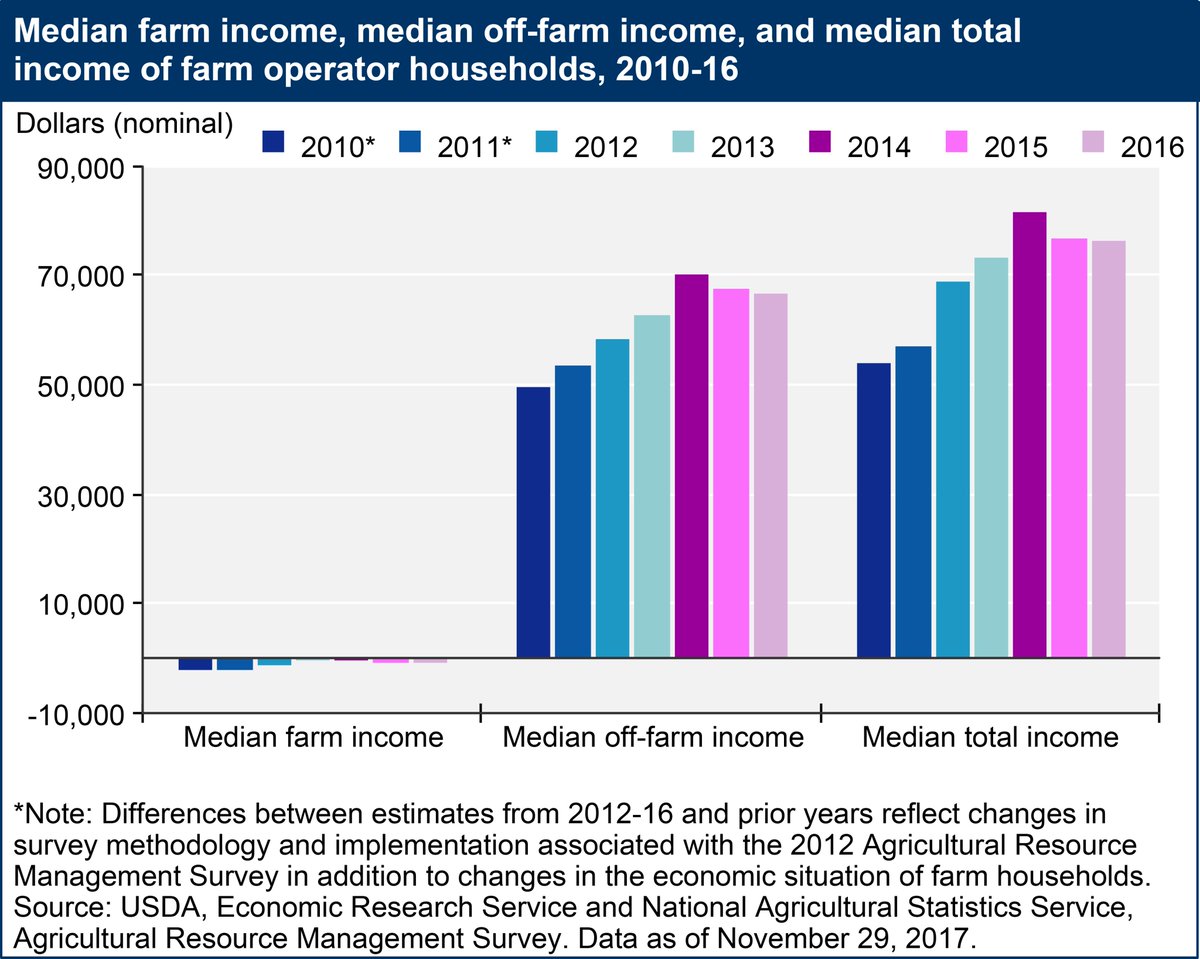 ,
,
What's amazing to me is the disparity between the farm and nonfarm income. The bottom line would seem to be that median farmers get their income from nonfarm sources, so why call them farmers?
(I've some thoughts on the age of farmers which I'll stick in another post. I think my logic there will somewhat undermine the picture above.)
,What's amazing to me is the disparity between the farm and nonfarm income. The bottom line would seem to be that median farmers get their income from nonfarm sources, so why call them farmers?
(I've some thoughts on the age of farmers which I'll stick in another post. I think my logic there will somewhat undermine the picture above.)
Sunday, July 15, 2018
The Ups and Downs of Sport
When I moved to Reston in 1976, tennis was big. There were a number of recreation areas with multiple tennis courts, tennis leagues, and tennis coaches. That soon declined. The Southgate area which had 4 courts, converted two to basketball. I've not noticed anything on the leagues and teaching in recent years and seldom see anyone playing on the one set of courts I pass with some regularity.
Horse riding was a part of the early Reston, but when I arrived the stable was on its last legs. The building finally collapsed a few years after I arrived, which led to a long fight within Reston Association about whether to rebuild or convert the stable and riding area to other uses. The other uses finally won, so a parking lot, two basketball courts, and a soccer field went in, a sign of the sports which were popular then.
By the early 2000's construction was booming and so was soccer. The soccer field, by which I pass on the way to my garden plot, was very busy. Youth teams, and teams of young men, probably mostly Hispanic immigrants, were were omnipresent on the weekends and I suppose in the evenings.
Then came the recession and the collapse of construction and then the recession of immigration from the area. First the men's teams were no longer evident, then the youth teams dwindled away. While in the early years the maintenance people had problems keeping the grass growing, especially in front of the goals, there's no problem now.
As a capper, this trend has been confirmed by the media authority, the NYTimes, in this article
Horse riding was a part of the early Reston, but when I arrived the stable was on its last legs. The building finally collapsed a few years after I arrived, which led to a long fight within Reston Association about whether to rebuild or convert the stable and riding area to other uses. The other uses finally won, so a parking lot, two basketball courts, and a soccer field went in, a sign of the sports which were popular then.
By the early 2000's construction was booming and so was soccer. The soccer field, by which I pass on the way to my garden plot, was very busy. Youth teams, and teams of young men, probably mostly Hispanic immigrants, were were omnipresent on the weekends and I suppose in the evenings.
Then came the recession and the collapse of construction and then the recession of immigration from the area. First the men's teams were no longer evident, then the youth teams dwindled away. While in the early years the maintenance people had problems keeping the grass growing, especially in front of the goals, there's no problem now.
As a capper, this trend has been confirmed by the media authority, the NYTimes, in this article
Saturday, July 14, 2018
Guns and Drones and Second Amendment
I wonder, with drones becoming more and more capable and technology advancing on other fronts, how long will it be before we run into some constitutional questions?
For example, the Second Amendment confers the "right to bear arms". These days that means literally carrying a gun around, and pulling the trigger. Suppose we get drones with lethal capacity. Will the person who controls the drone be considered to be "bearing arms"?
For example, the Second Amendment confers the "right to bear arms". These days that means literally carrying a gun around, and pulling the trigger. Suppose we get drones with lethal capacity. Will the person who controls the drone be considered to be "bearing arms"?
Friday, July 13, 2018
An Arms Race in Robocalls?
My wife and I were being annoyed by robocalls. Saw something about Nomorobo and signed up for it. It's free for landlines (which all we needed). The way it works requires the phone to ring once, but before it can ring again Nomorobo figures out it's a robocall and intercepts it. So the ring-once is still a bit annoying, but at least you don't have to pause the movie, move the cat out of your lap, and get up to answer the phone, only to find it's robo.
So we've been happy with it; only the occasional call has been getting through.
But this morning two calls got through, one was even masked by seeming to come from someone in our telephone exchange (at least if we still had telephone exchanges). So I wonder whether the robocall people have started to figure out Nomorobo's algorithms and begun to change to counter them?
So we've been happy with it; only the occasional call has been getting through.
But this morning two calls got through, one was even masked by seeming to come from someone in our telephone exchange (at least if we still had telephone exchanges). So I wonder whether the robocall people have started to figure out Nomorobo's algorithms and begun to change to counter them?
Skewing the Stats--A Greenie Crime
I wrote a letter to the NYTimes on an article in last week's NYTimes magazine:
I should also note that this isn't peculiarly a failing of the environmentalist movement; everyone and her brother do it.
When I read Brook Larmer’s article: “E-Waste Offers an Economic Opportunity as Well as Toxicity”Image” I was very surprised. According to the article the US generates 42 pounds of e-waste per person per year. For our 2-person household, our PC, laptop, cellphones and TV would barely amount to 100 pounds. We don’t replace those items very often. Something seemed off.
So I did a little googling on the UN University site, finding this: “The weight of e-waste generated worldwide in 2016, including used refrigerators, TVs, personal computers and cellphones, was up by 8 percent from 2014, when the previous study into the problem was conducted.” http://www.asahi.com/ajw/articles/AJ201712140050.html
Turns out UNU defines e-waste as anything that uses electricity, not just electronic gear. (http://collections.unu.edu/view/UNU:6120)In answer to my question--I don't think so. Maybe in the future when everything is on the internet, but not now.
Including all kitchen appliances, lamps, etc. in “e-waste” certainly gives a bigger headline figure, but are the problems in recycling appliances really the same as in handling cellphones and laptops?
I should also note that this isn't peculiarly a failing of the environmentalist movement; everyone and her brother do it.
Thursday, July 12, 2018
How Far Ahead Are Democrats Thinking?
There's lots of comments about the impact of Kavanaugh on the Supreme Court. There's also Democratic proposals for what they want to do if and when they are elected in 2020. I wonder though about this issue:
Given the decision on Obamacare (this name seems to be fading in favor of ACA--not sure why the change) by SCOTUS, what sort of constitutional basis can the Dems use for future health care legislation? Can they fix ACA in 2021 by reviving the provisions Trump is killing? Would such revivals find support in SCOTUS? There would still be the 5 Justices who supported its legality but on divided opinions. Would the Dems need to redo ACA to base it more firmly on the authority to tax? Would they want to?
And how about the next bridge further--legislation to provide Medicare for All?
Given the decision on Obamacare (this name seems to be fading in favor of ACA--not sure why the change) by SCOTUS, what sort of constitutional basis can the Dems use for future health care legislation? Can they fix ACA in 2021 by reviving the provisions Trump is killing? Would such revivals find support in SCOTUS? There would still be the 5 Justices who supported its legality but on divided opinions. Would the Dems need to redo ACA to base it more firmly on the authority to tax? Would they want to?
And how about the next bridge further--legislation to provide Medicare for All?
Wednesday, July 11, 2018
Who Runs in 2020
My cousin asked me about my opinions on who the Democrats should nominate for 2020.
I found it difficult to answer. So far there's no one head and shoulders above the crowd.
If I had to choose, maybe Hickenlooper, the Colorado governor, but that's based on almost nothing. My feelings now are somewhat similar to my feelings in 1969-71. We have a president I can't stand, who's not a likable person. What the Democrats ended up doing was choosing McGovern, a very fine man, but too easily caricatured as out of the mainstream and Nixon won by a landslide.
That's my fear this time: our dislike of Trump and Republican/Trump positions will be so strong we end up with a candidate who can't win.
I found it difficult to answer. So far there's no one head and shoulders above the crowd.
If I had to choose, maybe Hickenlooper, the Colorado governor, but that's based on almost nothing. My feelings now are somewhat similar to my feelings in 1969-71. We have a president I can't stand, who's not a likable person. What the Democrats ended up doing was choosing McGovern, a very fine man, but too easily caricatured as out of the mainstream and Nixon won by a landslide.
That's my fear this time: our dislike of Trump and Republican/Trump positions will be so strong we end up with a candidate who can't win.
Tuesday, July 10, 2018
Why No Americans in Thai Rescue?
This is (not) serious: I understand while we had American military--Seals--on the site of the rescue of the Thai soccer team, they didn't go into the cave.
Why not?
Could it be they're too big--Accu-weather said the tightest opening was 15 inches, which is smaller than the 2 feet I'd heard before. Seems to me likely that Americans would usually be too big to fit through the smaller opening.
Bottomline: we need more immigrants in the smaller sizes so our military can be ready for any eventuality.
Why not?
Could it be they're too big--Accu-weather said the tightest opening was 15 inches, which is smaller than the 2 feet I'd heard before. Seems to me likely that Americans would usually be too big to fit through the smaller opening.
Bottomline: we need more immigrants in the smaller sizes so our military can be ready for any eventuality.
Monday, July 09, 2018
One of the Mysteries of the Economy Is Solved
Economists are moaning about how the U.S. economy isn't increasing in productivity as fast as it used to.
There's an observation, given a name I don't remember at the moment, that increasing productivity in services is difficult: it takes roughly the same number of people and time to perform Beethoven's Emperor piano concerto now as it did 200 years ago.
But some critical areas of the economy are declining in productivity. Back when I was young one reporter would write one article in a newspaper. But these days, as described here, on the recent rash of stories on Alan Dershowitz, it takes two reporters to write an article. In the good old days, the subject wouldn't have rated one story.
There's an observation, given a name I don't remember at the moment, that increasing productivity in services is difficult: it takes roughly the same number of people and time to perform Beethoven's Emperor piano concerto now as it did 200 years ago.
But some critical areas of the economy are declining in productivity. Back when I was young one reporter would write one article in a newspaper. But these days, as described here, on the recent rash of stories on Alan Dershowitz, it takes two reporters to write an article. In the good old days, the subject wouldn't have rated one story.
Sunday, July 08, 2018
The Importance of SCOTUS
Someone in the Times today wrote to the effect that the importance of Trump's choice for the Supreme Court is beyond calculation. That's bunk.
The choice is important, but but not that critical. There was a review in the Times of a book on the Opium War between Britain and China. The reviewer, Ian Morris, described the writer as believing historical actors were very important, the influence of accident and personal quirks often determining how events turned out. And that's the way the author told the story of the war. The reviewer liked the book, but was more in the camp of historical forces.
I probably tend to be in the latter. A metaphor: society is a big balloon filled with water. You can shape the balloon, but only within limits. The same applies to constitutional law and society.
The choice is important, but but not that critical. There was a review in the Times of a book on the Opium War between Britain and China. The reviewer, Ian Morris, described the writer as believing historical actors were very important, the influence of accident and personal quirks often determining how events turned out. And that's the way the author told the story of the war. The reviewer liked the book, but was more in the camp of historical forces.
I probably tend to be in the latter. A metaphor: society is a big balloon filled with water. You can shape the balloon, but only within limits. The same applies to constitutional law and society.
Subscribe to:
Posts (Atom)