Always fascinated by the Amish, who are exempted from ACA (Obamacare) because they were exempted from Social Security way back in the last century, as this article describes.
The article doesn't mention the Amish occasionally being medical tourists--i.e., traveling to Mexico for some operations, something about which I've read in the last couple years.
Monday, October 07, 2013


Friday, October 04, 2013
Ezra Klein Differs on ACA Software
Kevin Drum and Ezra Klein are notably more damning of the Obama administrations healthcare exchange software than I have been. This from Klein:
'But the Obama administration did itself -- and the millions of people who wanted to explore signing up -- a terrible disservice by building a Web site that, four days into launch, is still unusable for most Americans. They knew that the only way to quiet the law's critics was to implement it effectively. And building a working e-commerce Web site is not an impossible task, even with the added challenges of getting various government data services to talk to each other. Instead, the Obama administration gave critics arguing that the law isn't ready for primetime more ammunition for their case.
Thursday, October 03, 2013
Wednesday, October 02, 2013
Farmers Didn't Improve Their Fields Until the 20th Century?
One meme of a few in the food movement, Prof. Pollan I'm looking at you, is farmers began industrial agriculture in the 20th century, specifically when nitrates left over from the military started to be used on our fields. (That's my memory of Omnivore's Dilemma.)
Low-Tech Magazine has a long post on lime kilns (all that rain in the British Isles tended to acidify the fields, thus creating a demand for lime to counter it). Wikipedia cites usage of lime for agricultural purposes in the 13th century. It's easy to underestimate the brains of our ancestors.
I've memories of our whitewashing the stable walls, and using lime on the concrete behind the cows to keep it dry and prevent the cows from slipping.
Low-Tech Magazine has a long post on lime kilns (all that rain in the British Isles tended to acidify the fields, thus creating a demand for lime to counter it). Wikipedia cites usage of lime for agricultural purposes in the 13th century. It's easy to underestimate the brains of our ancestors.
I've memories of our whitewashing the stable walls, and using lime on the concrete behind the cows to keep it dry and prevent the cows from slipping.
Tuesday, October 01, 2013
Obama's Open Government Fail--on Obamacare
I just love to tweak IT types and goo-goo types about openness, and occasionally I like to tweak my liberal friends. In that spirit, let me quote this from the NYTimes post on activity on the healthcare exchanges:
More seriously, I expect the dust to settle and the glitches to get resolved (mostly) in the next few days or weeks, just as Medicare Part D did back in the Bush days.
"It is unclear what the [healthcare] exchanges meant in citing heavy volume; most did not provide numbers, or even return phone calls in the first hours of operation. It is also unclear to what degree problems with the Web sites were due to the kind of technical hurdles that supporters of the program had warned about and that opponents had predicted would demonstrate its unwieldiness."Too bad HHS didn't require each exchange website to post their count of unique visitors.
More seriously, I expect the dust to settle and the glitches to get resolved (mostly) in the next few days or weeks, just as Medicare Part D did back in the Bush days.
3 Minutes for Food?
Via Marginal Revolution, a USAtoday story on how the universe is gradually slowing down, in the inevitable triumph of entrophy.
Actually, it seems that fast food outlets are having trouble maintaining their speed of "drive-thru" visits. I don't patronize such lines, so I was struck by the fact that McDonald's fills orders in about 3 minutes (the current figure is 9 seconds slower than it used to be).
Actually, it seems that fast food outlets are having trouble maintaining their speed of "drive-thru" visits. I don't patronize such lines, so I was struck by the fact that McDonald's fills orders in about 3 minutes (the current figure is 9 seconds slower than it used to be).
Monday, September 30, 2013
Good Advice from Joel Achenbach
This is directed to all you baby boomer youngsters:
"Those of us staring into the gaping maw of degeneration, senescence and ultimate obliteration are often driven to take on new activities and interests. You could make the case that Walt went overboard.
If you find yourself with an urge to try something new, my advice is to steer clear of anything that might create a problem for which the activation of a remote-controlled machine gun would potentially be the solution.
Sunday, September 29, 2013
Saturday, September 28, 2013
Does USDA Pay Farmers for Not Farming?
The Internet has made me more aware of the persistence of myths and inaccuracies, not to say "lies", in the world of public discourse.
To quote Mark Twain:
One of the persistent memes is the idea FSA (USDA) pays farmers for not farming, for not producing. That came up in a recent Jonathan Chait piece here, in connection with a discussion that the right supported cutting food stamps but not cutting farm subsidies. Chait linked to a Megan McArdle defense of the theory, though she would like to cut both food stamps and ag subsidies, based on "reciprocity". The idea being that food stamps went to the idle poor, who did nothing for them, while subsidies went to farmers who at least were farming. Chait used a GAO Report of last year
which I missed, to counter McArdle's argument.
Seems to me there are several aspects to the meme:
[Updated to add the last sentence on the CRP paragraph.]
To quote Mark Twain:
One of the persistent memes is the idea FSA (USDA) pays farmers for not farming, for not producing. That came up in a recent Jonathan Chait piece here, in connection with a discussion that the right supported cutting food stamps but not cutting farm subsidies. Chait linked to a Megan McArdle defense of the theory, though she would like to cut both food stamps and ag subsidies, based on "reciprocity". The idea being that food stamps went to the idle poor, who did nothing for them, while subsidies went to farmers who at least were farming. Chait used a GAO Report of last year
which I missed, to counter McArdle's argument.
Seems to me there are several aspects to the meme:
- it can refer to the "supply management/production adjustment" programs of past farm bills, in which case it's wrong. Those programs are dead.
- it can refer to the problem of payments issued to dead farmers. That can be bad administration by FSA, though the casual discussion of it by people like Chait and EWG doesn't recognize some of the legitimate complexities.
- it can refer to the problem of direct payments issued based on acreage which is converted to non-farm uses, as cited in the GAO report. That again is bad administration.
- it can refer to the fact that the direct payment program is "decoupled", to comply with WTO rules--there's no requirement that farmers farm in order to earn the payments. Again, the GAO report blasted the program for this, but it's what Congress passed.
- it can refer to the Conservation Reserve Program (CRP), which has multi-year contracts for farmers to devote land, not to production of crops, but to conservation uses. In my mind, the program's aim is to protect highly erodible land and provide conservation benefits, not to reduce production, but it's true that the program does reduce production. (It's rather like saying the military draft in the 1960's gave men free health insurance--it did.) It's also true that some of the contracts can cover a whole farm, assuming all of the acreage is highly erodible.
[Updated to add the last sentence on the CRP paragraph.]
Friday, September 27, 2013
What Illegal Spying Is Not So Bad?
Seems that some of the cases where NSA employees definitely broke the law involved spying on significant others. See this piece. Somehow that makes NSA seem less fearsome to me, just a bunch of insecure men jealous of their lovers. Should the motive really make a difference when we're talking violations of privacy? No, but somehow.
Thursday, September 26, 2013
Another Sentence
From a Slate piece on Ted Cruz
" Susman laughed. "I will say this: Being a stud with girls on the debate circuit does not mean you’re a stud with girls."
A Sentence to Enjoy, on Sows
"Being nursed by a dozen hungry mouths is an extreme weight watcher’s diet plan." From Sugar Mountain Farm, in a post on the natural weaning process, and the human controlled process.
Wednesday, September 25, 2013
To Sea, Young Man, to Sea
Via Brad Delong's Grasping Reality with Both Hands, here's a study comparing the cost of college with the benefits of college. What interests me on the graphic is the outlying institutions--some with names you'd expect, but some not. For example, what's SUNY-Maritime doing so cheap and so rewarding?
I'm reminded of a high school math teacher, who returned to his alma mater after his predecessor died of diabetes (very much missed--Mr. Hayford), with a goatee! Now this was 1958, when all men were clean-shaven. But after leaving the Forks, Mr. Turna had gone off to the Merchant Marine academy and then spent some time at sea--I know he visited west African ports and as a mate had to bail out a crewman. The ladies were attracted to him (may be faulty memory, though then it seemed as if every male my age or older had a greater attraction for women than I) though not to the extent they took his senior-level trig, spherical geometry, and advanced algebra classes. We were still back in the dark ages then; such math wasn't for women.
I'm reminded of a high school math teacher, who returned to his alma mater after his predecessor died of diabetes (very much missed--Mr. Hayford), with a goatee! Now this was 1958, when all men were clean-shaven. But after leaving the Forks, Mr. Turna had gone off to the Merchant Marine academy and then spent some time at sea--I know he visited west African ports and as a mate had to bail out a crewman. The ladies were attracted to him (may be faulty memory, though then it seemed as if every male my age or older had a greater attraction for women than I) though not to the extent they took his senior-level trig, spherical geometry, and advanced algebra classes. We were still back in the dark ages then; such math wasn't for women.
Tuesday, September 24, 2013
Returns on Cows and Buffalos
Brad DeLong notes a study on the returns to owning cows and buffaloes in India. Bottom line is--it's not profitable in an economic sense. The speculation is that the labor of women has no value, economically, so there's no cost for women or children to tend cattle. Or, the return on formal savings instruments (i.e., savings accounts) is low and uncertain so there's a cultural preference to owning cattle. (I gather that while cows are sacred to Hindus, buffaloes aren't so the study treats them as almost interchangeable.)
Here's the NBER url. Strikes me that the economists don't devote enough attention to the calves The survey asked the people to estimate the value of a calf, which I assume meant guessing what the calf could be sold for on the open market. Now in economic theory I guess the price should reflect the value of retaining the calf. But maybe it doesn't--if the family has sufficient grazing land then the marginal cost of rearing a calf to maturity is relatively small--the labor cost of tending multiple animals instead of a single is almost zero.
Here's the NBER url. Strikes me that the economists don't devote enough attention to the calves The survey asked the people to estimate the value of a calf, which I assume meant guessing what the calf could be sold for on the open market. Now in economic theory I guess the price should reflect the value of retaining the calf. But maybe it doesn't--if the family has sufficient grazing land then the marginal cost of rearing a calf to maturity is relatively small--the labor cost of tending multiple animals instead of a single is almost zero.
Monday, September 23, 2013
Can't Figure the Figures--Crop Insurance
Via Farm Policy, an article in Choices magazine on crop insurance, co-written by Keith Collins, formerly chief economist of USDA and now working for the crop insurance industry.
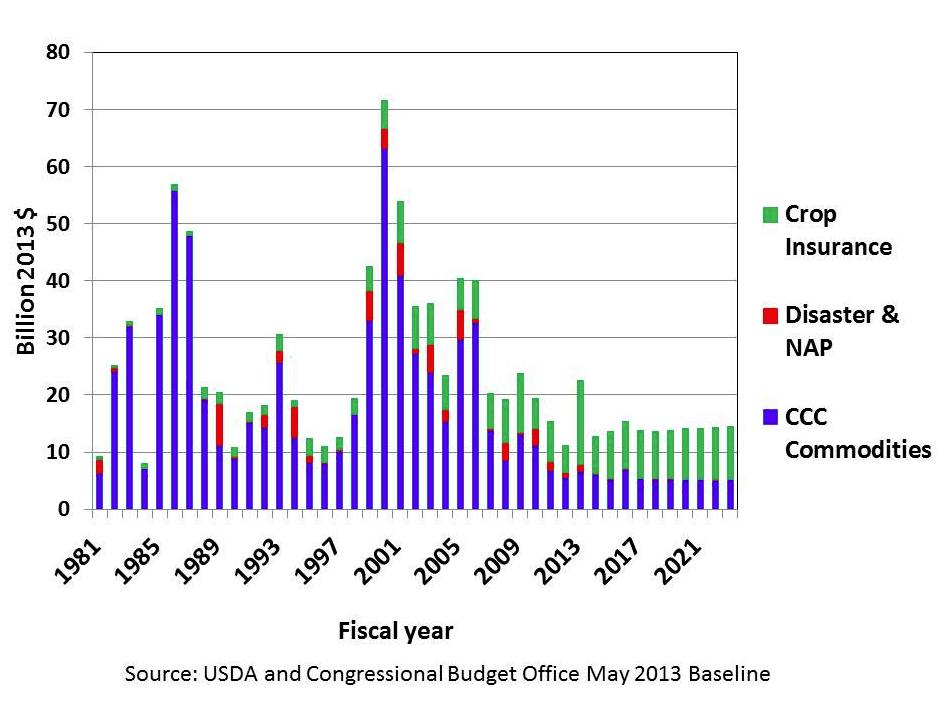
I have to assume the figures are accurate, but this figure from the article blows my mind:

It's deflated by crop prices somehow but seems to show some $60 billion in CCC payments in 2000.
[updated as follows]
Looking at the EWG database, there were about $23.5 billion in payments in 2000, excluding crop insurance, so it looks as if the deflator almost triples the payments in 2000. While I can understand adjusting figures for inflation, i.e., using constant dollars, I don't the deflator. I went to the CBO site, which I don't understand too well, and couldn't find the backup data for this, just their projections for the future.
I have to assume the figures are accurate, but this figure from the article blows my mind:
It's deflated by crop prices somehow but seems to show some $60 billion in CCC payments in 2000.
[updated as follows]
Looking at the EWG database, there were about $23.5 billion in payments in 2000, excluding crop insurance, so it looks as if the deflator almost triples the payments in 2000. While I can understand adjusting figures for inflation, i.e., using constant dollars, I don't the deflator. I went to the CBO site, which I don't understand too well, and couldn't find the backup data for this, just their projections for the future.
Sunday, September 22, 2013
In the Old Days Legislators Were Good
Think so? Then hie thyselves over to Boston 1775 and read the story of Champagne Charlie Townshend.
Saturday, September 21, 2013
SOL Results for Fairfax County--Disturbing
Via the Reston Patch, here's the full release of results on the state Standards of Learning test for Fairfax county. The test changed this year so the release notes one can't directly compare these results with those for prior years.
That's fine, but. And it's a big but. What's noticeable to me is that the current year scores are down more for blacks, Hispanics, students with disabilities, economically disadvantaged, and limited English proficient than they are for whites and Asians. That pattern is disturbing because just a simple change of standards, making the test harder, shouldn't show it. Something else is going on.
The drop for whites is 7 points, for Asians 8, but 20 points for blacks, 21 for Hispanics and so on.
That's fine, but. And it's a big but. What's noticeable to me is that the current year scores are down more for blacks, Hispanics, students with disabilities, economically disadvantaged, and limited English proficient than they are for whites and Asians. That pattern is disturbing because just a simple change of standards, making the test harder, shouldn't show it. Something else is going on.
|
English Reading Performance
|
||||||
|
Student Group
|
Virginia
|
FCPS
|
||||
|
2010-11
|
2011-12
|
2012-13
|
2010-11
|
2011-12
|
2012-13
|
|
|
All Students |
88
|
89
|
75
|
93
|
94
|
82
|
|
Black |
80
|
80
|
59
|
87
|
88
|
68
|
|
Hispanic |
84
|
84
|
65
|
86
|
87
|
66
|
|
Asian |
94
|
95
|
87
|
96
|
96
|
88
|
|
Economically Disadvantaged |
80
|
81
|
59
|
85
|
86
|
63
|
|
Limited English Proficient |
79
|
80
|
54
|
85
|
86
|
59
|
|
Students with Disabilities |
67
|
66
|
43
|
85
|
84
|
56
|
|
White |
92
|
93
|
82
|
97
|
97
|
90
|
The drop for whites is 7 points, for Asians 8, but 20 points for blacks, 21 for Hispanics and so on.
Friday, September 20, 2013
Why You Can't Do FSA Programs on the Internet
I'm sure few farmers would like to be compared the patrons of a check-cashing service, but when I read this piece from a professor who studies such services by working at one, that's what I thought. Takes me back to the days of Sec. Glickman, and the effort led by someone whose name I forget, to follow through on reengineering business processes. A small part of the effort was doing customer satisfaction surveys, which was a brand new concept to us FSA types. After all, we were handing out money, so how could farmers not be satisfied with us? </end sarcasm>
Actually the surveys as I remember did find that farmers were quite satisfied with their local offices (perhaps excluding the farm loan applicants, I'm not sure). And the reason was simple--the <s>clerks</s> <s> program assistants</s> program technicians knew the farmers and could tailor their approach to the personality and needs of the individual. That fact was then a big hurdle to the idea of moving FSA programs on-line to the extent that people could work from home.
Actually the surveys as I remember did find that farmers were quite satisfied with their local offices (perhaps excluding the farm loan applicants, I'm not sure). And the reason was simple--the <s>clerks</s> <s> program assistants</s> program technicians knew the farmers and could tailor their approach to the personality and needs of the individual. That fact was then a big hurdle to the idea of moving FSA programs on-line to the extent that people could work from home.
Republican Farm Policy
Kevin Drum, probably the blogger whose views most coincide with mine, or rather vice versa, says that Republican farm policy makes perfect sense.
[edited to add]
I follow the Volokh Conspiracy, which just posted on the farm bill: crop insurance versus SNAP cuts issue. I sometimes comment there, but I'm abstaining this time. There's too much wrong and incomplete information there, probably because it's mostly a bunch of "city folk", as my mother would say.
[edited to add]
I follow the Volokh Conspiracy, which just posted on the farm bill: crop insurance versus SNAP cuts issue. I sometimes comment there, but I'm abstaining this time. There's too much wrong and incomplete information there, probably because it's mostly a bunch of "city folk", as my mother would say.
Thursday, September 19, 2013
Shame on Starbucks
Yes, I'm talking about the ad the founder of Starbucks ran in today's Post and NYTimes in which he asks his customers to leave their guns at home, son, don't take your guns to Starbucks. (Sorry, briefly channeled Mr. Cash.)
No, I'm not upset by his position. The company can do anything they want, within the law. Personally although there's been some open-carry demonstrators around in VA, I've not seen anyone with a weapon except police. I don't think I particularly care one way or another--I don't go in bars which in my mind is where people, arms, and alcohol are a combustible mixture. Starbucks usually not so much, though I did see one very heated exchange between a customer and a clerk in my local Starbucks a year or so ago.
So if I don't care about guns, why do I call "shame"?
Because the letter is printed in monospaced type, probably elite. And I've a personal peeve against such type: it's less legible than a good variable spaced typeface and with modern technology there's not a reason in the world to stick with elite, or pica.
No, I'm not upset by his position. The company can do anything they want, within the law. Personally although there's been some open-carry demonstrators around in VA, I've not seen anyone with a weapon except police. I don't think I particularly care one way or another--I don't go in bars which in my mind is where people, arms, and alcohol are a combustible mixture. Starbucks usually not so much, though I did see one very heated exchange between a customer and a clerk in my local Starbucks a year or so ago.
So if I don't care about guns, why do I call "shame"?
Because the letter is printed in monospaced type, probably elite. And I've a personal peeve against such type: it's less legible than a good variable spaced typeface and with modern technology there's not a reason in the world to stick with elite, or pica.
Wednesday, September 18, 2013
Walt Jeffries and IT Development
Sugar Mountain Farm is a blog I follow. Not sure why, maybe the combo of intimidating expertise, different lifestyle, humor, .... and just enough commonality (that's not the right word, but it's close enough) with my rearing to be able to enjoy it vicariously. (Come to think of it, I wonder if Walt ever read "Swiss Family Robinson", one of my favorite books when growing up.)
Anyhow, that's not the point. Let me quote from most of a recent post:
There's not much point to this observation, except as it confirms the saying: "too soon old, too late smart". There's much in my career I'd redo if I could. And much of what I regret in my work life traces back to hubris.
The Greeks were right.
Anyhow, that's not the point. Let me quote from most of a recent post:
Will [a son] is working on learning to weld stainless steel in preparation for making some of the parts we need for the butcher shop. Tractor ears was his first sheet metal project in stainless steel. By doing small useful tests we explore techniques and develop the necessary skills for design and production. This is a way. Chez Tao.To me that sounds much like the "code a little, test a little" process of software development and very different from the big project "waterfall" model which used to reign supreme in the 1980's, and which seems to retain a hold even today. It's a model which often leads to disaster, and waste of money--witness the failed project to create a common health record between DOD and VA.
To build the butcher shop we developed techniques by building our cottage, a much smaller version using many of the same methods. Prior to the cottage we built the dog house. Before that a ferro cement and brick pig hut. Even earlier, table top models. With each progressively larger version we developed technique and honed skills.
There's not much point to this observation, except as it confirms the saying: "too soon old, too late smart". There's much in my career I'd redo if I could. And much of what I regret in my work life traces back to hubris.
The Greeks were right.
Tuesday, September 17, 2013
Return to Punched Card Storage
Via Brad Delong at Grasping Reality, here's a post converting Google's data storage into punched card equivalent. Bottom line: it would cover New England with 4.5 kilometers of punched cards.
(Given my training on using punched cards to run COBOL programs, I'm intrigued by the conversion.)
(Given my training on using punched cards to run COBOL programs, I'm intrigued by the conversion.)
Murphy's Law in New Zealand
"“If you land in someone’s paddock [when flying using a jetpack], you will always land on their prime
sheep,” Mr. Kenny says, stressing that liability insurance for pilots is
a must."
As quoted at Marginal Revolution
As quoted at Marginal Revolution
Monday, September 16, 2013
Rep. Issa Praises Obama Administration!!
The nether reaches of hell must be starting to freeze.
This FCW article reports this comment by Rep. Issa:
(Hmm, since I'm feeling devilish today, what's the odds of having a similar database for Pigford payments?)
This FCW article reports this comment by Rep. Issa:
"The whole Recovery.gov effort has been a great success. I’m taking no positive shots at how they spent their money, because I don't think it created jobs. But it accounted for funding in a more transparent way than ever before, and did so on a small budget," Rep. Darrell Issa (R-Calif.), said at an event hosted by the Data Transparency Coalition on Sept. 10.I have to admit I was skeptical of it, I haven't revisited the site since its early days, and I still suspect a subject-matter expert could punch holes in the data for her subject area. But the fact remains, even if its reputation is a tad higher than it deserves, it does set an example for the future and there weren't many scandals related to the Recovery Act spending, once we got past the early glitches about the quality of data. So at least one gold star for the Obama administration.
(Hmm, since I'm feeling devilish today, what's the odds of having a similar database for Pigford payments?)
South Versus Midwest
Politico has an article on the farm bill, summarizing the current status but with some discussion of the sectional differences Midwest versus South. It argues that current plantings have increased in the Midwest, not so in the South. (I've a reservation, TX and OK are down in current plantings, presumably partially because of drought. )
The issue of basing payments on planted acres versus base acres is always interesting: do we want the safety net for current and future farmers or for past farmers? The issue of yields gets less attention--I've lost track of whether there's been any updating of yields in past farm bills. A fine kettle of questions for some philosopher/economist to figure out.
The issue of basing payments on planted acres versus base acres is always interesting: do we want the safety net for current and future farmers or for past farmers? The issue of yields gets less attention--I've lost track of whether there's been any updating of yields in past farm bills. A fine kettle of questions for some philosopher/economist to figure out.
Friday, September 13, 2013
Did ARS Sponsor This Cutting-Edge Research?
(The answer is "no", but I need a title.)
What's the research?
From the Ig Nobel Awards, via University Diary.
What's the research?
"The probability prize was awarded to animal scientists at Scotland's Rural College for making two related discoveries. "First, that the longer a cow has been lying down, the more likely that cow will soon stand up," read their citation. "And second, that once a cow stands up, you cannot easily predict how soon that cow will lie down again."
From the Ig Nobel Awards, via University Diary.
French Fries and Good Sentences
Al Kamen in the Post muses about why the Capitol cafeteria didn't retaliate on British food after Parliament refused to back a strike on Syria, a retaliation like the one when they renamed "french fries" to "freedom fries" back in 2003 when the French didn't back GWBush.
"The greater problem in this instance may have been that no one particularly likes British food, so there weren’t many options: Fish and chips to Fish and French fries or English muffins to Cowardly Crumpets?
Thursday, September 12, 2013
The Things We Lose Without Knowing--the Milky Way
From Kottke -- most American kids will never see the Milky Way (from their home, I suppose). Some, maybe even most, change is good, but some isn't. (Though I suppose the people in this world who can see the Milky Way are often in what we used to call the Third World. There's always tradeoffs--did Robert Heinlein write that?)
Harry Potter Kills
According to Alex Tabarrok at Marginal Revolution, a scientific sampling of people who died in the last year would show that reading Harry Potter novels is strongly correlated with dying young. If you don't read Harry Potter you're much more likely to live to a ripe old age. Wish I had known that before I read the series.
[more]
[more]
Wednesday, September 11, 2013
Amazing Sentence of Today: Judges Err
"n ordinary litigation, the judges misunderstand things all the time and
reach decisions anyway, and they rarely discover all that they’ve
misunderstood. "
This sentence is from a very good post by Stewart Baker at Volokh Conspiracy discussing the recently declassified FISA court materials. Don't know whether he's right, but two points he makes:
This sentence is from a very good post by Stewart Baker at Volokh Conspiracy discussing the recently declassified FISA court materials. Don't know whether he's right, but two points he makes:
- the "wall" between law enforcement and intelligence which played a disputed role in the failures to prevent 9/11 was unreasonably enforced by Judge Royce Lamberth.
- cultural differences between IT types and legal types may have played a big part in the problems. (That's an attractive argument to me: I believe in Murphy's Law.)
Tuesday, September 10, 2013
EWG and Non-Farmers
The EWG has a new report out, entitled "City Slickers Harvest Cash Crop" which Ron Nixon in the NYTimes writes about here, using the hook of the possible extension of farm programs for another year.
EWG has a familiar theme: the inequity of government payments to people who don't get dirt under their nails. Frankly, I'm surprised the amount here is so low:
EWG has Google maps of the locations of some recipients. Perhaps significantly, they don't show NYC or Boston. The distribution of locations in the DC area seems a bit more random than I'd expect; a few markers in the poorer areas, probably showing heirs.
EWG has a familiar theme: the inequity of government payments to people who don't get dirt under their nails. Frankly, I'm surprised the amount here is so low:
"Residents of America’s 54 largest cities collected more than $24 million in Direct Payment farm subsidies in 2012, according to new research by the Environmental Working Group."Maybe I've been brainwashed by their previous reports to expect a bigger figure? I wonder, would this headline sound better to the public: "Heirs of Deceased Farmers Receive Government Dollars"? Of course, we don't know how much is going to heirs, and how much is truly going to Wall Street investors in farmland, but probably the majority of the $24 million. And it may be that those Wall Streeters who now own farmland have been suckered--if the current high farmland values turns out to be indicators of a bubble, they could be hurt.
EWG has Google maps of the locations of some recipients. Perhaps significantly, they don't show NYC or Boston. The distribution of locations in the DC area seems a bit more random than I'd expect; a few markers in the poorer areas, probably showing heirs.
Saturday, September 07, 2013
Sailing, Sailing, Through the Arctic
I may have expressed the opinion that the vision of commercial ships sailing around Russia through the Arctic, particularly those sponsored by China, was an indicator of global warming.
Via Tom Ricks at the Best Defense, here's an interesting discussion of the practicality of this. Bottom line, it's probably not practical for container ships, because they're limited in draft and beam, even though it can be significantly faster.
I recommend a book called The Box, on the development of containers. This quote from the article is significant:
Via Tom Ricks at the Best Defense, here's an interesting discussion of the practicality of this. Bottom line, it's probably not practical for container ships, because they're limited in draft and beam, even though it can be significantly faster.
I recommend a book called The Box, on the development of containers. This quote from the article is significant:
What is far more important than speed is reliability. Unlike the bulk shipping discussed earlier, schedule integrity is a key service-attribute for containerships. The Arctic will always suffer from periods of poor visibility and the potential for wind-driven ice, both of which can make routes with a comparatively low average transit time have a large variability around that average. More than half of all container cargo is now component-level goods—materials destined for factories for use in production processes operating on a just-in-time-type inventory-management system. That makes consistency, reliability, and schedule integrity of paramount importance. The key goal of container shipping is 99 percent on-time delivery. If this is attainable at all, it will be extraordinarily expensive using Arctic transit routes. Thus the variability in transit time that may be tolerable in bulk shipping is unacceptable for container shipping.
4-H and the Economist
Interesting article praising 4-H in The Economist, implying that it, extension, and land-grant u's account for the differences between US and European agriculture.
I think not, actually--they contribute but don't "account".
I think not, actually--they contribute but don't "account".
Friday, September 06, 2013
Why Washington Employment in FSA Grows
From a recent GAO report on FSA enforcement of the adjusted gross income limits:
I'd praise GAO for recommending simplifying the rules. I'd also note the indications that some accountants and attorneys actually lie to FSA! I'm shocked, shocked I say.
" For example, GAO found errors in 19 of the 22 tax return files it reviewed from FSA offices in two states; one of these errors led to a potentially improper payment of $40,000. FSA headquarters does not monitor state offices' reviews of tax returns to ensure that the offices are applying program guidance consistently and making accurate eligibility determinations, even though federal standards for internal control direct agencies to monitor and assess the quality of performance over time. Also, 2008 Farm Bill provisions requiring a distinction between farm and nonfarm income make it difficult for agency officials to verify if participants' incomes exceed the limits without making errors. Because the statutory limits for farm and nonfarm income differ, to verify such income, FSA officials must comb through sometimes long and complex tax returns to classify and calculate income--a difficult task for those who are not accountants or tax preparers. Recent bills in the House and Senate have proposed using total adjusted gross income instead of farm and nonfarm income, which would reduce the need for FSA to review tax returns." [emphasis added]People like to talk about the top-heavy Washington bureaucracy of various agencies, including FSA (yes, I'm looking at you NASCOE). It's good to mock the proliferation of well-paid bigshots at both departmental and agency levels. But one should also remember that no one outside the agency is ready to trust field (in this case, state office) people to do things 100 percent right and to accept the mistakes if they don't.
I'd praise GAO for recommending simplifying the rules. I'd also note the indications that some accountants and attorneys actually lie to FSA! I'm shocked, shocked I say.
Wednesday, September 04, 2013
Civil Service College
Via Marginal Revolution, here's the "programme" of Singapore's Civil Service College for "Officers" (which I think is their term for front line employees, FSA's equivalent of the county offices. One item is a 16-hour course in "Responsiveness In Frontline Customer Service: Making Customer Satisfaction A Daily Pleasure".
I've noticed a cultural difference between the other former members of the British Empire and the U.S. in regards to government employees: in the US we call them "bureaucrats" with a pejorative edge; in the other countries, they're "civil servants" or "bureaucrats" used as a neutral term. It may trace to differences in how we established independence (a la David Hackett Fischer's book on the US and New Zealand): we had a revolution against British authority, the face of which was bureaucrat/civil servants. While Canada, Australia, Singapore, India generally had a more amicable parting of the ways with the "mother country", in which the local people just took over the bureaucracy.
I've noticed a cultural difference between the other former members of the British Empire and the U.S. in regards to government employees: in the US we call them "bureaucrats" with a pejorative edge; in the other countries, they're "civil servants" or "bureaucrats" used as a neutral term. It may trace to differences in how we established independence (a la David Hackett Fischer's book on the US and New Zealand): we had a revolution against British authority, the face of which was bureaucrat/civil servants. While Canada, Australia, Singapore, India generally had a more amicable parting of the ways with the "mother country", in which the local people just took over the bureaucracy.
Tuesday, September 03, 2013
I Think We Look Pretty Good
To this Indian student who writes about his impressions of the U.S. Hat tip: Marginal Revolution
At least, "pretty good' is my overall impression of his impressions--impressive, isn't it?
At least, "pretty good' is my overall impression of his impressions--impressive, isn't it?
My Best Line of the Day
In commenting on a Wonkblog post about whether Americans knew where Damascus and Syria were, I wrote: "Surely the question is not whether Americans know where Damascus is, but whether our targeters know where the Chinese and Russian embassies are."
I thought it was good, but then I realized Ezra Klein is so young he probably was in grade school when we hit the Chinese Embassy during the Kosovo action.
No one should be that young.
I thought it was good, but then I realized Ezra Klein is so young he probably was in grade school when we hit the Chinese Embassy during the Kosovo action.
No one should be that young.
Tip of the Hat
To Diana Nyad. When I heard two days ago she was trying to swim between Cuba and the US again, for the umpteenth time, I said she should give up, she's too old.
Turns out she wasn't and I was wrong.
Turns out she wasn't and I was wrong.
Sunday, September 01, 2013
FSA and Drones
Via Marginal Revolution, here's a piece on how archeologists are using drones in their work.
Causes me to ask: when is FSA going to drones? Last I knew FSA had a set of aerial photographs which were scaled and ortho-corrected (which I think means adjusted for changes in elevation) with which one could measure the area of a field, and a yearly set of slides taken from small planes to help identify which crop was in which field. I'm sure that's changed as they've implemented their GIS system, but I'm not sure how. On the theory the agency still needs to spot-check the accuracy of what they're being told by the farmer, I'd assume there's still some aerial slides being taken. Drones might be a better approach (except for all the rules and regulations about their use, which presumably archeologists in Peru don't need to worry about).
Causes me to ask: when is FSA going to drones? Last I knew FSA had a set of aerial photographs which were scaled and ortho-corrected (which I think means adjusted for changes in elevation) with which one could measure the area of a field, and a yearly set of slides taken from small planes to help identify which crop was in which field. I'm sure that's changed as they've implemented their GIS system, but I'm not sure how. On the theory the agency still needs to spot-check the accuracy of what they're being told by the farmer, I'd assume there's still some aerial slides being taken. Drones might be a better approach (except for all the rules and regulations about their use, which presumably archeologists in Peru don't need to worry about).
Saturday, August 31, 2013
My Feelings on Syria--the Obama Doctrine
I'm as ambivalent about Syria as I am on most things, but I'd urge my representatives in Congress to support limited military action in response to the use of chemical weapons.
Seems to me we want to raise the costs of the use of such weapons anyway we can, both now and for the future. I'd even recommend a corollary to the "Obama doctrine:" anytime and anywhere we determine that chemical weapons have been used, the perpetrators of such use may be struck by our military forces. (Did you know there was an "Obama Doctrine"--I didn't until I checked wikipedia.)
Having said that, I'm assuming our military has identified targets, the destruction of which will thread all the needles of the obstacles critics have raised: minimum harm to civilians, maximum harm to those involved in the use of the weapons, least degradation of Assad's command and control over such weapons, most painful to Assad, etc.
[posted prematurely]
Seems to me we want to raise the costs of the use of such weapons anyway we can, both now and for the future. I'd even recommend a corollary to the "Obama doctrine:" anytime and anywhere we determine that chemical weapons have been used, the perpetrators of such use may be struck by our military forces. (Did you know there was an "Obama Doctrine"--I didn't until I checked wikipedia.)
Having said that, I'm assuming our military has identified targets, the destruction of which will thread all the needles of the obstacles critics have raised: minimum harm to civilians, maximum harm to those involved in the use of the weapons, least degradation of Assad's command and control over such weapons, most painful to Assad, etc.
[posted prematurely]
Failed Historian's Favorite Sentence
"The truth is that what goes on in the pages of the American Educational Research Journal stays in the pages of the American Education Research Journal."
That's from an interesting article by Sam Wineburg on history, historians, and making an impact in the real world. His point, to save lazy people from clicking through, is that there's no set of interpreters who take the results of academic research in peer-reviewed journals and make it attractive to the general public, or even the teachers in schools.''
[Update--to clarify, I'm the "failed historian" in the title.]
That's from an interesting article by Sam Wineburg on history, historians, and making an impact in the real world. His point, to save lazy people from clicking through, is that there's no set of interpreters who take the results of academic research in peer-reviewed journals and make it attractive to the general public, or even the teachers in schools.''
[Update--to clarify, I'm the "failed historian" in the title.]
Friday, August 30, 2013
Different Roles for Different Folks
That's the theme of a good post on the Washington post site by Jonathan Bernstein. The point is that political activists and political officeholders have different roles in our government. Some raise hell; others are the decider.
Wednesday, August 28, 2013
Weather in Hell: Cooling?
Today the Post runs an article written by Jane Black, whom I ordinarily consider to be one of the food movement, which treats a big(!) industrial (!) Minnesota farmer who grows genetically engineered crops(!). And it's favorable(!), or at least understanding. In part it's because he's tried other crops and other niches, in part because he cares for his soil, and mostly because the Minnesota Sustainable Ag organization praises him.
One thing I wish she'd addressed: she describes him as "precisely" applying fertilizer, but without specifying how the reader doesn't know whether it's part of "precision agriculture" (which can be defined as replacing the footsteps of the farmer with the memory of the computer).
One thing I wish she'd addressed: she describes him as "precisely" applying fertilizer, but without specifying how the reader doesn't know whether it's part of "precision agriculture" (which can be defined as replacing the footsteps of the farmer with the memory of the computer).
Tuesday, August 27, 2013
Crop Insurance--Prairie Potholes, Good Farming, and Seatbelts
As crop insurance takes over being the main "safety net" for crop farmers, it gets more attention:
- from Congress, particularly those in the prairie pothole region, who want consideration for "prevented planting" coverage and have gotten their Congressional delegation involved, as described in this Farm Policy issue. The problem, as I may have described before, is, unlike Gertrude Stein's rose, a pothole is sometimes arable land and sometimes not. Or, more accurately, since the marshiness of a pothole varies directly with the general water table level, in wet years a pothole expands its untillable area; in dry years it contracts. So farmers want coverage for the wet years under their insurance policy. (It's sort of the mirror image for areas of the Great Plains, where a period of wet years may enable a couple years of continuous cropping whereas dry years mean you have to fallow or reconvert the land back to grazing.)
- from NRDC, with a study described in a Des Moines Register article suggesting lower premiums for farmers who use good conservation methods:
"The group said the use of cover crops, such as grasses and legumes that improve soil health and reduce runoff, no-till farming and an improved irrigation schedule are the best management practices that could be used"
Monday, August 26, 2013
When To Give Bonuses--a Flawed View
The Post has an article on the backlog in VA processing veterans claims. Part of the problem seems to be that their system to measure performance of their claims processors is flawed--it gives more credit for easy claims and less credit for hard claims than it should. That points to the difficulty of constructing good measures of performance in a service-oriented bureaucracy. Build a widget, and you can count widgets. Run a dairy/poultry farm and you count pounds of milk, numbers of eggs, and feed consumed. But try to measure service and it gets difficult.
But that's not why I'm blogging on the piece. Another part of the piece is the fact VA is giving bonuses to employees even though the backlog is growing. Now in principle I've no problem with bonuses being awarded when an organization is having problems. There can be outstanding performers in poorly-run organizations, and they can be recognized.
But what blew my mind is this quote, from a bigshot HR type:
I can only hope the HR person was misquoted, because the statement as quoted reflects poorly on all good government bureaucrats.
But that's not why I'm blogging on the piece. Another part of the piece is the fact VA is giving bonuses to employees even though the backlog is growing. Now in principle I've no problem with bonuses being awarded when an organization is having problems. There can be outstanding performers in poorly-run organizations, and they can be recognized.
But what blew my mind is this quote, from a bigshot HR type:
"“There are many, many employees who are exceeding their minimum standards, and they deserve to be recognized for that,” she said."No, no, no and no. Exceeding the minimum standards is called "being average", and there's no bonuses for that--maybe an "atta-boy" (or girl, or woman). You give bonuses for being outstanding.
I can only hope the HR person was misquoted, because the statement as quoted reflects poorly on all good government bureaucrats.
Sunday, August 25, 2013
Do Not Pay and It's Implementation
A quote from an article in FCW on OMB's instructions on implementing the Do Not Pay legislation:
Interesting, though I still think it would be better to do a "data hub" to hide the source databases from the paying agencies.The legislation mandates that payments to federal payees be checked against five databases: the Social Security Administration’s Death Master File, the General Services Administration's System for Award Management (the new name for their Excluded Parties List), the Debt Check database at Treasury, and databases kept by the departments of Housing and Urban Development and the Health and Human Services.The law also permits OMB to tap commercial databases, potentially including credit reporting agencies, payroll processors, and consumer data services, as a potential check against fraud or improper payments.
Saturday, August 24, 2013
The MLKing Speech
Robert Kaiser, who was an intern at the Washington Post then, was assigned to help cover the March on Washington. He writes a column today on how the Post missed Martin Luther King's speech: I Have a Dream". Two paragraphs towards the end:
Sometimes it's different. For example, JFK's inaugural speech got generally good reviews, if my memory is accurate. His "ask not what you can do for the country..." was recognized as a good line and not much more. But through the years, particularly after his "martyrdom", as writers wanted to discuss his oratory, and wanted something good to work from, that particular sentence was selected more and more, until in the end it predominates in our memory of him.
"We were poised and ready for a riot, for trouble, for unexpected events — but not for history to be made. Baker’s 1,300-word lead story, which began under a banner headline on the front page and summarized the events of the day, did not mention King’s name or his speech. It did note that the crowd easily exceeded 200,000, the biggest assemblage in Washington “within memory” — and they all remained “orderly.”
In that paper of Aug. 29, 1963, The Post published two dozen stories about the march. Every one missed the importance of King’s address. The words “I have a dream” appeared in only one, a wrap-up of the day’s rhetoric on Page A15 — in the fifth paragraph. We also printed brief excerpts from the speeches, but the three paragraphs chosen from King’s speech did not include “I have a dream.”This is how history sometimes happens. The actual occurrence is like a speck of sand, nearly indistinguishable among all the other events happening concurrently. But somehow it gets inserted into an oyster and layers of nacre begin to build, gradually forming what we recognize as a pearl, and obscuring the very existence of any other happening.
Sometimes it's different. For example, JFK's inaugural speech got generally good reviews, if my memory is accurate. His "ask not what you can do for the country..." was recognized as a good line and not much more. But through the years, particularly after his "martyrdom", as writers wanted to discuss his oratory, and wanted something good to work from, that particular sentence was selected more and more, until in the end it predominates in our memory of him.
The Amish Make the Map
Here's a map showing counties in the US where at least 10 percent of the people speak a language other than English, and the language.
So looking at it, you can see the French Cajuns in LA and New England, the Navajos in the Four Corners., the Portuguese in New England, Chinese in Tompkins County, NY (Cornell University) and Massachusetts, etc. Several counties scattered around (MT, WI, OH, NY, IA) have either German or similar languages. At first I was thinking German immigrants, since my grandfather was part of an influx to Wisconsin in the 19th century, but then I realized the data most likely reflects the Amish/Mennonite communities.
So looking at it, you can see the French Cajuns in LA and New England, the Navajos in the Four Corners., the Portuguese in New England, Chinese in Tompkins County, NY (Cornell University) and Massachusetts, etc. Several counties scattered around (MT, WI, OH, NY, IA) have either German or similar languages. At first I was thinking German immigrants, since my grandfather was part of an influx to Wisconsin in the 19th century, but then I realized the data most likely reflects the Amish/Mennonite communities.
Friday, August 23, 2013
Rominger Brothers and USDA
It seems the Rominger farm visited by Mark Bittman may have been the home farm of ex-Deputy Secretary Rominger, based on his oral history interview. He's rather general in the interview, disappointingly so. Of course the interviewer is a USDA type, so throwing softball questions at him.
Google Maps west of Sacramento
Google Maps west of Sacramento
If You Want a Friend in DC, Get Sunny
To paraphrase HSTruman's words about getting a dog. That's what I was reminded of by this Politico piece
Subscribe to:
Posts (Atom)