I think this statement is true. The link says Trump's rating is 37 percent, while Obama's lowest was 38 percent.
I'm sure the conservative bloggers (Powerline, I'm thinking of you) who made much of Obama's unpopularity will note Trump's as well.
Monday, January 16, 2017


Sunday, January 15, 2017
Unique Identity: the American Solution
Some countries, like Estonia and Burkina Faso, try to assign a unique identifier to each citizen.
Others, like the U.S., don't. Instead we have workarounds. One of the latest which has comet to my attention is the Food and Nutrition Service's "Electronic Disqualified Recipient System (eDRS). This seems to be a file of people who have been disqualified for food stamps (aka SNAP) because of fraud. FNS is now notifying the public it will furnish the file to each of the states so they can verify SNAP recipients against the file.
One might consider this to be somewhat similar to the "do not fly" list, where civil liberties people protest the lack of procedures for challenging the contents. But it seems likely from this bit in the MD manual that there is a process for determining fraud:
Others, like the U.S., don't. Instead we have workarounds. One of the latest which has comet to my attention is the Food and Nutrition Service's "Electronic Disqualified Recipient System (eDRS). This seems to be a file of people who have been disqualified for food stamps (aka SNAP) because of fraud. FNS is now notifying the public it will furnish the file to each of the states so they can verify SNAP recipients against the file.
One might consider this to be somewhat similar to the "do not fly" list, where civil liberties people protest the lack of procedures for challenging the contents. But it seems likely from this bit in the MD manual that there is a process for determining fraud:
Fraud overpayments. Consider cases suspected of fraud to be client error overpayments until the court or an Administrative Disqualification Hearing (ADH) makes a determination of fraud. Consider an overpayment in any month in which a client files a false report timely and this results in an overpayment to be a client error overpayment. This applies even if there is an agency error in the same month, unless the agency caused the client's failure to report.
Saturday, January 14, 2017
The Most Powerful Force in Washington
According to former intelligence chief Dennis Blair:
Vox ] Atlantic interview, on the Trump dossier. Quite interesting--bottomline, not much government agencies could have done with it, since it relates to an American. Need enough evidence of a crime to get a warrant.
It reminds me of the old days of the Washington Post Federal page, which used to have a column highlighting Fed screwups.
But maybe the real most powerful force in Washington is the reality described in the last paragraph:
[Corrected source]
"There is no more powerful force in Washington than, “What if this comes out somehow and I was found not to have done my utmost?”That's from a [
It reminds me of the old days of the Washington Post Federal page, which used to have a column highlighting Fed screwups.
But maybe the real most powerful force in Washington is the reality described in the last paragraph:
"I would just give you one of Blair’s Laws developed over the years: If there is a choice in explaining a government action between a Machiavellian, clever, ingenious plot to achieve that result and sort of blind, bumbling, well-meant incompetence, choose number two all the time.
[Corrected source]
Friday, January 13, 2017
Complications of Organic Farming
Extension has a piece where they analyzed the phosphorus and potassium added to an organic farm (since 1985) and the adverse effects of excess P and K.
Perhaps I'm too skeptical of the food movement but I suspect some of the adherents believe that "natural" equates to "easy". After all, if you don't have to hassle with herbicides and pesticides and just rely on Mother Nature how difficult could farming be? But as shown in the piece, if you want to maximize what you produce you're faced with the problem of analyzing and adjusting your inputs.
Perhaps I'm too skeptical of the food movement but I suspect some of the adherents believe that "natural" equates to "easy". After all, if you don't have to hassle with herbicides and pesticides and just rely on Mother Nature how difficult could farming be? But as shown in the piece, if you want to maximize what you produce you're faced with the problem of analyzing and adjusting your inputs.
Thursday, January 12, 2017
Sharing Agricultural Data and the Rewards Thereof
Here's a DTN/Progressive Farmer piece on software packages, "real estate robots" to evaluate farmland, particularly its value.
"The beauty of the services is that they can help you assess a potential rental farm's crop and yield history, protest your land taxes, look for comparable sales, gauge real-time property values, or identify who owns the farm you covet -- all from the comfort of your personal computer.Meanwhile precision agriculture is building data on fields. And somehow I think there's still a prohibition on FSA releasing some crop data outside USDA.
By logging onto these free sites, you know boundaries on every parcel, what economic rental rates are and which farm is owned by a brother and sister in Florida, Sherrick said.
Wednesday, January 11, 2017
USDA Is Tail-End Charlie
"Tail-end charlie" is a term from aerial combat--the last plane in a formation is particularly vulnerable. In ground combat you don't want to be "point" on a patrol, nor do you want to be at the end of column.
Anyhow, since Trump has now nominated a head of the VA, USDA is officially the tail-end charlie. Farmers who expected a NYC billionaire to put priority on their concerns were fooling themselves.
Anyhow, since Trump has now nominated a head of the VA, USDA is officially the tail-end charlie. Farmers who expected a NYC billionaire to put priority on their concerns were fooling themselves.
Tuesday, January 10, 2017
I'm Relaxed on Trump Appointees
Jonathan Bernstein captures why I'm relaxed about Trump appointees: the confirmation hearings fulfill other functions than approving/disapproving. The only thing worrisome is whether all the ethics paperwork will be filed before Senate approval. The Senate should not approve before seeing all the paperwork.
My attitude is generally: "enough rope", as in give him enough rope to hang himself. I remember the results of Reagan's appointments: Interior, EPA, and State all self-destructed, and OMB didn't go so well either.
My attitude is generally: "enough rope", as in give him enough rope to hang himself. I remember the results of Reagan's appointments: Interior, EPA, and State all self-destructed, and OMB didn't go so well either.
Monday, January 09, 2017
Driverless Car Showdown--Waymo and Mobileye
Mobileye is doing the learning approach, as described here. I've blogged before about the advantages of this approach. But Alphabet (Google) has spun off its driverless car enterprise into Waymo, which announced this week it would have Chrysler minivans outfitted with its technology on the road by the end of the month. Waymo isn't building its own cars anymore; instead it's providing a package of sensors, computers, and software to be added onto existing cars. As well as I can tell Waymo is still taking the top-down approach, presumably taking advantage of Google Map data and expertise.
The competition between the two approaches will be interesting.
The competition between the two approaches will be interesting.
Sunday, January 08, 2017
Vertical Farming and Misleading Illustrations
The New Yorker has an article on vertical farming, featuring a Cornell professor, Ed Harwood, who is depicted as the prime mover behind aeroponics. (When you check the wikipedia article he's mentioned in one sentence.) Anyhow, Harwood's aeroponics uses water sprays of nutrients and a patented fabric together with specialized LED lights.
It all sounds good, but I'm constitutionally unable fully to approve of vertical farming. The catch in this article is the illustration, which instead of showing stacks of plant trays and LED lights shows a few leafy open-air terraces, with the implication that the light for photosynthesis is furnished by the sun. The illustration fits the original concept of vertical farming, but not that described in the article.
It all sounds good, but I'm constitutionally unable fully to approve of vertical farming. The catch in this article is the illustration, which instead of showing stacks of plant trays and LED lights shows a few leafy open-air terraces, with the implication that the light for photosynthesis is furnished by the sun. The illustration fits the original concept of vertical farming, but not that described in the article.
Saturday, January 07, 2017
The Virtues of Consistency in Managers
I think I've recounted this before, but I'll do it again. Early in my managerial career I exploded at an employee, using some curse words. My boss, actually the deputy director of the division, counseled me in a session I've remembered. (Of course I had to apologize to the employee.) Also in the division was another branch chief, Lew, a WWII veteran of D-Day (I think his ship was sunk) who was, to stereotype, a volatile Italian-American, and a male chauvinist. (This was 1975 or so.) One of his section chiefs was a young woman, Linda, who was new to management. I think the conversation happened some months after a reorganization of the division.
Anyhow, the deputy director noted that while putting Lew as Linda's boss seemed counter-intuitive, he thought it was working. The key factor was that Lew was consistent, so Linda could learn to adapt to his ways. By contrast, if your manager was unpredictable, erupting occasionally while usually being emotionally withdraw (i.e, like me), it was hard for employees to adapt, to learn what worked and what didn't.
The lesson rang true to me then, and I've found subsequent experience confirming it. With this in mind, I fear our President-elect will not be a good manager. His subordinates will get tired of his changes of directions, and start withholding problems/information which might trigger bad decisions. And that withholding may lead to bigger problems.
We'll see.
Anyhow, the deputy director noted that while putting Lew as Linda's boss seemed counter-intuitive, he thought it was working. The key factor was that Lew was consistent, so Linda could learn to adapt to his ways. By contrast, if your manager was unpredictable, erupting occasionally while usually being emotionally withdraw (i.e, like me), it was hard for employees to adapt, to learn what worked and what didn't.
The lesson rang true to me then, and I've found subsequent experience confirming it. With this in mind, I fear our President-elect will not be a good manager. His subordinates will get tired of his changes of directions, and start withholding problems/information which might trigger bad decisions. And that withholding may lead to bigger problems.
We'll see.
Friday, January 06, 2017
A Good Cornellian
Being lazy, I'm stealing from Vox:
There's something to be said, however, for not hiding one's light under a bushel--publicizing one's donations helps establish a norm that this is the proper thing to do.
"Charles F. Feeney, who made a fortune from duty-free stores and prudent investments in technology companies, last year successfully completed his goal of giving away $8 billion. Over years of giving, he aggressively avoided the spotlight and asked recipients not to publicize the donations. Feeney has kept about $2 million — with an “m,” not a “b” — to continue his modest retirement. What a nice dude. [The New York Times]
There's something to be said, however, for not hiding one's light under a bushel--publicizing one's donations helps establish a norm that this is the proper thing to do.
Thursday, January 05, 2017
CRISPR: Once Again
Here's a piece on various advances in science the use of CRISPR (editing out genes) will enable in 2017 and future years.
I've been doing regular posts noting the rapid advances in using the method. My first notice was about 20 months ago, when I noticed it bypassed the usual objections to genetic modification. Maybe it's time for me to keep quiet, rather than trying to impress with my prescience?
I've been doing regular posts noting the rapid advances in using the method. My first notice was about 20 months ago, when I noticed it bypassed the usual objections to genetic modification. Maybe it's time for me to keep quiet, rather than trying to impress with my prescience?
Wednesday, January 04, 2017
Farm Structure
ERS did a piece on farm structure recently. Here's its graph:
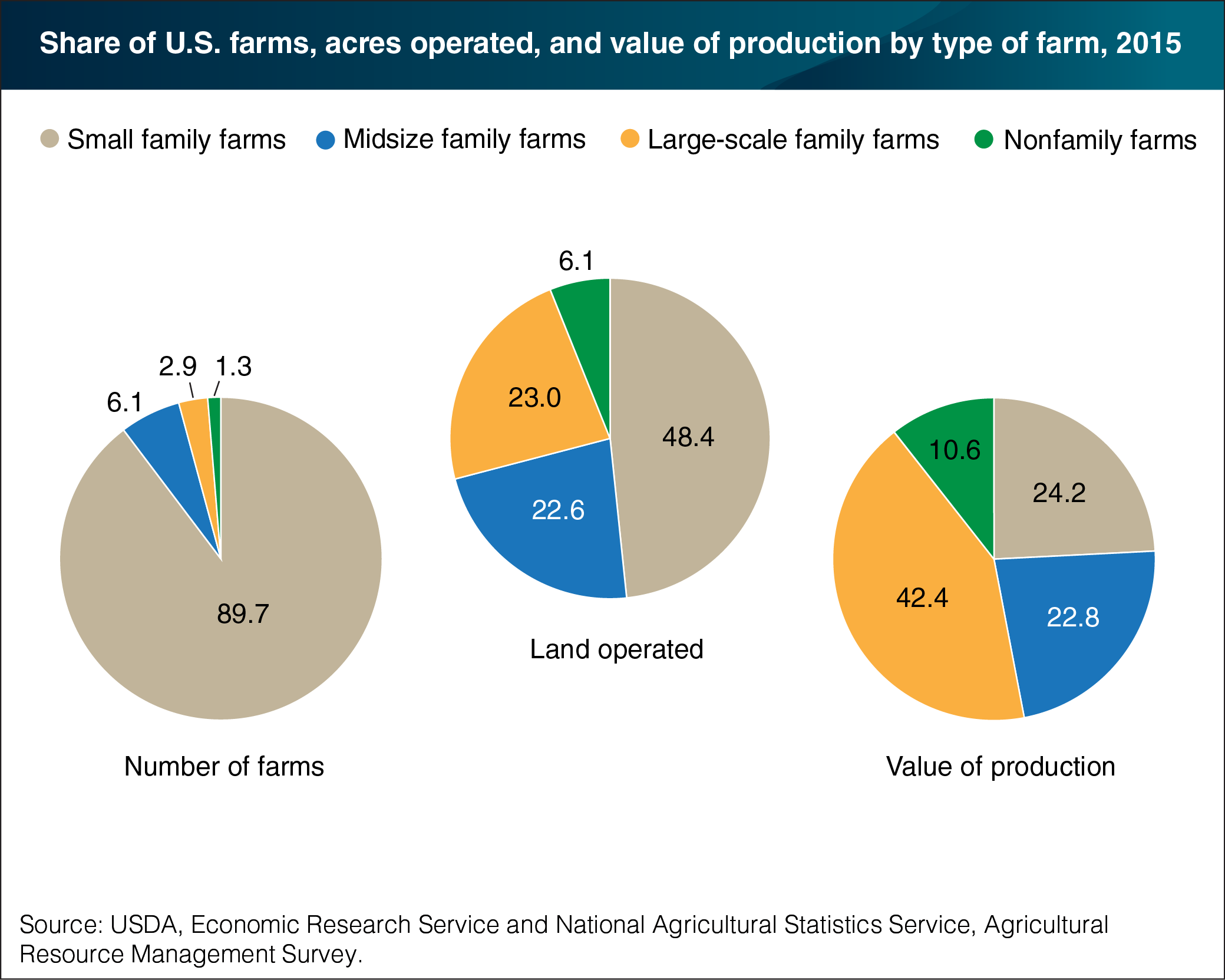
I've used it to counter the common meme that big corporations dominate agriculture. It's not true, at least with field crops. But then I started thinking--it's true enough that corporations are big in fruits and vegetables, but why would that be?
I'm guessing the key is that fruits and vegetables must offer much higher gross income per acre than wheat or corn. If true, it would follow that those acres are much more valuable and therefore take more capital to acquire, leading naturally to the greater use of corporations to assemble the acreage.
Another factor might be the economic structure: field crops likely require less processing than do vegetables. And fruits and vegetables spoil, they can't be stored, at least not unless they're processed by canning, juicing, drying, or freezing. Those factors make it more likely for vertical integration. We've had vertical integration with poultry and eggs for 50-60 years. I suspect the fruits and vegetables sector preceded birds.
I've used it to counter the common meme that big corporations dominate agriculture. It's not true, at least with field crops. But then I started thinking--it's true enough that corporations are big in fruits and vegetables, but why would that be?
I'm guessing the key is that fruits and vegetables must offer much higher gross income per acre than wheat or corn. If true, it would follow that those acres are much more valuable and therefore take more capital to acquire, leading naturally to the greater use of corporations to assemble the acreage.
Another factor might be the economic structure: field crops likely require less processing than do vegetables. And fruits and vegetables spoil, they can't be stored, at least not unless they're processed by canning, juicing, drying, or freezing. Those factors make it more likely for vertical integration. We've had vertical integration with poultry and eggs for 50-60 years. I suspect the fruits and vegetables sector preceded birds.
Monday, January 02, 2017
Lag Times and Lead Times
People who study human behavior in societies need to worry about lag times and lead times. That comment results from this piece on the results of legalizing pot in Washington--most studies show little change in teenage pot use.
I'm not convinced, perhaps because I've a vivid memory of a high school teacher warning against the dangers of marijuana, probably in 1958 or so. But over the last 50 years there have been "epidemics" of use/abuse of various substances, most notably the "crack" epidemic in the 1980's. That seems to have settled down, perhaps because kids saw the adverse impacts of crack addiction and decided to avoid it. There have been others--the "date drug" scare, for one.
Such epidemics are, I think, very much like epidemics of physical disease: the flu, SARS, HIV, Ebola. The initial cases don't show up in summary statistics; there's a lead time for the disease to spread to the point where it will show up. The necessity of a lead time means there's a lag time in seeing its effects.
So I'm not convinced by a few years experience in one state.
I'm not convinced, perhaps because I've a vivid memory of a high school teacher warning against the dangers of marijuana, probably in 1958 or so. But over the last 50 years there have been "epidemics" of use/abuse of various substances, most notably the "crack" epidemic in the 1980's. That seems to have settled down, perhaps because kids saw the adverse impacts of crack addiction and decided to avoid it. There have been others--the "date drug" scare, for one.
Such epidemics are, I think, very much like epidemics of physical disease: the flu, SARS, HIV, Ebola. The initial cases don't show up in summary statistics; there's a lead time for the disease to spread to the point where it will show up. The necessity of a lead time means there's a lag time in seeing its effects.
So I'm not convinced by a few years experience in one state.
Sunday, January 01, 2017
Saturday, December 31, 2016
The Agency of Subjects of Regulation
"Agency" is a big buzz-word, has been for a number of years. Typically in liberal and academic circles it means that people have minds and wills of their own, particularly the enslaved, the poor, the marginalized. But it's also true when bureaucrats try to regulate behavior. Often the picture in the bureaucrat's mind does not match the reality, or at least the picture in the mind of the person being regulated. That's a truth often ignored in discussions.
It's particularly nice for a liberal to find this mistake occurring when conservatives/libertarians are the ones designing the regulations. That's the case in Kansas, where governor Brownback has pushed tax reforms and cuts, intended to prove the old supply-side theory that less regulation and lower taxes will encourage growth and fill the government's coffers. Jared Bernstein has this quote from a Wall Street Journal article (behind pay wall):
It's particularly nice for a liberal to find this mistake occurring when conservatives/libertarians are the ones designing the regulations. That's the case in Kansas, where governor Brownback has pushed tax reforms and cuts, intended to prove the old supply-side theory that less regulation and lower taxes will encourage growth and fill the government's coffers. Jared Bernstein has this quote from a Wall Street Journal article (behind pay wall):
The WSJ piece points out that the number of entities taking advantage of this new loophole [not taxing small business income "passed through" to an individual] turned out to be 70 percent above the state’s projections.
Steve Moore, a key trickler that pushed the plan in Kansas, didn’t see that coming:
“Sometimes it was legitimate, and sometimes it was a gaming of the tax system to pay the zero rate, so that loophole has to be closed,” he said. “Unless you have some rules about this, people really will shift income and they’ll find ways to legally avoid paying tax, and that was never the intention.”
Friday, December 30, 2016
Luck Turns Against the Old
Based on a sample of one, I believe this is true: the older you get the unluckier you are.
In this statement I'm basically referring to physical luck, to accidents. I see it in myself--I seem to be having more and more close calls. For example, the other day I was on the sidewalk of Colts Neck Drive, near the driveway for one of the apartment complexes. I just started to cross when I saw a car beginning to leave the complex. Very quickly I calculated I was far enough (5-10') into the driveway that the car would stop and I should keep going. The next second I found myself walking into the car, which had pulled out quickly without stopping before pulling onto Colts Neck. (I assume what happened was the driver was looking to the left to check Colts Neck and never looked to the right at all to see me.)
That's the most recent of near accidents I've encountered, in many of which I would have been at fault.
This makes me think--all through my adult life I was lucky (only 3 car accidents, one of which was totally not my fault). I should have been thankful then; instead I'm fearful now.
In this statement I'm basically referring to physical luck, to accidents. I see it in myself--I seem to be having more and more close calls. For example, the other day I was on the sidewalk of Colts Neck Drive, near the driveway for one of the apartment complexes. I just started to cross when I saw a car beginning to leave the complex. Very quickly I calculated I was far enough (5-10') into the driveway that the car would stop and I should keep going. The next second I found myself walking into the car, which had pulled out quickly without stopping before pulling onto Colts Neck. (I assume what happened was the driver was looking to the left to check Colts Neck and never looked to the right at all to see me.)
That's the most recent of near accidents I've encountered, in many of which I would have been at fault.
This makes me think--all through my adult life I was lucky (only 3 car accidents, one of which was totally not my fault). I should have been thankful then; instead I'm fearful now.
Thursday, December 29, 2016
Texas Runs on Wind?
Texas under governor Perry has rapidly developed its wind resources, of which it has plenty.
Public Service--Report Amazon Phishing
Received an email announcing either a $50 or $100 credit from Amazon. Rather obvious phishing.
Forward such emails to stop-spoofing@amazon.com.
Forward such emails to stop-spoofing@amazon.com.
Wednesday, December 28, 2016
Where Driverless Vehicles First Are Used
In controlled environments, such as mines. See this Technology Review article on their use in Australia.
Tuesday, December 27, 2016
Habits and Back Pain
Interesting piece here on what our health dollars are spent on.
It requires access to doctors, establishing habits, and perseverance.
" The three most expensive diseases in 2013: diabetes ($101 billion), the most common form of heart disease ($88 billion) and back and neck pain ($88 billion)."Several years ago I was having low back pain. Finally mentioned it to my doctor who gave me an exercise routine which takes 15 minutes a day. No more back pain. I wonder how much of the pain people suffer could be avoided with similar routines: 10 percent maybe? That's a bunch of money.
"only about 4 percent of spending on low back and neck pain was on pharmaceuticals. Generally, more spending is done on elderly people, but about 70 percent of the spending on low back and neck pain was on working-age adults"
It requires access to doctors, establishing habits, and perseverance.
Monday, December 26, 2016
Contra Trump II
I blogged previously on how Democrats should view and oppose Trump. To extend my thoughts, because Trump has few or no principles, he can be unusually flexible (can Teflon be flexible?). Similarly his opponents must be flexible, meaning they should avoid confirmation bias. (See this New Yorker post on this and other ideas relevant to the Trump era.)
We shouldn't believe or argue that Trump is fascist, authoritarian, racist or inept. I guarantee for every ten examples we can point to over the next four years showing those qualities he will have a few counter examples. Our best bet is to attack him as inconsistent, unprincipled, hypocritical showman, of whom the American people will become tired and disillusioned and be willing for a return to Democratic sanity and steadiness in 2020.
The bottom line on Trump is he lost the popular vote by 2.8+ million and won the electoral vote with a lot of luck and a very unlucky opponent. And demographic trends are still against the Republicans. So a competent candidate in 2020 without 40 years of baggage should be favored, even against an incumbent president, assuming Trump will have as rocky a tenure as we Democrats have to believe he will have.
We shouldn't believe or argue that Trump is fascist, authoritarian, racist or inept. I guarantee for every ten examples we can point to over the next four years showing those qualities he will have a few counter examples. Our best bet is to attack him as inconsistent, unprincipled, hypocritical showman, of whom the American people will become tired and disillusioned and be willing for a return to Democratic sanity and steadiness in 2020.
The bottom line on Trump is he lost the popular vote by 2.8+ million and won the electoral vote with a lot of luck and a very unlucky opponent. And demographic trends are still against the Republicans. So a competent candidate in 2020 without 40 years of baggage should be favored, even against an incumbent president, assuming Trump will have as rocky a tenure as we Democrats have to believe he will have.
Sunday, December 25, 2016

Saturday, December 24, 2016
Historical Drinking Patterns
A piece here on current drinking patterns: New England and Wisconsin the heaviest, northern Midwest and Northwest states next, the evangelical South, Utah, and Idaho the least. There's a note that the patterns don't change rapidly, but the only data is 21st century. I wonder about the origins:
- Utah and Idaho would date from their settlement by whites--the Mormon church frowns on alcohol.
- Wisconsin presumably dates back to the German immigrants who settled there with their beer, among whom were some of my maternal ancestors.
- but how about the South? Their current dryness is accounted for by evangelical religion. I'm not sure when that developed--George Whitefield did evangelical work in the 1740's. I don't remember that he was particularly teetotal. Did dryness develop along with the progress of evangelical religion?
- and how about the North? Evangelical religion, the second Great Awakening, was perhaps more powerful in the North during the early 19th century. I'm thinking Prohibition saw a contest between the immigrant wets, the Germans with their beer, Italians et.al. with their wine, etc. against the WASPy religious types. With the end of Prohibition the immigrants had won.
Friday, December 23, 2016
Miller and Smith--And the Course of History
The Times had a piece on changes in the most common last names, the hook being the fact that Latino last names are moving up.
What caught my eye, though, were two of the other most common names: "Smith" and "Miller". (Jones and Williams and Johnson were also big). Why? They're occupational names. Back in the day when surnames first were assigned, the predominant occupation was farming, but we don't see "Farmer" as a big surname. Miller and smith would be higher income occupations back in the 16th century. It appears that higher income people had more surviving offspring then, and in the future.
On a related issue Megan McArdle has a piece on the inheritance of status, giving a brief summary of some work tending to show that socioeconomic status is very inheritable.
What caught my eye, though, were two of the other most common names: "Smith" and "Miller". (Jones and Williams and Johnson were also big). Why? They're occupational names. Back in the day when surnames first were assigned, the predominant occupation was farming, but we don't see "Farmer" as a big surname. Miller and smith would be higher income occupations back in the 16th century. It appears that higher income people had more surviving offspring then, and in the future.
On a related issue Megan McArdle has a piece on the inheritance of status, giving a brief summary of some work tending to show that socioeconomic status is very inheritable.
Thursday, December 22, 2016
NIHism in Government
FCW has advice to high ranking career civil servants who have to adjust to their new bosses in the Trump administration. All good, but this recognizes the NIHism common in government.
" Don't let arrogance or intransigence alienate you from the incoming leadership team. It's crucial to focus on outcomes and not be wed to the name of an initiative or its current process. Change happens. President George W. Bush's administration had a number of shared services initiatives branded as "eGov initiatives" and "lines of business." Those named initiatives were set aside by the Obama administration and time was lost before a new wave of shared services efforts were launched. This is a normal occurrence. Be prepared for it and keep the goal in mind -- the outcome matters much more than the form or structure of a current program."As I've written before, the Madigan "Infoshare" (GHWBush's USDA secretary) initiative limped into the Espy USDA tenure, lost momentum, then was sort of revived under Glickman, but changed/killed under the GWBush administration. The problem is that special projects represent a way for the administration to make a difference, to put their own stamp on the agency. But because they're identified with one administration, unless they're completed within the term of the administration, it makes them particularly vulnerable as targets for the next. By contrast the daily work of the bureaucracy is more immune to change.
Two-fer for USDA Secretary?
Chris Clayton discusses possible picks for Secretary, including a Hispanic woman from Texas with previous USDA experience.
USDA is vitally important to Trump--he's devoted one transition team member to the entire department!!!
USDA is vitally important to Trump--he's devoted one transition team member to the entire department!!!
Wednesday, December 21, 2016
Contra Trump
I think our new president will be a transactional one. Mr. Trump seems to have few fixed principles or beliefs, so he's likely to be very flexible in approaching issues.
I also think this flexibility and his lack of government experience (along with that of his appointees) is sure to lead to fiascoes and scandals, as well as significant changes and accomplishments. (See Cowen's post on the latter.)
With that assumption, I don't agree with those who believe Democrats should be unfailingly confrontational, following the pattern of Republicans with Obama but going one better. I'd suggest a two-pronged stance:
My underlying assumption is that the deals Dems reach with Trump will be successful, at least as contrasted to the issues on which we attack.
I also think this flexibility and his lack of government experience (along with that of his appointees) is sure to lead to fiascoes and scandals, as well as significant changes and accomplishments. (See Cowen's post on the latter.)
With that assumption, I don't agree with those who believe Democrats should be unfailingly confrontational, following the pattern of Republicans with Obama but going one better. I'd suggest a two-pronged stance:
- take every opportunity to point out Trump's lack of principles and flip flops--he'll provide sufficient ammunition.
- do deals when possible. Given past partisanship such deals are likely to split Republicans.
My underlying assumption is that the deals Dems reach with Trump will be successful, at least as contrasted to the issues on which we attack.
Tuesday, December 20, 2016
A Puzzle: Increasing Education and No Mobility
In recent days some seemingly solid articles/posts have reported the following:
- over the past 40-50 years the average American has gotten more education (i.e., more people graduating high school, more people going to college, more people graduating college, etc.)
- over the past 40-50 years the added income attributable to education, the education "premium", has increased.
- over the past 40-50 years the earnings of the average American is no greater than his/her parents.
Monday, December 19, 2016
Originalism on the Electoral College
Electoral college voting today. Some, mostly Democrats, now believe in originalism as it pertains to the college--should be a set of independent judges exercising their judgment. Others, notably Republicans, now believe the college should vote according to the norms and precedents in history, disregarding the original intent.
Sunday, December 18, 2016
A New Front for Animal Rights--Voluntary Milking?
DeLaval has a set of photos -- sure don't look like dairy barn I grew up with.
If I understand "voluntary" means a cow can walk into the robot and be milked whenever she wants. While I've always believed dairies generally took good care of their cows, the voluntary aspect is something entirely new. There would seem to a tension between the food movement, which likely disapproves of the size a dairy needs to be to justify such a robot system, and the animal rights movement, which should see a gain to animal welfare from the voluntary milking.
American Factoids--Declining Scots-Irish
German Federal States are, on average, about 8,600 square miles. East
German states are about 7,000, west German ones are about 9,600. US
states are, on average, about 74,000 square miles, so far from
comparable.
That's from Lyman Stone also these:
That's from Lyman Stone also these:
Do you know what major American ancestry-group is declining faster than any other? Scotch-Irish. The vaunted origin-ancestry of Appalachia lost nearly 2.2 million self-identifiers from the 2009 ACS sample to the 2014 ACS sample, marking a 42% decline. The only ancestries to lose more people were German and English; much of the decline in those two groups was centered around Appalachia.
Want to guess the fastest-growing ancestry group in America? I bet you guessed “Mexican” or “Chinese.” Those are solid guesses; Mexican is #3, at 11% growth with 2.4 million new self-identifiers.
The correct answer, however, is “White/Caucasian.” The number of Americans self-identifying not as English or German or Scotch-Irish but “White” as their ancestry, as distinct from just their race, rose 47% from the 2009 ACS to the 2014 ACS, with 3.9 million new identifiers. The second largest grower was “American” as an ancestry; this is un-hyphenated American, mind you. There are 2.9 million new “Americans,” giving 15% growth.
Saturday, December 17, 2016
"LIfe After Cows"
Unlike crop farming, dairy farms can come to a sudden and abrupt end. I know.
Two kids can set a fire, the barn goes, and the herd has to be sold. (Averaging 27,000 lb per cow--that's a figure unheard of in the 1950's.)
Or advancing age, low prices, a smaller dairy, no successors can make for a more gradual sell-off, as here.
Or a TB test comes out positive, and the bureaucrats order a "depopulation". (Some great photos at this site, prairie Canada.
Or, as happened with my dad, there's a severe stroke, so the cows went the next day, a phrase I can't type without emotion, even though I never wanted to farm.
Two kids can set a fire, the barn goes, and the herd has to be sold. (Averaging 27,000 lb per cow--that's a figure unheard of in the 1950's.)
Or advancing age, low prices, a smaller dairy, no successors can make for a more gradual sell-off, as here.
Or a TB test comes out positive, and the bureaucrats order a "depopulation". (Some great photos at this site, prairie Canada.
Or, as happened with my dad, there's a severe stroke, so the cows went the next day, a phrase I can't type without emotion, even though I never wanted to farm.
Friday, December 16, 2016
The Dream of Online Access to USDA Operations
In 1992 we had the dream of permitting farmers online access to ASCS, SCS, Farmers Home applications. In the initial Infoshare pilot we found very limited adoption. As I've observed from a distance the different embodiments of that dream over the years, I've always been curious how many farmers were really getting online and making use of the capabilities USDA provided. But despite my suggestions over the years, I'm not aware of any Federal site which publishes usage figures, so there's no way for a member of the public to see whether progress is being made.
Recently I found a clue, at least for FSA/NRCS/RD, thanks to the requirement for public notice on data requirements. (The first time in my life I've really seen a value for that procedural requirement.)
Here is the Federal Register document from USDA on the information collection requirement for e-Auth.
Recently I found a clue, at least for FSA/NRCS/RD, thanks to the requirement for public notice on data requirements. (The first time in my life I've really seen a value for that procedural requirement.)
Here is the Federal Register document from USDA on the information collection requirement for e-Auth.
"The USDA eAuthentication Service provides public and government businesses single sign-on capability for USDA applications, management of user credentials, and verification of identify, authorization, and electronic signatures. USDA eAuthentication obtains customer information through an electronic self-registration process provided through the eAuthentication Web site. The voluntary online self-registration process applies to USDA Agency customers, as well as employees who request access to protected USDA web applications and services via the Internet. Users can register directly from the eAuthentication Web site located at www.eauth.egov.usda.gov. The information collected through the online self-registration process will be used to provide an eAuthentication account that will enable the electronic authentication of users. The users will then have access to authorized resources without needing to reauthenticate within the context of a single Internet session."
"Description of Respondents: Farms; Individuals or Households; Business or other for-profit; Not-for-profit institutions; Federal government; State, Local or Tribal Government.There's no breakdown given for how many of the respondents are actually farmers. My guess would be about 80,000 to 100,000, which might be from 10 to 25 percent of potential users.
Number of Respondents: 114,256.
What's Wrong With Old White Men?
Bernstein comments that Trump's cabinet is old, other observers have said they're white, mostly, and mostly men (particularly if you omit what I'd call the "semi-cabinet--EPA, SBA,UN ambassador). It's notable there's little attention to their religious or ethnic diversity; the days when we paid attention to those parameters is long gone. And everyone assumes they're all heterosexual.
As an old white heterosexual male I see nothing at all wrong with his selections. :-) By the same token, I understand why others might justifiably criticize the narrowness of his universe.
As an old white heterosexual male I see nothing at all wrong with his selections. :-) By the same token, I understand why others might justifiably criticize the narrowness of his universe.
Thursday, December 15, 2016
Taxing Sugar--Hypocrisy
The Post (Wonkblog) has a piece arguing the merits of taxing sugar, that is sugar instead of soda.
I'm sure one could find in back issues of the Post an attack on USDA's current sugar program, which sets import quotas for foreign sugar, as costing the American consumer millions of dollars in added costs for their sugar. I'm also sure you won't find the food movement backing the sugar program as an instance in which government programs make Americans healthier.
(Note: I really have no brief for the sugar program; I just note the world is more complicated than advocates realize.)
I'm sure one could find in back issues of the Post an attack on USDA's current sugar program, which sets import quotas for foreign sugar, as costing the American consumer millions of dollars in added costs for their sugar. I'm also sure you won't find the food movement backing the sugar program as an instance in which government programs make Americans healthier.
(Note: I really have no brief for the sugar program; I just note the world is more complicated than advocates realize.)
Wednesday, December 14, 2016
Our Blinders
Love to pick on economists:
Here's Alex Tabarrok at Marginal Revolution:
My point is it's easy to slip into a generalization which isn't true, particularly when it's a binary issue: is factory farming ethical or not? IMHO it's more accurate to talk about gradations and percentages: a majority of the urban elite (especially native white elites) who have an opinion would likely have questions about the ethics of factory farming.
Here's Alex Tabarrok at Marginal Revolution:
"Animal rights will be the big social revolution of the 21st century. Most people have a vague feeling that factory farms aren’t quite ethical."I want to point out the blindness--the "most people". With my background I don't really buy the argument, or maybe it's better to say the issue is more complex for me than the average brown bear. Anyhow, when I read it, I resisted the concept a bit. But when you think about it--who are the people who Prof. Tabarrok has in his head? They're likely people like him, members of the urban elite. I venture to say that most members of American society don't think about the ethics of factory farming at all. And I venture to say that most people in foreign countries have no opinion on the issue.
My point is it's easy to slip into a generalization which isn't true, particularly when it's a binary issue: is factory farming ethical or not? IMHO it's more accurate to talk about gradations and percentages: a majority of the urban elite (especially native white elites) who have an opinion would likely have questions about the ethics of factory farming.
Tuesday, December 13, 2016
Mapspotting: Ithaca and Native Americans
One of the pleasures of being a know-it-all is noticing things the media/experts don't. These days the Times, the Post, and websites display a lot of data using maps, often at the county level, enabling me to "mapspot".
For example, it's often easy to pick out Ithaca, NY, or rather Tompkins county. It sits in the center of the state and with the presence of Cornell U. and Ithaca College it often stands out--it's an example of the "big sort", people separating themselves by money, lifestyle, and opinion.
On a darker note, there are counties in the west of North Dakota/South Dakota and around the Four Corners area of Arizona/New Mexico which stick out. Note the Vox maps on various causes and trends of mortality in this piece. Why--because there are Indian reservations there--Sioux and Navaho. Watch Longmire.
For example, it's often easy to pick out Ithaca, NY, or rather Tompkins county. It sits in the center of the state and with the presence of Cornell U. and Ithaca College it often stands out--it's an example of the "big sort", people separating themselves by money, lifestyle, and opinion.
On a darker note, there are counties in the west of North Dakota/South Dakota and around the Four Corners area of Arizona/New Mexico which stick out. Note the Vox maps on various causes and trends of mortality in this piece. Why--because there are Indian reservations there--Sioux and Navaho. Watch Longmire.
Monday, December 12, 2016
Trump and LBJ
I'm getting some echoes of LBJ in our current president-elect. Like Trump, LBJ paid obsessive attention to TV, going so far as to have 3 TV's, one for each network going in his offices. Like Trump, LBJ did a lot of feinting and faking, trying to build some drama and keep his adversaries off balance. (I'm thinking of his appointments and occasionally on policy. He kept Hubert Humphrey in suspense for months before confirming his selection as Vice President.) Like Trump, LBJ didn't relax, he drove himself and his staff relentlessly. Like Trump, I don't think LBJ had many close friends. Like Trump, LBJ was unfaithful, though unlike Trump he stayed in his marriage. Like Trump, LBJ didn't conform to the usual norms of gentility and political custom. Like Trump, LBJ could be volatile and very thin-skinned.
Unlike Trump, LBJ's domestic policies were admirable.
Unlike Trump, LBJ's domestic policies were admirable.
The China Lobby--Traces of History
In the 50's and 60's we had something called the "China Lobby", a group of politicians and lobbyists who had long supported the Chinese Nationalists, before and after their move to the island of Formosa (Taiwan). They had influence, ensuring the US did not recognize the existence of Communist China. They tended to be right wing Republicans, although not completely so, and had alliances with hard-liners opposing the USSR, seeing a monolithic communist conspiracy for world domination.
Then Nixon went to China, and recognized the regime. The China Lobby was aghast--IIRC George Will and William Safire were outraged. Over time the outrage has diminished, partially because the members of the lobby have died (Madame Chiang Kai-shek, a fascinating woman), partly the passage of time has dulled passions. But there's always been a group which supports more arms to China and resists initiatives of opening to China.
With Trump's tweets and phone call with the Taiwan president I'm wondering whether the China Lobby is still exerting its influence. We'll see.
Then Nixon went to China, and recognized the regime. The China Lobby was aghast--IIRC George Will and William Safire were outraged. Over time the outrage has diminished, partially because the members of the lobby have died (Madame Chiang Kai-shek, a fascinating woman), partly the passage of time has dulled passions. But there's always been a group which supports more arms to China and resists initiatives of opening to China.
With Trump's tweets and phone call with the Taiwan president I'm wondering whether the China Lobby is still exerting its influence. We'll see.
Friday, December 09, 2016
The Results of Ending Fox Hunts in Britain
 That's the door of No. 10 Downing Street, according to this
 Founding Fathers and Conflict of Interest
For those who believe in "originalism", a cautionary tale on the conflicts of interest between our first president.
Thursday, December 08, 2016
Loving Trump
Just saw the movie "Loving". Quite good, will be on some Oscar lists, but not up to last year's Spotlight. That said, this thought struck me:
Richard Loving would have voted for Trump.
Why? Because he felt powerless to take care of his wife, a feeling shared by many Trump voters.
Richard Loving would have voted for Trump.
Why? Because he felt powerless to take care of his wife, a feeling shared by many Trump voters.
Wednesday, December 07, 2016
One Stop Shopping for Government Services
FCW has Steve Kelman's piece on a one-stop shop in China:
Some 20 different agencies are represented in the center. Lots of the work handled involves services for businesses, such as registration and approvals for establishing a new business, and various approvals related to construction. The center also provides a number of citizen services, such as applications for passports and work permits, and various transactions related to health insurance. Many, though not all, of the forms can be completed online. The in-person services are designed for people -- often the older and less-educated -- with questions or who need in-person assistance actually filling out a form.Back in the 90's I had this sort of thing in the back of my mind. InfoShare had that dream, and the Osage County office in Kansas was a step along the way. I was ambivalent about the projects: moving to PC's and the Internet in county offices could only be justified by cost savings--good, which inevitably meant personnel cuts, but that meant a further decline in rural area jobs--not good. One faint possibility would be a true consolidation of USDA services, where things like Skype (CU-SeeMe back then) could enable one employee to tap the expertise of others located in distant offices but then adding other services. Problem was, government doesn't have that heavy of an impact on daily lives, particularly in rural areas. Suppose the service center could handle social security--how many visits do the 2 or 3,000 residents of a rural county make to a distant social security office in a year? And given the difficulty in getting USDA agencies working together, any further expansion at that time was a pipe dream.
Tuesday, December 06, 2016
Changes in DC
There's a piece in the Washingtonian on how the Obama administration changed Washington, DC.
Perhaps the single most telling stat on changes in DC during the past years is contained in this Post article on the stagnation in high school graduations. There's a table with the data on VA, MD, and DC, showing a graph of rates from 2000 to 2031-2. While white rates in both states are flat, the graph for white rates in DC soars above all others, reaching 500+ percent over 2000-1 by the end of the period. (I'm guessing that the rate is already 200 percent of 2000-1, an increase paralleling the Hispanic increase, but the Hispanic rate levels off and then drops in the 2020's.)
Perhaps the Obama administration symbolized the demographic changes in DC, without actually causing them.
Perhaps the single most telling stat on changes in DC during the past years is contained in this Post article on the stagnation in high school graduations. There's a table with the data on VA, MD, and DC, showing a graph of rates from 2000 to 2031-2. While white rates in both states are flat, the graph for white rates in DC soars above all others, reaching 500+ percent over 2000-1 by the end of the period. (I'm guessing that the rate is already 200 percent of 2000-1, an increase paralleling the Hispanic increase, but the Hispanic rate levels off and then drops in the 2020's.)
Perhaps the Obama administration symbolized the demographic changes in DC, without actually causing them.
Monday, December 05, 2016
Waning Enthusiasm for Pro Football
I don't know about the rest of the world but I'm gradually seeing my enthusiasm for pro football wane. A decade or more ago I would watch every play of every game on Sunday, particularly the Redskins. And I would be very much into the game, yelling at great plays, rapid heartbeat, etc.
But over time it's become easier for me to miss parts of games, or even the whole game. Yes, when I'm watching and the team is doing good, I really enjoy it. And I still read the Post articles and check the stats. But...
Why is it? 20 years ago or more, actually more, the Redskins were a good team. Since then they haven't been--don't think they've won a playoff game the few times they've actually made the playoffs. So there's that. There's also the consciousness of injuries, particularly concussions. And the game is slower, what with replays and challenges and more ads. Used to be a 1 o'clock game would end before 4, but no longer.
There's also age--my supply of interest seems to be shrinking generally. I no longer read every story in the newspaper, for example.
Age might be the determining factor.
But over time it's become easier for me to miss parts of games, or even the whole game. Yes, when I'm watching and the team is doing good, I really enjoy it. And I still read the Post articles and check the stats. But...
Why is it? 20 years ago or more, actually more, the Redskins were a good team. Since then they haven't been--don't think they've won a playoff game the few times they've actually made the playoffs. So there's that. There's also the consciousness of injuries, particularly concussions. And the game is slower, what with replays and challenges and more ads. Used to be a 1 o'clock game would end before 4, but no longer.
There's also age--my supply of interest seems to be shrinking generally. I no longer read every story in the newspaper, for example.
Age might be the determining factor.
Sunday, December 04, 2016
Trump and Nondisclosure
Trump is famous for requiring his employees to sign nondisclosure agreements. Apparently also when his lawsuits are settled, there's a no-publicity clause in the agreement. So I posed a
question on this Post piece: could Trump issue an executive order requiring all Presidential appointees to sign a nondisclosure agreement modeled after the ones he requires employees of his businesses? Don't know the answer.
I do know that the Supreme Court back in the 70's limited the right of the executive branch to restrict employees' contact with Congress.
question on this Post piece: could Trump issue an executive order requiring all Presidential appointees to sign a nondisclosure agreement modeled after the ones he requires employees of his businesses? Don't know the answer.
I do know that the Supreme Court back in the 70's limited the right of the executive branch to restrict employees' contact with Congress.
Saturday, December 03, 2016
Knowing What You Don't Know; a Corollary
I may have blogged in the distant past about a time I discovered the importance of knowing what you don't know. Briefly, I took a call from the Arkansas program specialist. I hadn't been in my position too long, the specialist pressed for an answer on an issue, while clearly indicating which way he thought the answer should go. I don't like conflict (might be an understatement) so I went along with him.
Some months later OIG filed a report challenging the rule the Arkansas office had applied, reporting that they had had approval from Washington for this dubious action. Big embarrassment when I had to admit to my boss, a very nice guy, I was the one who had screwed up. After that learning experience I tried to remember the lesson and to teach it to my employees when I moved back into management.
Long story short: Evan Osnos, a very good writer in the New Yorker, has this paragraph on Trump's phone call with the president of Taiwan:
[The ability to spell diminishes with age, at least in my case. Misspelled "correllary"]
Some months later OIG filed a report challenging the rule the Arkansas office had applied, reporting that they had had approval from Washington for this dubious action. Big embarrassment when I had to admit to my boss, a very nice guy, I was the one who had screwed up. After that learning experience I tried to remember the lesson and to teach it to my employees when I moved back into management.
Long story short: Evan Osnos, a very good writer in the New Yorker, has this paragraph on Trump's phone call with the president of Taiwan:
"For a piece I published in September, about what Trump’s first term could look like, I spoke to a former Republican White House official whom Trump has consulted, who told me, “Honestly, the problem with Donald is he doesn’t know what he doesn’t know.” It turns out that is half of the problem; the other half is that he has surrounded himself with people who know how much he doesn’t know."
[The ability to spell diminishes with age, at least in my case. Misspelled "correllary"]
Subscribe to:
Posts (Atom)