Friday, May 09, 2008
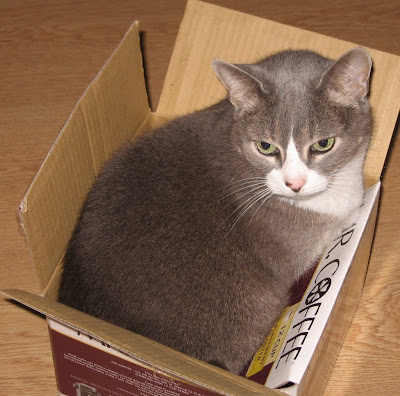
Initial Friday Cat Blogging
The first time I've added a photo to my blog. (Takes us old people time to get caught up with new-fangled ideas. Coffee is vital to me so I wear out coffee carafes. Carrie decided the box the latest one came in was just the right size for her:


How Slowly We (Govt) Adapt to Change
From the GAO on e-mail and official records (my comments in italics):
E-mail, because of its nature, presents challenges to records management.My comments, and perhaps the emotion, date from some years associated with records management. Records management was part of the rationalization of business (see Alfred Chandler's writings)--creating, processing and filing information. But it rests on the economic fact it was costly to generate a memo (or equivalent piece of paper). You had to have a specialized individual (called a clerk-typist or secretary). She (or sometimes he) had to be able to handle multiple carbon copies for the multiple files, including something called the "official record". The piece of paper had to be routed through levels of bureaucracy until it got to an approving official. Once signed, the copies would be distributed appropriately. But all that's so 20th century.Preliminary results of GAO's ongoing review of e-mail records management at four agencies show that not all are meeting the challenges posed by e-mail records. Although the four agencies' e-mail records management policies addressed, with a few exceptions, the regulatory requirements, these requirements were not always met for the senior officials whose e-mail practices were reviewed. Each of the four agencies generally followed a print and file process to preserve e-mail records in paper-based recordkeeping systems, but for about half of the senior officials, e-mail records were not being appropriately identified and preserved in such systems. Print and file makes no sense--electronic is cheaper
- First, the information contained in e-mail records is not uniform: it may concern any subject or function and document various types of transactions. As a result, in many cases, decisions on which e-mail messages are records must be made individually. Why make decisions at all?
- Second, the transmission data associated with an e-mail record--including information about the senders and receivers of messages, the date and time the message was sent, and any attachments to the messages--may be crucial to understanding the context of the record. So keep the whole thing.
- Third, a given message may be part of an exchange of messages between two or more people within or outside an agency, or even of a string (sometimes branching) of many messages sent and received on a given topic. In such cases, agency staff need to decide which message or messages should be considered records and who is responsible for storing them in a recordkeeping system. Again, why decide anything--keep the whole sequence.
- Finally, the large number of federal e-mail users and high volume of e-mails increase the management challenge.
Instead, e-mail messages were being retained in e-mail systems that lacked recordkeeping capabilities. (Among other things, a recordkeeping system allows related records to be grouped into classifications according to their business purposes.) Unless they have recordkeeping capabilities, e-mail systems may not permit easy and timely retrieval of groupings of related records or individual records. Gee--I think being able to do a Google search on a body of text is a whole lot better than relying on poorly paid clerks to perform groupings according to a subject scheme that is likely 20 years out of date.
Further, keeping large numbers of record and nonrecord messages in e-mail systems potentially increases the time and effort needed to search for information in response to a business need or an outside inquiry, such as a Freedom of Information Act request. Factors contributing to this practice were the lack of adequate staff support and the volume of e-mail received. In addition, agencies had not ensured that officials and their responsible staff received training in recordkeeping requirements for e-mail. If recordkeeping requirements are not followed, agencies cannot be assured that records, including information essential to protecting the rights of individuals and the federal government, is being adequately identified and preserved.
Food Expenditures
John Phipps links to the NYTimes graphic on living expenses (which I'd read on paper, but it's a whole lot neater on line) as a great example of presentation of complex data.
What's interesting is looking at food expenditures, which are 15 percent of total. But when you mouse around the expenditures for various foods, it looks as if we're eating pretty sensibly at home. I mean snacks, misc. foods, and frozen foods together are about 1 percent of total or about 6.5 percent of food costs. That's not too bad. Vegans will have problems with all the money spent on meat (close to 2 percent). Fruits and vegetables seem to be about 1 percent of total. Dairy about 1 percent. Alcohol a little over 1 percent. Eating out about 6 percent. Coffee, tea, other drinks about 1 percent.
A little noted item--domestic service is .2 percent. Remember in the good old pre-WWI and WWII days, everyone (i.e., upper middle class and upper) had servants; now they have permanent press and fast foods.
What's interesting is looking at food expenditures, which are 15 percent of total. But when you mouse around the expenditures for various foods, it looks as if we're eating pretty sensibly at home. I mean snacks, misc. foods, and frozen foods together are about 1 percent of total or about 6.5 percent of food costs. That's not too bad. Vegans will have problems with all the money spent on meat (close to 2 percent). Fruits and vegetables seem to be about 1 percent of total. Dairy about 1 percent. Alcohol a little over 1 percent. Eating out about 6 percent. Coffee, tea, other drinks about 1 percent.
A little noted item--domestic service is .2 percent. Remember in the good old pre-WWI and WWII days, everyone (i.e., upper middle class and upper) had servants; now they have permanent press and fast foods.
Too Good for Your Own Good
Ah, for the days of planned obsolescence. My wife will mourn this loss of the unbreakable glass from France, as reported by Mr. Beauregard.
Thursday, May 08, 2008
New Young "Farmer"
Back once again to the old question: "Who is a farmer"? Here's the blog post of a young idealist (as mentioned in the LA Times article) just starting out. She finds that FSA isn't of help.
FSA's definition is someone who is selling to a wholesale distributor and is growing on owned (albeit mortgaged) land. That's because the law authorizing loans to beginning farmers defines it that way, probably because back in the New Deal days (when the program originated) that was all we had. Now if Ms Bradbury contacted her representatives in Congress and one of them were on the appropriate committee and...and... and...20 years from now the law might be changed.
Bottomline: while the bureaucracy has its own impediments to change, our beloved founding fathers made sure the rules by which the bureaucracy operates would be slow to change.
FSA's definition is someone who is selling to a wholesale distributor and is growing on owned (albeit mortgaged) land. That's because the law authorizing loans to beginning farmers defines it that way, probably because back in the New Deal days (when the program originated) that was all we had. Now if Ms Bradbury contacted her representatives in Congress and one of them were on the appropriate committee and...and... and...20 years from now the law might be changed.
Bottomline: while the bureaucracy has its own impediments to change, our beloved founding fathers made sure the rules by which the bureaucracy operates would be slow to change.
Even Farmers Market Farmers Get Old
The LA Times has an article on the graying of farmers selling at farmers markets. An excerpt:
IN GENERAL, experts say, new farmers market growers tend to come from one of three groups: young idealists looking for a rural lifestyle, immigrants who use farmers markets to make money from small plots of land, and those like Coleman who inherit family farms.Assuming that's right, it tells you few people go into farming to make money, even though money can be made, at least in good years like this one. Of course, that statement is also true of teachers and even public servants (as us bureaucrats like to be known).
Wednesday, May 07, 2008
Al Gore and Procurement Fraud
I blogged about a month ago on abuse of government credit cards and noted Al Gore's contribution. The Project on Government Oversight has this perfectly ironic note.
"One of the more ironic stories of purchase card abuse comes to us from Milwaukee, Wisconsin, where a U.S. Forest Service employee, Suzanne Poetz, has pleaded guilty to stealing $300,000 from her agency's program. As part of her plea, Poetz admitted to over 150 instances of theft. But the best part of all? In 1998, Poetz received a Hammer Award from Vice President Al Gore--for developing the Agriculture Department's purchase card program. (The Hammer Awards were given to federal employees whose work "resulted in a government that works better and costs less")."All I need to see now is a story telling how someone, maybe a Republican congressman, who pushed for contracting out government services made money by taking bribes from such a contractor.
What Should They Fear?
Economists (if "they" = "political candidates).
So says Brad DeLong
Somehow, I'm not convinced that economists are fearsome. Truman supposedly wanted a "one-armed" economist, because his always said: "on the one hand...on the other hand".
So says Brad DeLong
Somehow, I'm not convinced that economists are fearsome. Truman supposedly wanted a "one-armed" economist, because his always said: "on the one hand...on the other hand".
Best Result of the Night
The report that the Indiana ID law denied the vote to some nuns (no picture ID, too infirm to file a provisional ballot and then get an ID). I wonder how our mostly Catholic Supreme Court is feeling now about their recent decision upholding the law. (If I recall, the decision rested mainly on the idea that no harm had been shown--no one had been denied the vote.)
[I'm waiting for this to be revealed as a belated April Fool joke.]
[I'm waiting for this to be revealed as a belated April Fool joke.]
Tuesday, May 06, 2008
Clearance Process
This article says OMB is going to rely on automated matching of data to speed clearance process.
Here's a followup article
I have some doubts--the TSA watch list shows some of the problems of putting together databases. And genealogists run into the problem regularly--does record A refer to the same person as record B? I think a learning, evolutionary process could work. By which I mean, assign something like a credit rating to a person based on available data, track the person's history and adjust the rating accordingly. Unfortunately, that sort of thinking doesn't fit with the black and white, binary choice world of security clearances.
Here's a followup article
I have some doubts--the TSA watch list shows some of the problems of putting together databases. And genealogists run into the problem regularly--does record A refer to the same person as record B? I think a learning, evolutionary process could work. By which I mean, assign something like a credit rating to a person based on available data, track the person's history and adjust the rating accordingly. Unfortunately, that sort of thinking doesn't fit with the black and white, binary choice world of security clearances.
The Perversity of Rules
One thing the Dems promised in 2006 was, if they gained the majority, they would reinstate the "pay-go" rules--the procedural rule saying that any law authorizing new expenditures must also include a means to pay for it (raising taxes or cutting other programs). All right-thinking good government types applauded this, and the Dems carried through on their promise.
So what's the problem? Well, as Dan Owen at Blog for Rural America explains, it creates an incentive to maintain old programs: "What's the response of those writing the farm bill? "We need to protect our commodity program baseline"." In other words, it's true enough that most crop farmers today are doing well, but if the ag committees cut direct payments in the new farm bill, that reduces the "baseline". A reduced baseline down the road means reduced ability to increase payments if that were needed. So, a good rule encourages a bad result--there's no such thing as a free lunch.
So what's the problem? Well, as Dan Owen at Blog for Rural America explains, it creates an incentive to maintain old programs: "What's the response of those writing the farm bill? "We need to protect our commodity program baseline"." In other words, it's true enough that most crop farmers today are doing well, but if the ag committees cut direct payments in the new farm bill, that reduces the "baseline". A reduced baseline down the road means reduced ability to increase payments if that were needed. So, a good rule encourages a bad result--there's no such thing as a free lunch.
What the World Needs Now: Smarter Flies?
Actually, yes. According to this NYTimes article on animal learning, some scientists bred flies to be smarter. That's a revelation--flies do learn. And then they determined that smarter flies had shorter lives. The general argument is that while there are benefits to being able to learn, there are also costs. (As Robert Heinlein would say, there's no such thing as a free lunch.) It's not quite clear where the costs come from, though if the young have to learn by experience, they're more vulnerable than if they were hard-wired. And brains are costly in terms of energy. (That's why there are so few in evidence these days.)
Monday, May 05, 2008
Fresh Food, Local Food
The NYTimes has an article on NYC's loss of supermarkets, meaning more people have to drive (assuming they have a car in NYC) to buy fresh produce. Apparently rents are rising (presumably because of a still hot real estate market and the rejuvenation of the city) and the profit margins just aren't there. Supermarkets are facing competition from other outlets, which sell milk, beer, etc. Reading between the lines, produce must have especially low profit margins. Perhaps because of spoilage--how often do you see lots of produce in the supermarket that's past it? And that's with the advantage of loyalty cards, so they can tell that the Harshaws will buy 14 bananas a week with about 95 percent reliability. Or maybe it's the problem of establishing reliable supplies over the year. That says something about the problems faced by the locavore movement and organic farming.
Sodsaver Provision
I hadn't been following this. At gristmill a story on the "sodsaver" provision: "The House and Senate versions of the farm bill both contained this new provision, which would have prohibited crop insurance and non-insured disaster payments for production losses to producers in any state who plowed up native grasslands in order to plant crops. This would have also prevented these farmers from receiving regular disaster payments, because farmers must first have crop insurance in order to be eligible for disaster payments."
Apparently the conference committee is restricting it to the desert pothole area (i.e., the area of small lakes/marshes left behind when the glaciers retreated that are great for ducks, etc.) and making it optional by the governor. That's much to the regret of conservationists. What concerns a former bureaucrat is the possibility the law will mix apples and oranges. Mostly in the past, eligibility provisions have been either/or, land or person. A person who violated the sod/swampbuster provisions would be ineligible for all payments everywhere. Or, if the program provisions on a farm were violated, there might be no payments for that farm. But this sounds as if it might be a mixture--someone plows grassland in ND and in SD, for example. ND says okay, but SD says no. Result--person is ineligible on all his land in SD but not in ND. Very difficult to control, unless the IT systems FSA uses have gotten considerably more sophisticated.
It's also interesting--under sodbuster NRCS would have to have an approved plan for the farm to make the producer eligible. Sounds to me as if this "sodsaver" provision is a tacit admission that NRCS was unable/unwilling to administer the "sodbuster" provisions as originally intended. No real surprise--NRCS as a bureaucracy did not have the culture of policing regulations.
Apparently the conference committee is restricting it to the desert pothole area (i.e., the area of small lakes/marshes left behind when the glaciers retreated that are great for ducks, etc.) and making it optional by the governor. That's much to the regret of conservationists. What concerns a former bureaucrat is the possibility the law will mix apples and oranges. Mostly in the past, eligibility provisions have been either/or, land or person. A person who violated the sod/swampbuster provisions would be ineligible for all payments everywhere. Or, if the program provisions on a farm were violated, there might be no payments for that farm. But this sounds as if it might be a mixture--someone plows grassland in ND and in SD, for example. ND says okay, but SD says no. Result--person is ineligible on all his land in SD but not in ND. Very difficult to control, unless the IT systems FSA uses have gotten considerably more sophisticated.
It's also interesting--under sodbuster NRCS would have to have an approved plan for the farm to make the producer eligible. Sounds to me as if this "sodsaver" provision is a tacit admission that NRCS was unable/unwilling to administer the "sodbuster" provisions as originally intended. No real surprise--NRCS as a bureaucracy did not have the culture of policing regulations.
Inconsistency, Thy Name is Human
Some, often on the conservative side, argue that we shouldn't increase taxes or pass laws to fight global warming. The threat of warming is projected and not proven, the cost would be too great to act now, why suffer lower growth now to help future generations?
Some, often on the conservative side, argue we should increase taxes and change laws to fight the social security trust fund deficit. The threat of SS bankruptcy is proven by projections, the cost would be minimal if we act now, we must suffer now to help future generations.
And then there are the opponents, who tend to take the opposite side of each issue.
Some, often on the conservative side, argue we should increase taxes and change laws to fight the social security trust fund deficit. The threat of SS bankruptcy is proven by projections, the cost would be minimal if we act now, we must suffer now to help future generations.
And then there are the opponents, who tend to take the opposite side of each issue.
Slow Food, No; Slow Medicine, Yes
I eat. I've previously blogged about my skepticism of "slow food", "locavore", etc. Carbon taxes, which would raise the cost of transportation (and of production on industrial ag operations), are fine. But I don't like the romanticism surrounding the movement (don't like movements, mostly).
I live, for a while longer, but this article on "slow medicine" in the NY Times today makes me lean to approving it:
I live, for a while longer, but this article on "slow medicine" in the NY Times today makes me lean to approving it:
Grounded in research at the Dartmouth Medical School, slow medicine encourages physicians to put on the brakes when considering care that may have high risks and limited rewards for the elderly, and it educates patients and families how to push back against emergency room trips and hospitalizations designed for those with treatable illnesses, not the inevitable erosion of advanced age.My sister and I used a hospice for my mother, who was old, had Alzheimer's, and was diagnosed with cancer of the pancreas. That example is one reason why I like "slow medicine", but her case also gives a caution. Mom broke her hip while she was in her late 80's, but she was able to recover quite well. It's easy to think about being close to the end of life, but more difficult to tell when one is there.
Saturday, May 03, 2008
Senator Roberts Opines
Senator Pat Roberts is not one of my favorite people. Back in 1996 he was the father of "Freedom to Farm", the bait and switch deal. Sold by the Republicans as a way to phase out farm payments it got converted into the ongoing direct payment program in 2002. (No, I don't know he planned it that way, but any realistic observer of farm programs knew in 1996 it wasn't going to work the way he described it.)
Anyhow, now I've vented a bit, the High Plains Journal quotes him and Rep. Moran as having problems with the way the bill is going. Read it here.
One thing I'll point to, just in case any one from NASCOE reads this--the $50 fee for going to the county office. I understand the logic, but that would be a good way to move farmers from visiting the office to working on-line. :-) That's not what NASCOE would like, I guess.
Anyhow, now I've vented a bit, the High Plains Journal quotes him and Rep. Moran as having problems with the way the bill is going. Read it here.
One thing I'll point to, just in case any one from NASCOE reads this--the $50 fee for going to the county office. I understand the logic, but that would be a good way to move farmers from visiting the office to working on-line. :-) That's not what NASCOE would like, I guess.
Pay Limit--Confusing Reports
From the ARgus Leader in SD:
"The tentative deal would base farm program payment limitations on whether the recipients are farmers or non-farmers, Herseth Sandlin said. In 2009, landowners with adjusted gross incomes of more than $750,000 who are not farmers would be prohibited from receiving farm payments. The amount would fall to $650,000 in 2010 and to $500,000 in 2011, she said. The income cap for farmers would be $950,000.Not sure what "a farmer" means in this context. This might mean a three tier system:
Farmers making more than that could still benefit from farm programs but would lose 10 percent of their direct payments for every $100,000 in income over the $950,000 cap, Herseth Sandlin said.
The tentative deal would also prohibit the U.S. Department of Agriculture from closing Farm Service Agency offices for two years, she said.
"(However) nothing is really final until the end," she said."
- An owner of cash-rented land who doesn't share in the risk of the crop is neither actively engaged nor a farmer--no payments, period.
- An owner of share-rented land is not a farmer but does share in the risk so can receive payments providing AGI is under the cap.
- A tenant (by share or cash lease) is actively engaged in farming and a "farmer", so can receive payments but at declining rate if AGI is over the cap (which means no payment if AGI is $2 million or more).
Small Farm Provision
The House-Senate conferees on the farm bill are reported to be looking after the small farmer--they're prohibiting small farmers (less than 10 acres of ?) from getting payments. Not clear what the "?" means nor what "payments" means. I can hear the rhetoric now, particularly when people (like Ken Cook or Tom Philpott) search around and discover a very deserving, struggling small farmer.
(Not that I don't have some sympathy for the logic here.)
(Not that I don't have some sympathy for the logic here.)
Uncle's Folly? Do College Freshmen Read?
Brad DeLong proposes to buy subscriptions for four periodicals for his nephew, who is off to college. I don't know whether to celebrate the idea that college freshmen still are familiar with printer's ink or the idea that uncles (and parents) are always out of touch with the real interests and concerns of the next generation.
Friday, May 02, 2008
Locavores--Think Rabbit
Yes, the best way for you locavores who haven't turned vegetarian yet to get your meat is the backyard rabbit hutch. You too can eat Flopsy, Mopsy, and save Peter Rabbit for Sunday dinner. In doing so, you'll be following in the footsteps of those in the home of great cuisine and terroir--France. See this piece on "Alice and Marcel", Mr. Beauregard's neighbors.
"Marcel lives for, and almost in his garden. From May to October he is out tending his veg at 6.30, just before he cycles to work. At 12, he comes home for lunch and does a quick bit of weeding before heading back for his afternoon stint at the arms factory. At 6pm, he is home again, and back in the garden until nightfall.It's a way of life for many in France, but fading.It would actually be wrong to call Marcel’s garden a garden. It is a veritable little biosphere. Aprt from fish on Fridays, pretty much everything that the family eat is from the garden. Fresh fruit and veg in summer and bottled, pickled preserved produce in winter."
U.S. and Foreign Courts--Their Interaction
Justices Stephen Breyer and Antonin Scalia have debated whether U.S. jurisprudence should be cognizant of developments in other countries, as in defining "cruel and unusual". That's a hot issue among some attorneys and even more so on cable news--the conservative types tend to say "no way", while the liberals say: "of course". (Actually, that's way over-simplified and, to a cynical old man, often depends on whose ox is gored. The usual context seems to be social issues: death penalty, etc.)
Now comes a review on H-Net of a book on the Warren Court and its influence on foreign law. (Of course, conservatives might view U.S. law, at least pre-Warren, as a model to be followed, a "city on a hill"; while liberals might be skeptical. Seems that maybe the court's example had an effect, but different in different regions.
Now comes a review on H-Net of a book on the Warren Court and its influence on foreign law. (Of course, conservatives might view U.S. law, at least pre-Warren, as a model to be followed, a "city on a hill"; while liberals might be skeptical. Seems that maybe the court's example had an effect, but different in different regions.
Update on "King Corn"
An interesting discussion of Iowa ag vis a vis the documentary "King Corn". Iowa Public TV interviews two farmers/ag leaders on the subject. A couple excerpts:
"We've heard different times over the last 20 years how everything had changed. 1996 we had higher prices for corn. We had prices change in 1988 and in the early 90s as well. And each time seemed like it was forever, it wasn't....
"Yeager: But if I was to go into a banker tomorrow and try to get money to go farm, I want to take my father's 160 and farm it, I want to turn it from corn into rutabagas or rhubarb or something like that. The banker is probably going to laugh me out of the room.Kirschenmann: Sure, and there's no way that you could do it because even -- some of the research that we have done at Iowa State University makes it very clear now that if farmers added a third crop to that corn and soybean rotation they would get a lot of benefits from that. It would reduce their disease pressure, the weed pressure.
So, there would be a lot of things that would reduce their costs. But you talk to a farmer and say, well, why don't you raise this third crop? The first question is, which one, what do I add to it? And, of course, we know that we can raise wheat in Iowa but some of the farmers that I talk to, at least in Central Iowa say, if they were to raise wheat they'd have to haul it 200 miles to find a place even that will buy it. So, that adds to the cost.
Yeager: Because their structure is set up -- we have a grain co-op in basically every town and every county across the state -- the infrastructure is there.
Thursday, May 01, 2008
Why I'm Optimistic on Global Warming
It's because of articles like this one from Technology Review, indicating we're starting up the learning curve on silicon solar panels.
Changing Payment Limitation Rules in Midstream
One thing I haven't posted on, nor have I seen much discussion on is "status date". (I think that's the term.) Anyhow, for payment limitation purposes under current law, FSA offices have to determine the way a farming operation is set up as of a certain date, which may be May 1. At least, that's the way it used to be.
So, if Congress changes the rules relating to limitations, the only way they can be fair about it is to extend current rules for 2008 and make the new ones effective for 2009.
So, if Congress changes the rules relating to limitations, the only way they can be fair about it is to extend current rules for 2008 and make the new ones effective for 2009.
Wednesday, April 30, 2008
Making Acreage Report Data Public
I commented on this decision back in February, but this article gives a bit more detail from the FSA side. I remain confused over the lines being drawn between releasing FSA data on farmers and prohibiting the release of other data. As usual, our political/legal system doesn't produce the sort of logical results which would comfort a rigid personality like me.
Farm Bill Status
Lots of links available on the farm bill, particularly through EWG, who also released 2007 payments, but this from Politico is interesting. I'm still hoping someone will pick up my idea about graduated payment reductions. Seems as if by switching the terms of debate they could confuse everyone so everyone could claim a victory, then see what happens in the administration of it. Oh well--doomed to be ignored, I guess, alas.
Former ASCSer Bjorlie
Interesting obit for Arnold Bjorlie, whom I knew as an area director in DC, focusing on his involvement in Non-Partisan League politics in ND
Tuesday, April 29, 2008
Loo Paper for the Bog
That's one of the hurdles in setting up a new English-language paper in Abu Dhabi--providing the infrastructure people are used to. ("Bog" being British slang for toilet") See the NYTimes article.
Interesting when the newspapers are reporting declines in circulation, someone thinks it wise to set up a new one in the Middle East and make it English.
I love the phrase, and I think it provides an insight on crossing cultural boundaries.
Interesting when the newspapers are reporting declines in circulation, someone thinks it wise to set up a new one in the Middle East and make it English.
I love the phrase, and I think it provides an insight on crossing cultural boundaries.
Slowly Up the Learning Curve--Video Seminars
Here's a discussion by John Quiggin at Crooked Timber of his experience holding a video-seminar.
On the one hand, that's the way to go. (John notes the traveling he would have to do to do the seminar in person, but not the energy involved. If "slow food" is good, so is "e-learning").
On the other hand, there have been many video-conferencing trials over the years. I remember doing video conferences between DC and Kansas City several times--it had too much overhead costs for the advantages. I remember trying a version of a video-phone in the late 80's--wasn't really useful. A few more years of Moore's law and maybe technology will be able to fulfill this particular promise. But still, , people are animals, and being there is part of our thing.
On the one hand, that's the way to go. (John notes the traveling he would have to do to do the seminar in person, but not the energy involved. If "slow food" is good, so is "e-learning").
On the other hand, there have been many video-conferencing trials over the years. I remember doing video conferences between DC and Kansas City several times--it had too much overhead costs for the advantages. I remember trying a version of a video-phone in the late 80's--wasn't really useful. A few more years of Moore's law and maybe technology will be able to fulfill this particular promise. But still, , people are animals, and being there is part of our thing.
How Do You Tell the Farmer--A Big Belly?
That seems to be the implication of this story on the "Farmer Wants a Wife" series on CW. The 30-year Missouri farmer doesn't look like a farmer, because he's got abs. Another mark of change--I remember the day when no farmer of my acquaintance had a belly. Course, that was before tractors with enclosed cabs, etc.
Monday, April 28, 2008
Republican Has Kind Words for Dems
From Rep. Tom Davis's interview but read the whole thing:
"John Koskinen did a lot of this [work] {i.e., IT} under President Clinton, and he was excellent. The first thing I’d say to the administration is make sure management is an important part of OMB. Consult with leaders of both parties. Get people who understand government and understand how it works. Clay Johnson is a great guy and has ideas, but he has not been in government before. You need somebody who can mold [government and the private sector] together, and that’s something that has been lacking.
Steve Kelman understood it pretty well on a procedural side and on the contracting side, and Al Gore understood that you needed to change the way government works. Democrats believe in government. A lot of our guys just don’t want government, and that makes it hard because they’re just trying to tear down government. Well, government is here to stay, and a lot of us can see the wonderful things government can do. You just want to do it right. If you’re going to have government, and it’s not going to get any smaller in terms of its directives, let’s make it work and make it efficient.
Anti-Agribusiness
For an interesting attack on agribusiness, read this.
I found this bit interesting:
I found this bit interesting:
When we were growing up, beef was, for the most part, grass fed and local. Family farmers took their sale cattle to either the auction barn or the stockyards, and there were a few in every county. The local stockyard then delivered the livestock to a larger facility in the closest city - St. Joseph and Kansas City, Missouri were cowtowns with bustling stockyards and as a child I climbed the pens in both. As a teenager, my best friend was the daughter of the local stockyard owner, and we frequently hitched rides with her brother who drove the semi to the stockyards in KC. (That's how small-town cheerleaders scored weed without ruining their reputations - to the three members of my high school graduating class of 18 who read this blog, now you know our secret.) Some farmers sold all of their beef to a specific butcher for a niche market. My maternal grandparents were kosher farmers and my Great Uncle was a kosher butcher.The author covers lots of bases, many of which I disagree with. I'll only cite one point on health: there probably are no statistics available, but my sense is that a concentrated food industry makes screwups more serious and much more visible, but it may still be safer than a decentralized food industry of the past. My comparison would be to the aviation industry--one mistake can kill hundreds of people on a big plane and make headlines all around the world. But the reality seems to be that general aviation, the small planes, are much more likely to have fatal accidents and much more dangerous.
Identity Checks and Government Blogging
Here's an article on changes being made by DHS in handling their no-fly list and here's the DHS blog's post on it . (If I understand, Ted Kennedy gets stopped all the time, because there's a suspected terrorist (or at least someone on the no-fly list) with a similar name, so they have to establish Ted isn't the same person. Now, under the proposal, if Ted allows his date of birth to be added to the airlines data, he can go right through.)
The proposal makes sense to me, but not to the first four comments on the blog. Maybe they aren't into genealogy, where you have to distinguish among multiple John Rippeys or even worse, William Smiths. Much less try to reconcile the data between ASCS and SCS to determine whether each agency was dealing with the same people. But then, I'm just a retired bureaucrat who tends to trust bureaucracies, at least in some instances.
The proposal makes sense to me, but not to the first four comments on the blog. Maybe they aren't into genealogy, where you have to distinguish among multiple John Rippeys or even worse, William Smiths. Much less try to reconcile the data between ASCS and SCS to determine whether each agency was dealing with the same people. But then, I'm just a retired bureaucrat who tends to trust bureaucracies, at least in some instances.
Sunday, April 27, 2008
Economics Articles Today
Seems to be a big day for economics.
Roger Lowenstein has a very interesting article in the NY Times Mag on companies like Moody's which rated the securities backed by pools of mortgages. It's even clear enough for a codger to understand. What struck me was the play of wits between banks and rating agencies--banks want to get the highest rating for a mix of mortgages, so they game the system and the rating agency may or may not catch them. Then people got sucked into assuming the future would look like the past, which it didn't.
Tyler Cowen has a column in the Times arguing that free trade in rice would help everyone. I normally like his writing, but this was confusing to me. See for yourself.
And Anthony Faiola has the first article in a Post series called "The New Economics of Hunger". I liked it for its even-handedness, but especially for the graphics in the print edition. The most space was devoted to the comparative imports and exports of grains by world region (clue--North America exports the majority of the world's grain). But only in the area of 10 percent of each grain is traded, most is grown and consumed in the same country.
Roger Lowenstein has a very interesting article in the NY Times Mag on companies like Moody's which rated the securities backed by pools of mortgages. It's even clear enough for a codger to understand. What struck me was the play of wits between banks and rating agencies--banks want to get the highest rating for a mix of mortgages, so they game the system and the rating agency may or may not catch them. Then people got sucked into assuming the future would look like the past, which it didn't.
Tyler Cowen has a column in the Times arguing that free trade in rice would help everyone. I normally like his writing, but this was confusing to me. See for yourself.
And Anthony Faiola has the first article in a Post series called "The New Economics of Hunger". I liked it for its even-handedness, but especially for the graphics in the print edition. The most space was devoted to the comparative imports and exports of grains by world region (clue--North America exports the majority of the world's grain). But only in the area of 10 percent of each grain is traded, most is grown and consumed in the same country.
Most Interesting Sentence from Yesterday
Reading Aaron David Miller's book, The Much Too Promised Land, the sentence was something like: "Most Arab-Americans are not Muslim, most Muslim Americans are not Arab."
Most Surprising Sentence This Year?
It's missing from the on-line version, but in the print Post, car columnist Warren Brown ended his review of the new Jaguar with his standard line about comparable cars, which went something like:
"compare to X, Y, and Z, and believe or not, the Hyundai [something]."
Those South Koreans are fast learners.
"compare to X, Y, and Z, and believe or not, the Hyundai [something]."
Those South Koreans are fast learners.
Saturday, April 26, 2008
Stem Rust and the Food Crisis
Norman Borlaug, the Nobel winner and father of the Green Revolution, has an op-ed in the NYTimes on the threat stem rust poses to wheat. Read the whole thing. I found this fact interesting:
From 1965 to 1985, the heyday of the Green Revolution, world production of cereal grains — wheat, rice, corn, barley and sorghum — nearly doubled, from 1 billion to 1.8 billion metric tons, and cereal prices dropped by 40 percent.
A Lesson in Log-Rolling and Back Scratching [updated[
Politico's report on the apparent deal on the farm bill is here.
A prime example of legislative log-rolling--one that deserves close study by any students of how government really works.
Jim Wiesemeyer provides some details.
A prime example of legislative log-rolling--one that deserves close study by any students of how government really works.
Jim Wiesemeyer provides some details.
Friday, April 25, 2008
The Dog That Didn't Bark
I like Charlie Peters. I may even have been a charter subscriber to his magazine, the Washington Monthly. But while I have sympathy for this, I don't expect anything to come of it:
Why? Read the Sherlock Holmes story--it's terribly difficult to identify the significance and the causes of something that didn't happen.As we mourn the fifth anniversary of the war in Iraq, the question begs: How could we have averted this tragic folly? As a journalist, I have naturally thought about what our profession could have done. It seems clear to me that an enterprising reporter could have discovered that the (alleged) evidence of WMD was manufactured, out of date, or relied on extremely dubious sources like the aptly named "Curveball."
I ask myself why we seem to find out what’s wrong only when a disaster has happened. After the coal mine explodes, we learn that proper safety procedures weren’t being followed. And only after a Hurricane Katrina do we learn how unprepared we were for a natural disaster. To encourage the media to find out in time instead of too late, Understanding Government is offering a $50,000 award for preventive journalism, for the best article that identifies inept leaders, misguided policies, and bureaucratic bungling in time to prevent another disaster.
ID Cards for Government
Government Executive reports on the latest progress report on giving government employees and contractors fancy ID cards. If I understand, we went backwards from last year. And we're still falling short of Bush's objective. [smile]
Like to point out this line: "Agencies had blamed technical challenges to issuing the cards. For example, agencies had to develop solutions for integrating the IDs with support systems that maintain the data and provide an interface with enrollment and issuance functions."
In other words, your card is only as good as the underlying personnel system. If you don't have a good personnel system, it can't support a good ID card system. That's a small detail that program managers, like Bush (or, to be fair, like Gore before him) don't understand.
Like to point out this line: "Agencies had blamed technical challenges to issuing the cards. For example, agencies had to develop solutions for integrating the IDs with support systems that maintain the data and provide an interface with enrollment and issuance functions."
In other words, your card is only as good as the underlying personnel system. If you don't have a good personnel system, it can't support a good ID card system. That's a small detail that program managers, like Bush (or, to be fair, like Gore before him) don't understand.
Disputing with the Dean of Duke
I've commented and re-commented on a post at Grist by Prof. Bill Chameides, the dean of the Nicholas School of the Environment at Duke University. He's relying on Prof. Pollan for a description of the history of the farm programs in the 1970's.
I like my ending, which was to the effect the academics make the mistake that farm programs achieve the purposes for which they are intended.
I like my ending, which was to the effect the academics make the mistake that farm programs achieve the purposes for which they are intended.
Thursday, April 24, 2008
Validity of Elections
Yes, elections are valid only if the votes are counted correctly. There's lots of concern over the touch screen machines and whether voters can verify the way they voted. See this post over at Project on Government Oversight.
But I'm a bit bemused--I voted for years using the old mechanical lever machines and wasn't able to verify my vote once. For all I know, it was all fake machinery and the real results were arrived at by the election workers. For some reason, the clanking of machinery seems more convincing and more reliable than the transfer of elections. I wonder why?
But I'm a bit bemused--I voted for years using the old mechanical lever machines and wasn't able to verify my vote once. For all I know, it was all fake machinery and the real results were arrived at by the election workers. For some reason, the clanking of machinery seems more convincing and more reliable than the transfer of elections. I wonder why?
Run on Rice, the Gas Lines of the 70's
We now have panic, panic, I say, in the stores as people grab up rice and other staples because of fears of scarcity. See this LA Times story (also mentioned in Post and NYTimes today)--Costco and Sam's Club are putting limits on the amounts that can be bought. (Apparently restaurants go there for supplies.)
It reminds me of the gas lines in the 70's--no one wanted to run the risk of running out, so we all filled our tanks up whenever they hit the half-full mark, creating long gas lines. The available inventory moved from station tanks to car tanks, just as rice is moving from warehouses to pantries.
It's an interesting exercise--the economists would say that Costco should just double its price on rice again in order to ration supplies. But the reality is that food is an essential, particularly rice for a Chinese restaurant, so raising prices only slowly decreases demand; it's one of the reasons agriculture goes through booms and busts.
It reminds me of the gas lines in the 70's--no one wanted to run the risk of running out, so we all filled our tanks up whenever they hit the half-full mark, creating long gas lines. The available inventory moved from station tanks to car tanks, just as rice is moving from warehouses to pantries.
It's an interesting exercise--the economists would say that Costco should just double its price on rice again in order to ration supplies. But the reality is that food is an essential, particularly rice for a Chinese restaurant, so raising prices only slowly decreases demand; it's one of the reasons agriculture goes through booms and busts.
Wednesday, April 23, 2008
Still No Farm Bill
Apparently there's some movement but slow. A thought: this is one of the unforeseen consequences of delinking farm program payments from production--while farmers would like to know what the program is going to be before they do spring planting, it's not nearly as urgent as in the days when payments were more directly tied to production. (It's also true, with today's prices, the programs are less relevant.)
Poultry in France Is Regulated
I may have mentioned we had hens when I was growing up. I hated the brutes--their nips when you tried to take their eggs could hurt. That's probably why I've not written about poultry on this blog. But this bit in the Beauregard blog caught my eye (he's a Brit living in France teaching English) (he didn't bake something for his daughter to take to the convent for her pre-communion day of mediation):
Now, I have already written at length on the French and their skills as homebakers. This country might be the global gastronomic powerhouse, but French mums just can’t bake. Your bog standard cake stall at an British garden fete, beats the French effort hands down. This is also the country of strict hygiene controls. At a French school fete, you are allowed to bring along a cake bought in a supermarket, but woebetide you if you take along a home made effort, even if it is out of a packet. It’s all to do with the eggs. Powdered egg only. Anything made with real eggs is banned from the spheres of the school cake stall. This also explains why it is so difficult to get a plate of egg and chips in France. In all food outlets, only powdered egg is allowed. Which is why you can’t get an Egg MacMuffin in France.I assume they've had problems with salmonella?
Farmers Got a Raise
According to this Illinois study:
Farm wages, formally known as return to operator labor and management, averaged $171,507. Find yours by taking your net farm income, then subtracting a fair return to your equity in machinery and land. The statewide average was nearly $100,000 higher than 2006 and about $88,000 above the five year average. The labor and management return statistic has fluctuated as low as $38,707 in 2005, up to the $171,507 of 2007.I'm not clear on what they consider a "fair return". When I took the ag course in high school some 50 odd years ago, the instructor used 6 percent. Mom always said farmers were foolish--they could sell out and invest their money and live nicely. (Figure 1,000 acres at $4K per, and 6 percent = $240,000 return on investment.) It's one of the things that makes talking about farming tricky. And what would you pay the manager of $4 million in capital. Mutual funds charge something around 1 percent, so that would leave $70,000 for labor. Now I have to admit, crop farmers don't work hard, like dairy/poultry farmers (my parents) did, at least not year round. If they work 50 days worth of 16 hour days in the spring, and another 50 days in the fall (which is an overestimate, I think, but it gives a nice easy figure to multiply by--that's 1600 hours. Add another 200 days of 4 hour days (and 4 hours in the coffee shop), that's 800 hours. So the hourly rate isn't bad, isn't great but it's comparable to teachers.
Tuesday, April 22, 2008
You Can Fool Some of the (City) People...
A spike in readership led me to the Ethicurean site. Meanwhile Tom Philpott rails about the possibility high food prices will lead the EU to accept genetically modified crops:
Thus, the allegedly free market -- shamelessly rigged by U.S. and European biofuel mandates, which are jacking up the price of corn and soy -- overwhelms consumer desire.But looking at some stories on the Ethicurean site, it's apparent the free market also helps the cause of organic farming and local food. For example, the farmer whom Michael Pollan devoted a chapter to in Omnivore's Dilemma is charging $1k (that's $1,000) for a personal tour of his farm. (There are cheaper alternatives.) That's easy for someone like me, who is somewhat skeptical, to mock, but city folks have the annoying habit of visiting just at milking time and having no appreciation for the rhythms of a farm, so I can't poke too much fun at it. Besides, as in the case of the "Carbon Farmers of America", if rural rubes can convince city folk to subsidize what they'd do anyway, it barely begins to counterbalance the con games originated in the city.
Secretary Gates and Bureaucracy
From his speech at Maxwell-Gunther AFB:
But the bit about UAV's reminds me of an article in Washington Monthly--if I remember correctly it pointed out that Israel had done well with them, some individuals in the US were interested and developing versions, but the armed forces were resisting. Perhaps it even took a Congressional earmark to push their development.
This new set of realities and requirements have meant a wrenching set of changes for our military establishment that until recently was almost completely oriented toward winning the big battles and the big wars. Based on my experience at CIA, at Texas A&M and now the Department of Defense, it is clear to me that the culture of any large organization takes a long time to change, and the really tough part is preserving those elements of the culture that strengthen the institution and motivate the people in it, while shedding those elements of the culture that are barriers to progress and achieving the mission.In a way it's ironic that Gates is carrying this message. He won a certain amount of infamy among the left during the late 80's when he was at the CIA for being very skeptical of the reality of the changes in the USSR.
All of the services must examine their cultures critically if we are to have the capabilities relevant and necessary to overcome the most likely threats America will face in the years to come.
For example, the Army that went over the berm about five years ago was, in its basic organization and assumptions, essentially a smaller version of the Fulda Gap force that expelled Saddam Hussein from Kuwait a decade prior. As I've told Army gatherings, the lessons learned and capabilities built from Iraq and Afghanistan campaigns need to be institutionalized into the service's core doctrine, funding priorities and personnel policies. And that is taking place, although we must always guard against falling into past historical patterns where, if bureaucratic nature takes its course, these kinds of irregular capabilities tend to slide to the margins. ...
[After discussing counter-insurgency and unmanned aerial vehicles...]But in my view, we can do and we should do more to meet the needs of men and women fighting in the current conflicts while their outcome may still be in doubt. My concern is that our services are still not moving aggressively in wartime to provide resources needed now on the battlefield. I've been wrestling for months to get more intelligence, surveillance and reconnaissance assets into the theater. Because people were stuck in old ways of doing business, it's been like pulling teeth.
But the bit about UAV's reminds me of an article in Washington Monthly--if I remember correctly it pointed out that Israel had done well with them, some individuals in the US were interested and developing versions, but the armed forces were resisting. Perhaps it even took a Congressional earmark to push their development.
Subscribe to:
Posts (Atom)