Why do people in the U.S. earn so much more doing the exact same jobs as people in India? One reason is infrastructure: physical infrastructure such as (comparatively) good road and electricity networks, alongside economic infrastructure including a (somewhat) robust banking system. Institutions such as a (passable) set of commercial laws and (not completely capricious) regulatory regimes are another factor. The higher quality of these public goods allows the same amount of effort by the same quality employee to create considerably more value in the U.S. than in India.As your typical government-loving liberal, I hasten to point out the factors Kenny refers to are based on government.
Thursday, July 05, 2012
The Importance of Place
Charles Kenny writes for Businessweek on the importance of place: Indian workers making Big Mac earn much less (one seventh) than US workers, even when specified in terms of Big Macs--in other words, how many Big Macs can a McDonald's employee buy with her hourly wage. From the piece:


The Conservative America
Thomas Fleming has an op-ed in the Wall Street Journal (hat tip Ann Althouse), discussing the colonies at the time of independence. The closest he comes to mentioning slavery is this: " In some parts of the South, 10% owned 75% of the wealth."
It's amazing how easy it is to exclude people. For example, Mr. Fleming above excluded the slaves. But I myself did not remember to include Native Americans. Were they "Americans" included in the Declaration? Are they "Americans" today? Certainly their status is more complicated than most other citizens of the country. When Jackson sent the Cherokees and Creeks on the Trail of Tears from Georgia to Oklahoma was he in effect taking away their citizenship in the U.S.?
It's amazing how easy it is to exclude people. For example, Mr. Fleming above excluded the slaves. But I myself did not remember to include Native Americans. Were they "Americans" included in the Declaration? Are they "Americans" today? Certainly their status is more complicated than most other citizens of the country. When Jackson sent the Cherokees and Creeks on the Trail of Tears from Georgia to Oklahoma was he in effect taking away their citizenship in the U.S.?
Wednesday, July 04, 2012
A Safe Prediction
"
The Bottom Line
Unless Mitt Romney personally beats back an alien invasion — and maybe not even then — Mr. Obama will win the District of Columbia’s three electoral votes."
From Fivethirtyeight
(I voted for McGovern in the District in the year the Republicans came closest to winning.)
The Bottom Line
Unless Mitt Romney personally beats back an alien invasion — and maybe not even then — Mr. Obama will win the District of Columbia’s three electoral votes."
From Fivethirtyeight
(I voted for McGovern in the District in the year the Republicans came closest to winning.)
GAO Disses Direct Payments
GAO issued a report yesterday critical of FSA 's direct payment programs.
They ding them on several grounds, but I'd highlight the last:
Their recommendations for USDA/FSA:
The main thrust of the report is for Congress to end direct payment programs:
"Direct payments generally do not align with the principles significant to integrity, effectiveness, and efficiency in farm bill programs that GAO identified in an April 2012 report. These payments align with the principle of being “distinctive,” in that they do not overlap or duplicate other farm programs. However, direct payments do not align with five other principles. Specifically, they do not align with the following principles:
They ding them on several grounds, but I'd highlight the last:
Oversight: Oversight of direct payments is weak. With regard to oversight, USDA has not systematically reported on land that may no longer be eligible for direct payments because it has been converted to nonfarm uses, as required for annual reporting to Congress. In addition, GAO identified weaknesses in USDA’s end-of-year compliance review process. For example, USDA conducts relatively few reviews and generally does not complete these reviews within expected time frames.
Their recommendations for USDA/FSA:
- "...develop and implement a systematic process to report on land that may no longer be usable for agriculture, as required for annual reporting to Congress.
- ...ensure the more timely and consistent regular collection and distribution of geospatial imagery needed to corroborate that payments are only made for lands usable for agriculture.
- ...consider options within given budget constraints to improve FSA’s end-of-year reviews by selecting a larger sample of cases to review and ensuring that these reviews are completed in a timely manner.
- ...maintain comprehensive data on misrepresentation and enforcement actions taken nationwide, as needed for management oversight and reporting purposes."
The main thrust of the report is for Congress to end direct payment programs:
"Direct payments generally do not align with the principles significant to integrity, effectiveness, and efficiency in farm bill programs that GAO identified in an April 2012 report. These payments align with the principle of being “distinctive,” in that they do not overlap or duplicate other farm programs. However, direct payments do not align with five other principles. Specifically, they do not align with the following principles:
- Relevance: When the precursors to direct payments were first authorized in 1996 legislation, they were expected to be transitional, but subsequent legislation passed in 2002 and 2008 has continued these payments as direct payments. However, in April 2012, draft legislation for reauthorizing agricultural programs through 2017 proposed eliminating direct payments.
- Targeting: Direct payments do not appropriately distribute benefits consistent with contemporary assessments of need. For example, they are concentrated among the largest recipients based on farm size and income; in 2011, the top 25 percent of payment recipients received 73 percent of direct payments.
- Affordability: Direct payments may no longer be affordable given the United States’ current deficit and debt levels.
- Effectiveness: Direct payments may have unintended consequences. Direct payments may have less potential than other farm programs to distort prices and production, but economic distortions can result from these payments. For example, GAO identified cases where direct payments support recipients who USDA officials said own farmland that is not economically viable in the absence of these payments.''
Tuesday, July 03, 2012
Locavores and Vulnerability
I mentioned the storm which hit the Mid-Atlantic states had gone through Reston. The local Safeway got its power back yesterday, but its stock of perishable food, particularly frozen food, is still being rebuilt. I think it reflects the extent to which the food chain has adopted the "just-in-time" logic of Japanese car makers from the 1980's, which was a hot meme in the 1990's.
The discussion in the Post of the impact of the storm included observations from local vendors of high-end meat, including one perhaps apocryphal statement that his butcher had 80 head of cattle which he had to dispose of. At first it sounded unlikely to me, but thinking about the practicalities makes it more likely. Consider an operation where a butcher/meat packer buys cattle. He's set up to move the cattle from the feed lot/ranch to his slaughterhouse where they'll be killed and cut into products he can ship out to his stores. He knows how much meat his stores can take; he knows how long his refrigerated trucks will take to get the products to the store; he knows how long it will take to slaughter and butcher the animals.
Simple economics means he should speed the animals through as fast as possible; that's good for the bottomline, reduces the amount of capital needed, and incidentally probably serves the animals well. So what happens when the storm comes through and the stores call up and say, no deliveries until we notify you we've got power back? He's probably got no storage, no way to hold inventory. He maybe could load up his trucks and keep their refrigeration units running, but that won't hold much surplus. If he's got 80 head of cattle in the lot, he's not set up to feed and care for the animals, certainly not humanely.
There's a Chaplin or Lucille Ball short where one end of an assembly line stops and the rest keeps going--that's what can happen here.
The point of my reflections is this: though I often question the advocates of the food movement, they've got one thing right: our modern integrated food production and distribution system is efficient, but it's vulnerable. Simply because of its integration, a disruption wreaks more damage than with the locavore system.
The discussion in the Post of the impact of the storm included observations from local vendors of high-end meat, including one perhaps apocryphal statement that his butcher had 80 head of cattle which he had to dispose of. At first it sounded unlikely to me, but thinking about the practicalities makes it more likely. Consider an operation where a butcher/meat packer buys cattle. He's set up to move the cattle from the feed lot/ranch to his slaughterhouse where they'll be killed and cut into products he can ship out to his stores. He knows how much meat his stores can take; he knows how long his refrigerated trucks will take to get the products to the store; he knows how long it will take to slaughter and butcher the animals.
Simple economics means he should speed the animals through as fast as possible; that's good for the bottomline, reduces the amount of capital needed, and incidentally probably serves the animals well. So what happens when the storm comes through and the stores call up and say, no deliveries until we notify you we've got power back? He's probably got no storage, no way to hold inventory. He maybe could load up his trucks and keep their refrigeration units running, but that won't hold much surplus. If he's got 80 head of cattle in the lot, he's not set up to feed and care for the animals, certainly not humanely.
There's a Chaplin or Lucille Ball short where one end of an assembly line stops and the rest keeps going--that's what can happen here.
The point of my reflections is this: though I often question the advocates of the food movement, they've got one thing right: our modern integrated food production and distribution system is efficient, but it's vulnerable. Simply because of its integration, a disruption wreaks more damage than with the locavore system.
Our Christian Nation Founded in Sin?
John Fea reports that one conservative scholar believes it was unChristian to rebel against Britain.
Monday, July 02, 2012
Ginsu: Made in the U.S. of A
Another illusion shattered. I wonder if the implication of the previous sentence is true: do we start life with a defined set of illusions (Santa Claus, tooth fairy, etc.) and gradually they're shattered one by one so that by the end of life we face reality with no illusions? Or is the truth that we create new illusions as we lose the old ( housing prices can go up continuously,etc.0 so that I'm now seeing the world through a whole new set of illusions?
Anyhow, the NYTimes has an obit of Barry Becher, in which it reveals the shattering truth: the ginsu knife was made in Ohio. Not only that, "ginsu" has no meaning in Japanese.
A tangent: this is interesting. I remember the first things I ever saw which were made in Japan: a couple cheap mock fighter planes with friction motors, which may not be the right word but when you pushed them along a flat surface, they made an engine like noise. This was probably 1949 or so, the time when "Japanese" meant "cheap" and "junk", at least if it didn't mean something more hateful. So from that point to 1978 the image and associations with the word changed completely. Still a bit exotic, but completely believable that Japan could export great knives, which could do miracles.
Anyhow, the NYTimes has an obit of Barry Becher, in which it reveals the shattering truth: the ginsu knife was made in Ohio. Not only that, "ginsu" has no meaning in Japanese.
A tangent: this is interesting. I remember the first things I ever saw which were made in Japan: a couple cheap mock fighter planes with friction motors, which may not be the right word but when you pushed them along a flat surface, they made an engine like noise. This was probably 1949 or so, the time when "Japanese" meant "cheap" and "junk", at least if it didn't mean something more hateful. So from that point to 1978 the image and associations with the word changed completely. Still a bit exotic, but completely believable that Japan could export great knives, which could do miracles.
Sunday, July 01, 2012
How the World Changes: Stylish Russian Women
The Times had an article today discussing fashionable and rich Russian women. For some reason I found that amazing; maybe because I remember Nina Khruscheva, Nikita's wife, who for the 1950's and 1960's stood as a model for Soviet women. Hard to find a picture of her, so I'll steal this from Brown University.

Anyhow "stylish" was never used in connection with Soviet women. Nor was "fabulous". As proof, I did Google searches for "stylish Soviet women" and "stylish Russian women". Six hits for the former, 5600 for the latter.

Anyhow "stylish" was never used in connection with Soviet women. Nor was "fabulous". As proof, I did Google searches for "stylish Soviet women" and "stylish Russian women". Six hits for the former, 5600 for the latter.
Saturday, June 30, 2012
A Derecho?
While I was sleeping a derecho moved through Reston and on east. Reports of 450,000 power outages in Dominion's Northern Virginia area, out of roughly 850,000 served. 2 deaths and lots of disruption. One tree went down near the house, but fortunately fell parallel to the townhouses so not much damage. One power outage at Reston parkway and east, but we're west, so we have power and internet, if not phone or TV.
And I slept through it all.
[Updated with link]
[Updated to correct the name to "derecho ]
And I slept through it all.
[Updated with link]
[Updated to correct the name to "derecho ]
Friday, June 29, 2012
On Obesity and Exercise, and Children
I'm going to relapse into geezerhood and say the reason Americans are so far is they use strollers for their children. It's a good way to containerize and control your kids, but it doesn't get them used to exercising.
The other day coming back from the garden I encountered a woman pushing a 2x stroller with a couple kids sprawling across the seats. Granted, if the three of them were walking, the woman would have had problems; the kids looked as if they'd be two handfuls.
I was reading something somewhere the musings of a person who observed really young children in a foreign society being useful and handling dangerous tools, like a machete at age 3. Now that's a tad young. If I remember I was kept out of the barn until I was 5 or so, parents thought it was too dangerous. But I was anxious to help, to prove I was old enough to do something. That's not something usually possible for today's suburban kids.
The other day coming back from the garden I encountered a woman pushing a 2x stroller with a couple kids sprawling across the seats. Granted, if the three of them were walking, the woman would have had problems; the kids looked as if they'd be two handfuls.
I was reading something somewhere the musings of a person who observed really young children in a foreign society being useful and handling dangerous tools, like a machete at age 3. Now that's a tad young. If I remember I was kept out of the barn until I was 5 or so, parents thought it was too dangerous. But I was anxious to help, to prove I was old enough to do something. That's not something usually possible for today's suburban kids.
Thursday, June 28, 2012
Where I Used to Work: South Building
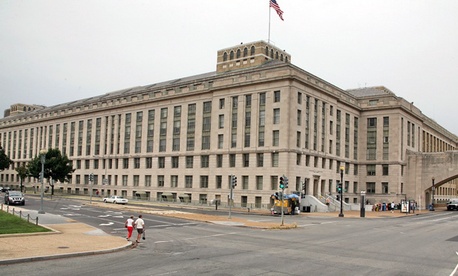
The photo is from a Government Executive piece on the House ag appropriations bill, which leads off:
The White House is challenging a move by House Republican appropriators to deny the Agriculture Department any funds in fiscal 2013 for repair and upkeep of its buildings.The South Building has been undergoing renovation over several years; not sure how far they've gotten. Some factoids about it: used to be the largest office building in the US (supposedly the world), see wikipedia; covers two blocks; the legend was the architect had just completed a prison for Michigan or somebody and he used those plans as the basis, may hold about 10,000 of USDA's employees.
It's "South" because the USDA Administration Building (AKA "the ivory tower" of Chet Adell) is on the north side of Independence Avenue. The picture is taken from the NE corner of the intersection of 12th St NW and Independence, with one of the two exits from the Metro's Smithsonian station in the recess just visible. Also visible is the disabled entrance required by ADA, as well as one of DC's food/souvenir trucks.
Minitel and Compuserve
The Times has a story on the impending demise in France of Minitel. Minitel was once the very popular French version of the Internet, or rather an intranet since it was all proprietary hardware and software. The French were way ahead of the rest of the world with computerization in the home. The U.S. had some experiments, which failed, one of which was by Time-Warner, but the French developed such a widespread platform even Norwegian bachelor farmers in Brittainy adopted it, using it to maintain the registrations of their cows, etc.
But since it was proprietary and not open, it's lost out in the competition with the Internet and PC's, lost out at least in the marketplace if not in the hearts of some of those aforesaid farmers.
Compare France with the U.S. Compuserve was an early networking outfit, but because we already had PC's penetrating the market it was software only; the hardware was PC's. Compuserve was eventually ousted and then bought by AOL, which reached for the stars in merging with Time-Warner, only to fail in competition with the open interface of Internet browsers. Sic transit gloria mundi.
But since it was proprietary and not open, it's lost out in the competition with the Internet and PC's, lost out at least in the marketplace if not in the hearts of some of those aforesaid farmers.
Compare France with the U.S. Compuserve was an early networking outfit, but because we already had PC's penetrating the market it was software only; the hardware was PC's. Compuserve was eventually ousted and then bought by AOL, which reached for the stars in merging with Time-Warner, only to fail in competition with the open interface of Internet browsers. Sic transit gloria mundi.
Shrewd Decision on ACA
The way I see Roberts decision is that it was Solomonic: he gave Obama what he wanted, the ability for ACA to go forward; he gave conservatives what they wanted, a limit on Congress's power to regulate interstate commerce; he gave Romney what he wanted, the ability to beat Obama up over his "raising taxes" without the necessity to come up with positive proposals to replace ACA.
Just my two cents.
[Updated: Ezra Klein agrees.]
Just my two cents.
[Updated: Ezra Klein agrees.]
Wednesday, June 27, 2012
Farm Bill in the House
I get the impression the House will likely oppose the conservation compliance requirement for crop insurance and the payment limitation, and since there's weak support on Senate Ag, if it goes to conference it will be out. I also get the impression the House may retain a bit more of the current structure (i.e. counter-cyclical programs, etc.) than did the Senate.
I'm always impressed by Farm Policy's completeness and Sustainable Agriculture's good analysis (even though I don't always agree with their policy positions, they seem to know their stuff).
I'm always impressed by Farm Policy's completeness and Sustainable Agriculture's good analysis (even though I don't always agree with their policy positions, they seem to know their stuff).
The Chobani Paradox
Stealing from the Wall Street Journal bia Keith Good, just because I'm interested in NY dairy (the background is the rise in popularity of "Greek style yogurt":
Another factor would be interstates: presumably Idaho yogurt can be economically shipped around the country, just as Wisconsin cheese can be. That's unlike whole milk, where getting it to New York City was the big hurdle, first solved by the railroads, then by trucks.
The Journal article noted that, “Meanwhile, the long-struggling dairy farmers of New York aren’t seeing their bottom line soar thanks to the Greek yogurt boom—and they aren’t adding to their herds to meet the demand.Much of upstate New York is hill and valley country. In the old days, your hay fields would be the valley and lower slopes, the pastures would be the steeper slopes. But farmers have discovered that cows waste energy walking to and from pasture, so that sort of dairying is less economical. If you can grow or buy corn, you can feed your cows all year round. I assume those are some of the facts behind NY's loss.
“So instead of expanding his plant here—in a region trying to reverse a trend of population and job loss—Mr. Ulukaya is building a factory in Idaho, in part because he can be sure of a steady supply of milk there. The New Berlin plant will remain open, but Mr. Ulukaya said he might have expanded it instead of opening another if he knew he could get enough milk.
“Milk production in states such as Idaho has surged in the past decade. Land is cheaper and dairy farms tend to be larger than in New York, making it easier for farmers to grow their herds. New York farmers say they are weighed down by property taxes and the high cost of land. Since their herds are smaller, expansion tends to be riskier.”
Another factor would be interstates: presumably Idaho yogurt can be economically shipped around the country, just as Wisconsin cheese can be. That's unlike whole milk, where getting it to New York City was the big hurdle, first solved by the railroads, then by trucks.
Tuesday, June 26, 2012
If It's Good for the Military, It's Good for ?
The White House is pushing the idea of making it easy for the military and their spouses to transfer licenses from one state to another. See this release touting the 23rd state to pass such measures.
This is laudable, but I don't see any reason to limit the scope to the military; make it work for everyone.
This is laudable, but I don't see any reason to limit the scope to the military; make it work for everyone.
MOOC's and Globalization
A "MOOC" is a massive open on-line course which has gained a lot of attention in recent days. One of the justifications for ousting the president of the University of Virginia was she wasn't moving fast enough to deal with such challenges. Somewhere in the newspapers today was a discussion of them, with the casual information that most enrollment in the biggest MOOC's came from outside the U.S. And Margaret Saletan, of University Diaries, has commented on the foreign students who signed up for her MOOC (a mini-MOOC on poetry).
I wonder about the impacts: if I'm a professor in Italy, or Kenya, or somewhere else and some of my students start to compare my course with the MOOC from Stanford, what happens? Do I raise my game? Do I try to outlaw such competition? Do I learn from the MOOC?
On a different subject, it's interesting the new President of Egypt has a Phd from SoCal.
I wonder about the impacts: if I'm a professor in Italy, or Kenya, or somewhere else and some of my students start to compare my course with the MOOC from Stanford, what happens? Do I raise my game? Do I try to outlaw such competition? Do I learn from the MOOC?
On a different subject, it's interesting the new President of Egypt has a Phd from SoCal.
Monday, June 25, 2012
Once Rural, Always Rural
And, a press release a while back from Sen. Jerry Moran
(R., Kan.) stated that, “Today, the U.S. Senate passed an amendment to
S. 3240, the Farm Bill, offered by [Sen. Moran] that will make certain
rural communities throughout Kansas remain eligible for U.S. Department
of Agriculture (USDA) Rural Development loan and grant programs. In the
absence of this amendment, nearly 1,000 rural communities across the
country would have become ineligible for USDA funds due to small
increases in population identified by the recent 2010 Census. USDA Rural
Development programs help provide affordable single and multi-family
housing, finance water and waste loans and grants, and support essential
community facilities like hospitals and schools.”
My interpretation: once you're "rural", you're always "rural". Increasing population would seem to say the RD programs are working, so when do you declare success and leave? (Granted, the fact Sen. Moran is a conservative is one reason for me to ding him for hypocrisy.)
My interpretation: once you're "rural", you're always "rural". Increasing population would seem to say the RD programs are working, so when do you declare success and leave? (Granted, the fact Sen. Moran is a conservative is one reason for me to ding him for hypocrisy.)
Commenting on Commenting
Sometimes I learn something new. Just the other day I realized I should be used "reply" to address comments, rather than just adding a comment. Why it took years to learn this, when I was well aware of it when I comment on others' blogs is a mystery.
Sunday, June 24, 2012
On the Faillibility of CBO Projections
"A major point of contention has been the crop insurance program, which cost about $7.3 billion last year, up from $951 million in 2000, or about $1.2 billion adjusted for inflation.”
Now I copied that from somewhere, but I've now had a senior moment and forgotten where--perhaps the NY Times story on the consideration of the farm bill.
Anyway, my point: I don't know how CBO scored the 2002 and 2008 farm bills, but I strongly suspect they didn't project $7.3 billion.
Got going and found this:
More specifically, when the 2008 farm bill was enacted, CBO estimated that the five-year cost
(FY2008-FY2012) for the major farm support programs—commodities, conservation, crop
insurance, renewable energy, and exports—would be $83.3 billion, or an average of $16.7 billion
per year. More current CBO projections, which include actual spending in FY2008 and FY2009
for these programs, show that spending for these programs is expected to total $86.7 billion (an
average of $17.3 billion per year), or $3.4 billion above the five-year 2008 CBO estimate. Most
of the difference between the 2008 estimate and more recent estimates, however, is attributable to
higher than expected crop insurance spending ($6.7 billion above estimates in 2008), [emphasis aqdded] which is offset by lower than expected spending for farm commodity and farm conservation programs.
My point: CBO is the best we've got, but their record isn't perfect. And decisions Congress makes based on the projections (which they often ignore) will also be imperfect.
Now I copied that from somewhere, but I've now had a senior moment and forgotten where--perhaps the NY Times story on the consideration of the farm bill.
Anyway, my point: I don't know how CBO scored the 2002 and 2008 farm bills, but I strongly suspect they didn't project $7.3 billion.
Got going and found this:
More specifically, when the 2008 farm bill was enacted, CBO estimated that the five-year cost
(FY2008-FY2012) for the major farm support programs—commodities, conservation, crop
insurance, renewable energy, and exports—would be $83.3 billion, or an average of $16.7 billion
per year. More current CBO projections, which include actual spending in FY2008 and FY2009
for these programs, show that spending for these programs is expected to total $86.7 billion (an
average of $17.3 billion per year), or $3.4 billion above the five-year 2008 CBO estimate. Most
of the difference between the 2008 estimate and more recent estimates, however, is attributable to
higher than expected crop insurance spending ($6.7 billion above estimates in 2008), [emphasis aqdded] which is offset by lower than expected spending for farm commodity and farm conservation programs.
My point: CBO is the best we've got, but their record isn't perfect. And decisions Congress makes based on the projections (which they often ignore) will also be imperfect.
Saturday, June 23, 2012
The "Nanny" State, Keeping Us Alive
Sarah Kliff at Ezra Klein's blog provides data from the New England Journal of Medicine on what we die of. (Around 1812 some of us exploded.) There's a chart summarizing the differences between 1900 (my parents were alive) and 2010 (I'm alive). I'm copying the graph:

I think the declines in many causes are attributable in part to "nanny" government, that government which ensures people, particularly in urban areas, have clean water and good sanitation, which oversees inoculations for things like diptheria and flu, which fights TB (which my mother had), (I understand some will argue against government intrusion. I remember when I got my TB vaccination in school, then my arm started to get swollen and painful. It was then I learned about mom's TB, which meant that my body reacted to the shot. There are gains to government intrusion, as there are costs, but I'm more impressed by the gains, at least in the field of public health.)
You really ought to read the Journal article in its entirety. Who knew that in 1912 they were worried about sedentary life caused by the automobile, or boasting of the superiority of Americans at the Olympics because of the diversity of our races? It's fascinating how other strands of our history appear in the annals of medicine.

I think the declines in many causes are attributable in part to "nanny" government, that government which ensures people, particularly in urban areas, have clean water and good sanitation, which oversees inoculations for things like diptheria and flu, which fights TB (which my mother had), (I understand some will argue against government intrusion. I remember when I got my TB vaccination in school, then my arm started to get swollen and painful. It was then I learned about mom's TB, which meant that my body reacted to the shot. There are gains to government intrusion, as there are costs, but I'm more impressed by the gains, at least in the field of public health.)
You really ought to read the Journal article in its entirety. Who knew that in 1912 they were worried about sedentary life caused by the automobile, or boasting of the superiority of Americans at the Olympics because of the diversity of our races? It's fascinating how other strands of our history appear in the annals of medicine.
Friday, June 22, 2012
Farming: Capital Requirements Keep Growing
Seems to me a story which the news media never covers is the continual increase in the capital needed to farm successfully. I go back to roughly 1950, when dad bought a John Deere tractor (model M, I think) and sold the team of horses. Turned out it meant investing in a new suite of machinery to make it work. If the farm was marginal before, with the increased capital requirement it was even more shaky. When you were talking making a living on the farm in that time frame, it was "go big or go under."
All that was triggered by reading this report from Illinois on the increase in the value of machinery from 2000 to 2010. Though the study is interested in the curves, and the cost per acre curve is interesting (i.e. big acreage is more cost efficient), I'm most struck by the absolute dollar figures, from the mid 6 digits up. Oh, machinery prices also increased.
All that was triggered by reading this report from Illinois on the increase in the value of machinery from 2000 to 2010. Though the study is interested in the curves, and the cost per acre curve is interesting (i.e. big acreage is more cost efficient), I'm most struck by the absolute dollar figures, from the mid 6 digits up. Oh, machinery prices also increased.
The Holier Than Thou Organics
Research summary:"These results suggest that exposure to organic foods may lead people to affirm their moral identities,
which attenuates their desire to be altruistic."
Thursday, June 21, 2012
EPA and Aerial Observation
From Farm Policy this morning:
I'm just waiting for these efforts, or a renewed court challenge based on the Bill of Rights, to spill over on FSA's aerial photography
"And, Pete Kasperowicz reported yesterday at The Hill’s Floor Action Blog that, “Rep. Shelley Moore Capito and 10 other House Republicans want to prevent the EPA from conducting air surveillance of farms.And this report on the farm bill passing the Senate this afternoon reports:
“Rep. Shelley Moore Capito (R-W.Va.) and 11 other House members introduced a bill Tuesday that would prevent the Environmental Protection Agency (EPA) from conducting aerial drone surveillance of farms to enforce the Clean Water Act, or using any other overhead surveillance.”
On a 56-43 vote, Sen. Mike Johanns (R-Neb.) came surprisingly close to winning a flat ban on the Environmental Protection Agency to conduct any aerial surveillance to inspect or record images of agricultural operations
Read more: http://www.politico.com/news/stories/0612/77703.html#ixzz1ySpSETnZ
I'm just waiting for these efforts, or a renewed court challenge based on the Bill of Rights, to spill over on FSA's aerial photography
EWG Loses One
An issue I personally think EWG should have won on: I believe in transparency. But here's the Washington Post editorial on the farm bill:
But if there’s anything the farm lobby dislikes more than losing its subsidies, it’s letting the public follow its money. Senate leaders barred consideration of the Begich-McCain amendment, which means there won’t even be a floor debate on increasing transparency in farm programs over the next five years. It’s not an auspicious start.
Pay Limit on Insurance/Conservation Compliance
From Chris Clayton:
The U.S. Senate voted Wednesday evening to reduce the taxpayer share of crop insurance premium subsidies for the largest farmers.Along with that, farmers would not be able to ignore conservation compliance requirements if they forego commodity programs and rely strictly on crop insurance for their safety net.
[Updated: Carl Zulauf of Ohio State has a discussion of the history of payment limits and the crop insurance proposals here.]
Wednesday, June 20, 2012
House Appropriations Bill
Here's the text, if anyone is interested.
This seems to be the headline item for FSA:
This seems to be the headline item for FSA:
Rep. Flake – The amendment prohibits funding to provide farm program benefits to individuals or entities with adjusted gross incomes of more than $250,000. The amendment was adopted on voice vote.I searched the test for "adjusted gross" and didn't find it, too lazy to do more.
Pearlie Reed in Government Executive
Here's their report on his retirement, a bit fuller than others but not much new.
Tuesday, June 19, 2012
WaPo on Reed
Al Kamen in the Washington Post noted the Pearlie Reed retirement today (it comes at the end of his column). Two excerpts:
The announcement’s timing was a bit curious, since it came five days after Reed actually retired, and two weeks after an inspector general’s report dinged an office under Reed’s jurisdiction for improperly handing out grants — though a department spokesman denied any connection between the IG report and Reed’s departure.
....
This marks the second retirement for Reed, a well-respected old hand who first came to the Agriculture Department as a college student. Reed retired in 2002 as chief of the Natural Resources Conservation Service but rejoined the USDA in 2009 to focus on civil rights issues inside and outside the agency.
http://www.washingtonpost.com/politics/incoming-winners-of-the-missile-contest/2012/06/18/gJQAzGERmV_story.html
The announcement’s timing was a bit curious, since it came five days after Reed actually retired, and two weeks after an inspector general’s report dinged an office under Reed’s jurisdiction for improperly handing out grants — though a department spokesman denied any connection between the IG report and Reed’s departure.
....
This marks the second retirement for Reed, a well-respected old hand who first came to the Agriculture Department as a college student. Reed retired in 2002 as chief of the Natural Resources Conservation Service but rejoined the USDA in 2009 to focus on civil rights issues inside and outside the agency.
http://www.washingtonpost.com/politics/incoming-winners-of-the-missile-contest/2012/06/18/gJQAzGERmV_story.html
Timeless Advice from the Government
I know some people who would say this advice on food is as good today as in 1918 (a WWI poster).
MIDAS Update and Implications
The "Midas Press blog" was posted about 3 weeks ago--just catching up to it. Posts on several different subjects. I note with some regret SCIMS is being replaced. The march of progress kills old attachments. This has been true since the beginning of time.
Interesting discussion of how GIS will finally drive farm records and reconstitutions here, including a comment on implications:
The second sentence of the quote also raises issues: what sort of training and implementation sequence will be possible?
I like the idea of a MIDAS blog--I wonder if it's been publicized, certainly not to the public.
Interesting discussion of how GIS will finally drive farm records and reconstitutions here, including a comment on implications:
For a typical county FSA office, this integration means that there will no longer be separate individuals handling GIS, Farm Records, and reconstitutions. To move forward with the new system, there will need to be a greater understanding of these processes and how each one affects the other.One of the things which bothered me back in the Infoshare days: selling the Infoshare plans meant claiming big savings in order to justify the procurement of hardware and software. But the reality was that big savings could only come by reduced employment, which should have raised all sorts of issues, none of which were being addressed at that time. I guess over the 20 years since Infoshare employment has been reduced.
The second sentence of the quote also raises issues: what sort of training and implementation sequence will be possible?
I like the idea of a MIDAS blog--I wonder if it's been publicized, certainly not to the public.
Monday, June 18, 2012
An Evolution in County Committees
The original AAA county committees in the 1930's were specialized by crop and function. They were a means to tap local knowledge of yields and production histories. They fit into the general left perspective of pushing local democracy. They also had the advantage of involved local community leaders in the program, securing their support for it, and in many cases for the Democrats who created the AAA. (Roughly speaking, the committees are elected by farmers in the county.)
Over the years the role of the committees has changed, their functions have diminished, the supervision from Washington has increased. People, both auditors and others, pay more and more attention to how the bureaucracy operates and whether there's consistency from place to place. And local option as represented in the committees makes consistency very hard to achieve. Technology makes it much easier for Washington to provide detailed direction, reducing the autonomy of the committees. Perhaps the biggest force in these changes has been the civil rights revolution. That seems to start in the 50's and 60's, but in fact a couple years after the AAA of 1933 was passed there were protests over the (mis)treatment of sharecroppers by some of the committees.
The latest step in this evolution is Sec. Vilsack's announcement that he'll appoint voting members to committees who are representatives of "disadvantaged communities". He was given this authority in the 2002 farm legislation, or rather Sec. Venneman was, and there's no explanation for the 10-year delay in using it. (There had long been provision for non-voting members on the committees.)
It's sort of ironic in the broad view: to the extent the civil rights movement worked to reduce the power of the committees, they have reduced the potential gains from having voting representatives
on the committees.
Over the years the role of the committees has changed, their functions have diminished, the supervision from Washington has increased. People, both auditors and others, pay more and more attention to how the bureaucracy operates and whether there's consistency from place to place. And local option as represented in the committees makes consistency very hard to achieve. Technology makes it much easier for Washington to provide detailed direction, reducing the autonomy of the committees. Perhaps the biggest force in these changes has been the civil rights revolution. That seems to start in the 50's and 60's, but in fact a couple years after the AAA of 1933 was passed there were protests over the (mis)treatment of sharecroppers by some of the committees.
The latest step in this evolution is Sec. Vilsack's announcement that he'll appoint voting members to committees who are representatives of "disadvantaged communities". He was given this authority in the 2002 farm legislation, or rather Sec. Venneman was, and there's no explanation for the 10-year delay in using it. (There had long been provision for non-voting members on the committees.)
It's sort of ironic in the broad view: to the extent the civil rights movement worked to reduce the power of the committees, they have reduced the potential gains from having voting representatives
on the committees.
The Terrorists in the Revolution
Who knew the Massachusetts militia at the battle of Bunker Hill poisoned their bullets?
Sunday, June 17, 2012
USDA/FSA Prizes for Innovation
A number of economists like the idea of prizes and competitions for innovation. They have a long history: if memory serves, Charles Lindbergh's flight was to win a competition for the first solo crossing of the Atlantic. They've been used more recently, as in Netflix's competition to improve their algorithm for suggesting DVD's one might like. I believe the Obama administration has used them, though at the moment I can't remember a specific instance. All of which leads to this question:
Is there a prize/competition USDA/FSA could sponsor that would be worthwhile? (It's brought to mind by a factoid I believe I ran across: crop insurance agents get $900 or $1000 for each policy they administer.)
Is there a prize/competition USDA/FSA could sponsor that would be worthwhile? (It's brought to mind by a factoid I believe I ran across: crop insurance agents get $900 or $1000 for each policy they administer.)
Saturday, June 16, 2012
Pearlie Reed Resigns
Government Executive piece on his resignation for "personal reasons", though the piece notes an audit of the grant management process in the Office of Advocacy and Outreach. (Washington bureaucrats are often cynical about such coincidences.) Supposedly there's no connection and Vilsack was supportive. However, the audit found procedures weren't followed and stated:
The audit is critical of the "approving official"in OAO, but I'm not clear who it was. It mentions: "The official also solicited input from the Office of the Assistant Secretary for Administration and the Office of Tribal Relations."
Mr. Reed is still listed on the USDA biographies page as Assistant Secretary for Administration, but the link to his bio is dead. An out-of-date bio is still available by searching: link There's no press release noted on the USDA site.
I'm sure our Republican friends will be all over this.
In summary, we are recommending that OAO not award grants to the 57 applicants at this time. We maintain that an independent review panel should reevaluate the applications to ensure that the most deserving applicants will be awarded grants. Due to the sensitivity of this issue and the timing of the proposed awards, we are providing our preliminary results to you for immediate corrective action. This issue, along with any others identified during our fieldwork, will be consolidated into a final report at the conclusion of our audit.OIG was requested to do the audit in April, so there must have been some backstory to this. Reed signed the response to OIG, essentially agreeing with it. In defense of the head of OAO he notes she was new and is identifying weaknesses in the office. Of course there's a long history of GAO/OIG reports critical of the Departmental administration in this area. Since Reed has been the big boss for 3 years, it's perhaps fair to ask what previous corrective actions he had taken.
The audit is critical of the "approving official"in OAO, but I'm not clear who it was. It mentions: "The official also solicited input from the Office of the Assistant Secretary for Administration and the Office of Tribal Relations."
Mr. Reed is still listed on the USDA biographies page as Assistant Secretary for Administration, but the link to his bio is dead. An out-of-date bio is still available by searching: link There's no press release noted on the USDA site.
I'm sure our Republican friends will be all over this.
Friday, June 15, 2012
Catnip Topics: PC Hardware
There are some topics on popular blogs which the readers will react to as cats react to catnip. It's not a pretty sight. One such topic is advice on PC hardware--Kevin Drum asked for comment on a report that some Mac user replaced the computer hard drive 3 times in 2.5 years.
His commentators rose to the topic, notably competing for the title of whose first computer was the oldest and smallest. Not sure why, though it's probably the same logic why us geezers talk about how hard our life was compared to today.
His commentators rose to the topic, notably competing for the title of whose first computer was the oldest and smallest. Not sure why, though it's probably the same logic why us geezers talk about how hard our life was compared to today.
Sauce for the Johanns Goose, But Not the Dems Gander?
"What I worry about is we’re going to get to a point, Mike, where
senators are going to say, ‘Look, I can’t support moving a bill forward
that I can’t get a vote on my amendment.’”
That's Sen. Johanns of Nebraska commenting on the prospects for the farm bill in Farm Policy
My point: Johanns is worrying about people taking a "my way or the highway" approach on the farm bill, but it seems to me the Reps have fairly often taken that approach.
That's Sen. Johanns of Nebraska commenting on the prospects for the farm bill in Farm Policy
My point: Johanns is worrying about people taking a "my way or the highway" approach on the farm bill, but it seems to me the Reps have fairly often taken that approach.
Thursday, June 14, 2012
South Pacific and a Cock-Eyed Optimist
Wife and I saw a revival of South Pacific the other week. One of the early songs is "Cockeyed Optimist". That's all I could think of when I read about this dewy-faced dairy farmer proposing, in the barn.
Good luck to them.
Good luck to them.
Gardens, Slaves, and Pigford
The NY Times has a long article about slaves, African-Americans, gardens, and vegetables.
I read it with interest, because I've toyed with the idea of writing on a similar subject, tied to the Pigford case. A couple of points:
I read it with interest, because I've toyed with the idea of writing on a similar subject, tied to the Pigford case. A couple of points:
- some African-Americans run away from the land because farming means toil and drudgery (a sentiment which I share)
- heir property, as in the following:
"Perhaps Malva will feel inspired to water the garden next week, when Diana goes to Philadelphia for the annual slavery reparations conference. Along the way, she’ll also stop in Baltimore to ask her uncle to sign legal papers that would give her power of attorney to manage the land.
The farm, she explained, is heir property: it belongs to 19 relatives, across the nation. And almost nothing can get done without their written consent. This is a common dilemma on African-American farms, explained Dr. Bandele, who started his career with the Emergency Land Fund, a black farm and property preservation group.One cousin neglects to pay his share of the property tax; in protest, another cousin refuses to pay. Ultimately, Dr. Bandele said, the property ends up in a forfeiture auction. Another black farm is lost."
Wednesday, June 13, 2012
Google Employs Bureaucrats
That's the theme of this Times piece. Of course it's true, in any organization you do what you can and you don't do what others are hopefully doing. It's called "division of labor", as Adam Smith dubbed it. The bigger the organization, the more likely that leads to things falling through the cracks.
What We Used to Look Like
Here's a post by James Fallows with a photo from the 1940's showing what US children used to look like, or at least what we wanted to think they looked like (i.e., WASPs). We watched Oliver Stone's "Born on the Fourth of July" Monday and the parade in Massapequa, NY and the scenes of the high school prom reminded me of this. (What did I think of the movie: I think it stood up pretty well over the years, though Stone has something about him, maybe a bit of romanticism, with which I'm uncomfortable.)
The U.S. has changed.
The U.S. has changed.
Tuesday, June 12, 2012
Popcorn, Seed Corn, and Fading Memory
Politico today carries a long piece about Senator McCain's opposition to a provision in the farm bill relative to popcorn. (Haven't checked but it sounds as if it makes popcorn producers eligible for corn crop insurance.) The article treats the provision as an example of an organization getting the legislation written to favor them.
Back in the day, if I remember, which I don't really, seed corn and popcorn were controversial in the context of the target price programs of the early 80's. Both were produced under contract, which meant the growers didn't really face price risk, which was what the program was supposed to be about. They also had their own niche market, pretty much independent of the field corn market, so efforts to adjust the production of field corn were irrelevant to popcorn and seed corn. They did, however, have an argument that the stalks could be used for silage.
Over the years I believe both the seed corn people and the popcorn people got language inserted into the law forcing ASCS/FSA to treat them on the same basis as field corn. If my memory is right, that means the only thing new is that today the lobbyists are forcing RMA/FCIC to treat them on the same basis.
The logic of the efforts is clear: a group of people who feel relatively strongly about an issue, no organized opposition because groups representing the taxpayers don't understand the issue, no leadership from the Executive because it's such a small issue, a bureaucracy which understands the issue but which works for Congress and is professionally inhibited from voicing opposition, and a legislator who can insert the relevant provision and mouth the words the lobbyist puts in their mouth.
Where's the tea party?
Back in the day, if I remember, which I don't really, seed corn and popcorn were controversial in the context of the target price programs of the early 80's. Both were produced under contract, which meant the growers didn't really face price risk, which was what the program was supposed to be about. They also had their own niche market, pretty much independent of the field corn market, so efforts to adjust the production of field corn were irrelevant to popcorn and seed corn. They did, however, have an argument that the stalks could be used for silage.
Over the years I believe both the seed corn people and the popcorn people got language inserted into the law forcing ASCS/FSA to treat them on the same basis as field corn. If my memory is right, that means the only thing new is that today the lobbyists are forcing RMA/FCIC to treat them on the same basis.
The logic of the efforts is clear: a group of people who feel relatively strongly about an issue, no organized opposition because groups representing the taxpayers don't understand the issue, no leadership from the Executive because it's such a small issue, a bureaucracy which understands the issue but which works for Congress and is professionally inhibited from voicing opposition, and a legislator who can insert the relevant provision and mouth the words the lobbyist puts in their mouth.
Where's the tea party?
Farm Labor: Half Illegal?
A paragraph from today's Farm Policy:
"And an update yesterday at the Economic Research Service Charts of Note webpage (USDA) stated that, “Over the past 15 years, roughly half of the hired laborers employed in U.S. crop agriculture have lacked the immigration status needed to work legally in the United States. Large shifts in the supply of foreign-born farm labor, such as those that might result from substantial changes to U.S. immigration laws or policies, could have significant effects on production costs in U.S. agriculture. Hired labor (including contract labor) accounted for about 17 percent of the sector’s variable production expenses and even higher proportions in more labor-intensive sectors, such as vegetables (35 percent), nursery products (46 percent), and fruits (48 percent), according to 2006-10 Agricultural Resource Management Survey (ARMS) data. This chart is found in The Potential Impact of Changes in Immigration Policy on U.S. Agriculture and the Market for Hired Farm Labor: A Simulation Analysis, ERR-135, May 2012.”
"And an update yesterday at the Economic Research Service Charts of Note webpage (USDA) stated that, “Over the past 15 years, roughly half of the hired laborers employed in U.S. crop agriculture have lacked the immigration status needed to work legally in the United States. Large shifts in the supply of foreign-born farm labor, such as those that might result from substantial changes to U.S. immigration laws or policies, could have significant effects on production costs in U.S. agriculture. Hired labor (including contract labor) accounted for about 17 percent of the sector’s variable production expenses and even higher proportions in more labor-intensive sectors, such as vegetables (35 percent), nursery products (46 percent), and fruits (48 percent), according to 2006-10 Agricultural Resource Management Survey (ARMS) data. This chart is found in The Potential Impact of Changes in Immigration Policy on U.S. Agriculture and the Market for Hired Farm Labor: A Simulation Analysis, ERR-135, May 2012.”
Monday, June 11, 2012
US the Free Trader
Sometimes we think the US uses tariffs on agricultural products unfairly. Here's a comparison worldwide.
Smith in NYTimes, and the Rest of the Story
Excerpt from Farm Policy:
The Times identified Dallas with his old USDA position but surprisingly didn't note his current position. Here's Linkedin:
Dallas Smith, a former USDA deputy under secretary for farm and foreign agricultural services, noted in a letter to the editor in Saturday’s New York Times that, “‘Where the Trough Is Overflowing’ (Deconstruction, editorial page, June 3) does a disservice to both America’s farmers, who feed an increasingly hungry world, and crop insurance, their primary risk management tool.
“There is one reason crop insurance has become the risk management tool of choice for most farmers and political leaders from both sides of the aisle: it works.”
The Times identified Dallas with his old USDA position but surprisingly didn't note his current position. Here's Linkedin:
Owner
Dallas R. Smith and Associates, Inc
Currently holds this position
Special Consultant
National Crop Insurance Services
1999
– Present
(13 years)
Deputy Under Secretary, Farm and Foreign Agricultural Services
United States Department of Agriculture
Government Agency; 10,001+ employees;
Government Administration industry
July 1965
– January 1999 (33 years 7 months)
I was a Senior Executive with USDA from 1985 to 1999. Before that I
worked as a County Extension Agent in NC, Cotton Marketing Specialist,
Peanut Branch Chief, Deputy Director and Director of a Division within
USDA in Washington DC. I also served as a Consultant to the White House
on tobacco issues and provide leadership to the Agriculture Committee
of the Gore-Mbekia Commission with South Africa. Prior to retirement I
received the Presidential Rank Award of Distinguished Executive.
Sunday, June 10, 2012
"Our Animal Natures"
Very interesting long piece in the NYTimes today with that title. The co-authors, a cardiologist and a writer, look at the diseases which animals get, which (human) animals get. (They repeat a joke among vets: "What do you call a physician? A veterinarian who treats only one species.)
The whole piece is amazing, though obvious, or maybe amazing because obvious, at least once you think about it. Another reminder of how easy it is for us to fall into tribalism, in this case dividing ourselves from the rest of the animal kingdom.
The whole piece is amazing, though obvious, or maybe amazing because obvious, at least once you think about it. Another reminder of how easy it is for us to fall into tribalism, in this case dividing ourselves from the rest of the animal kingdom.
Saturday, June 09, 2012
You Can Lead a Child to the Soil, You Can't Make Her Garden
That encapsulates a lesson Mrs. Obama has learned:
Neither Sasha nor Malia appear in photos in the book; they don't like to garden, Mrs. Obama has said during recent interviews.
Friday, June 08, 2012
PicturePHones and Video Teleconferncing
As it happens, I just finished a book on Bell Labs (The Idea Factory) when I saw this IRM notice on FSA video teleconferencing. (Bell Labs gave us the transistor, fiber optics, communications satellites, cell phones, and information theory, among many other things.)
As almost everything does these days, the conjunction called up memories. Bell Labs came up with the Picturephone in the 60''s, demoed it at the NY World Fair, and released it in a couple of cities. Though user reaction was favorable at the fair, it fell flat as a consumer product. The problem was the cost was too high for a communications device where both parties needed the device to communicate.
The book, which I recommend, compared the Picturephone and the cell phone. The cell phone was also bulky and costly at the beginning, but its big advantage was you could call anyone who had a regular phone or a cell phone with it; it linked you with the existing network and didn't require building a new network.
In the 1980's ASCS tried out a new version of the picturephone (not from AT&T): IRMD got 4-6 devices and I got one to communicate with KCMO. Again it was a flop--it appealed to the techies but it didn't do much .
A bit later IRMD set up a teleconference center to communicate with KCMO. We used it for a few teleconferences between programmers and program people, but it required a lot of scheduling and coordination. We didn't have enough business with KCMO that required the attendance of a lot of people, particularly as we made more use of email. And the value-added of seeing people talk was small. Our use tailed off to nothing. I don't know how long IRMD kept it going.
So I've considerable curiosity about the new system in FSA. The notice indicates it's popular and getting a workout, which is good, but it also sounds complicated which is bad. It sounds as if it's more capable than something like Skype or similar cheap apps. On the other hand if I were forced to bet, I'd say FSA probably never did a lot of training on things like Skype. Am I wrong? It sounds as if it's a dedicated system, separate from the regular communication network, which is a minus. If people have to share, they often don't.
I think I commented a while back about the ancillary benefits of conferences/face-to-face meetings (in the context of the uproar over GSA). The recent bio of Steve Jobs said he was careful to design Apple offices so as to throw people together. The Bell Labs book says AT&T did the same. Of course, that's workplace design, not travel conferences, but the principle is the same: people learn from each other and they often learn the most from people they don't work with on a daily basis.
To come back to Claude Shannon and information theory: his measure of "information" says the more redundancy in a message, the less information is conveyed. Most of our daily business is redundant; we do similar things over and over so we don't gain much information and we don't learn. That's why failure is so good: the first time you try something everything is new, little is redundant, there's lots of learning and lots of information. That's also why some meetings are good (though not the weekly staff meetings with which I used to bore my employees) provided they introduce new people, new subjects, or new surroundings.
As almost everything does these days, the conjunction called up memories. Bell Labs came up with the Picturephone in the 60''s, demoed it at the NY World Fair, and released it in a couple of cities. Though user reaction was favorable at the fair, it fell flat as a consumer product. The problem was the cost was too high for a communications device where both parties needed the device to communicate.
The book, which I recommend, compared the Picturephone and the cell phone. The cell phone was also bulky and costly at the beginning, but its big advantage was you could call anyone who had a regular phone or a cell phone with it; it linked you with the existing network and didn't require building a new network.
In the 1980's ASCS tried out a new version of the picturephone (not from AT&T): IRMD got 4-6 devices and I got one to communicate with KCMO. Again it was a flop--it appealed to the techies but it didn't do much .
A bit later IRMD set up a teleconference center to communicate with KCMO. We used it for a few teleconferences between programmers and program people, but it required a lot of scheduling and coordination. We didn't have enough business with KCMO that required the attendance of a lot of people, particularly as we made more use of email. And the value-added of seeing people talk was small. Our use tailed off to nothing. I don't know how long IRMD kept it going.
So I've considerable curiosity about the new system in FSA. The notice indicates it's popular and getting a workout, which is good, but it also sounds complicated which is bad. It sounds as if it's more capable than something like Skype or similar cheap apps. On the other hand if I were forced to bet, I'd say FSA probably never did a lot of training on things like Skype. Am I wrong? It sounds as if it's a dedicated system, separate from the regular communication network, which is a minus. If people have to share, they often don't.
I think I commented a while back about the ancillary benefits of conferences/face-to-face meetings (in the context of the uproar over GSA). The recent bio of Steve Jobs said he was careful to design Apple offices so as to throw people together. The Bell Labs book says AT&T did the same. Of course, that's workplace design, not travel conferences, but the principle is the same: people learn from each other and they often learn the most from people they don't work with on a daily basis.
To come back to Claude Shannon and information theory: his measure of "information" says the more redundancy in a message, the less information is conveyed. Most of our daily business is redundant; we do similar things over and over so we don't gain much information and we don't learn. That's why failure is so good: the first time you try something everything is new, little is redundant, there's lots of learning and lots of information. That's also why some meetings are good (though not the weekly staff meetings with which I used to bore my employees) provided they introduce new people, new subjects, or new surroundings.
Subscribe to:
Posts (Atom)