Interesting post by Stu Ellis at Farmgate on causes for food prices to increase.
I wonder--discussions of global food supply always pay attention to numbers of people, with some attention to the demand for better food when incomes increase. I wonder whether anyone has quantified the global human body-mass over time. I see the Latino construction workers laying the FIOS cable in my neighborhood and they're pretty uniformly small. (That's perhaps balanced out by how hard they work.) The Chinese in the 1970's were uniformly small, now they've got Yao Ming et. al. Diets make all the difference and allow differences in genetic endowments to be expressed.
Surely since WWII the average size of humans has increased significantly. If I remember, Gregory Clark's Farewell to Alms had some interesting data both on calories available to Westerners over the last 2-300 years and average height, but I don't think he had anything on waistline. Nor do I know how the reduction in physical labor and the increase in calories over the last 70 years fit together. Presumably the bigger the body, the more calories required to do x amount of work. So on a global basis, the per capita work has probably declined, and the per capita body has probably increased. Is it 6 of one, half dozen of the other? Inquiring minds want to know.
Monday, May 12, 2008


Whither Oil and the Dollar?
In the first place, if I knew I wouldn't be wasting my time blogging; I'd be relaxing at the English Country Home my wife wants which I could have bought from my profits.
But I've been skeptical that the current boom in farm crop prices can continue, remembering the lessons of the 1970's.
On the other hand, Kevin Drum (and Paul Krugman) think oil is permanently high. Kevin notes that the government bureaucrats have been predicting oil is at a peak for months. (I thought it'd peaked at $50.) And oil and food are linked, because both are traded in dollars. (And oil is a key input to food production.)
It seems every day you get different messages. Today I saw a post which agrees with my position (i.e., that now is most like the mid-70's) but unfortunately I didn't capture it, so you'll have to take my word for it. The common element of now and the 70's is the devaluation of the dollar--Nixon took the U.S. off the gold standard in 1971, I think it was, which made our grain cheap and the world took advantage. This decade the dollar has again gotten dramatically weaker. But here's the ERS study on the rising costs. The author doesn't totally agree with me, but close enough for government work.
(One factor not given much attention in the media is that we've had 2 years in a row of a global food production declines (i.e., bad weather):
But I've been skeptical that the current boom in farm crop prices can continue, remembering the lessons of the 1970's.
On the other hand, Kevin Drum (and Paul Krugman) think oil is permanently high. Kevin notes that the government bureaucrats have been predicting oil is at a peak for months. (I thought it'd peaked at $50.) And oil and food are linked, because both are traded in dollars. (And oil is a key input to food production.)
It seems every day you get different messages. Today I saw a post which agrees with my position (i.e., that now is most like the mid-70's) but unfortunately I didn't capture it, so you'll have to take my word for it. The common element of now and the 70's is the devaluation of the dollar--Nixon took the U.S. off the gold standard in 1971, I think it was, which made our grain cheap and the world took advantage. This decade the dollar has again gotten dramatically weaker. But here's the ERS study on the rising costs. The author doesn't totally agree with me, but close enough for government work.
(One factor not given much attention in the media is that we've had 2 years in a row of a global food production declines (i.e., bad weather):
"The result of adverse weather in 2007 was a second consecutive drop inBottom line, I'm still stubbornly holding to a prediction--oil prices and farm prices will both drop by at least 50 percent from current levels over the next years.
global average yields for grains and oilseeds. In historical perspective, two
sequential years of lower global yields occurred only three other times in the
last 37 years."
Sunday, May 11, 2008
Funniest Lines Today
Is from a NYTimes article on a possible defect in hip replacement parts made of ceramic--some users are reporting squeaks when they move:
"'“It can interrupt sex when my wife starts laughing,” said one man, who discussed the matter on the condition that he not be named.'"
Saturday, May 10, 2008
A Law Requiring Local Food
A famous (I guess, I never heard of him, but I trust the BBC) British chef says so:
Celebrity chef Gordon Ramsay says British restaurants should be fined if they serve fruit and vegetables which are not in season. He told the BBC that fruit and vegetables should be locally-sourced and only on menus when in season. Mr Ramsay said he had already spoken to Prime Minister Gordon Brown about outlawing out-of-season produce.This is called: "pass the ammunition" to your opponents. Via Ann Althouse.
A Presidential Veto of Farm Bill?
That's the promise from the Secretary of Agriculture Schafer and the topic of discussion on the various blogs here and here and here
Now in 1956 President Eisenhower vetoed a farm bill because it provided for high rigid price supports. (The report of the veto wasn't accessible, but the link has Sen. Knowland threatening the veto, which actually happened.) In 1973 Nixon threatened one, and Ford did veto in 1975 (an emergency increase in target prices and supports--he eventually acted administratively in 1976 after firing Earl Butz and seeing defeat looming in the elections). And way back in 1927 Silent Cal vetoed McNary-Haugen. The NY Times archive site is having problems this morning, but the results of the query "farm bill veto" is here.
The process is similar each time--a coalition in Congress (easier to assemble back in the 1920' s when we had more farmers) gets behind legislation to benefit farmers, they go a bridge too far, and the President slaps them down. Of course, often the President threatens a veto but doesn't carry through--I wonder if a political scientist has done a study of that. It's part of the pull and haul of democratic politics.
Now in 1956 President Eisenhower vetoed a farm bill because it provided for high rigid price supports. (The report of the veto wasn't accessible, but the link has Sen. Knowland threatening the veto, which actually happened.) In 1973 Nixon threatened one, and Ford did veto in 1975 (an emergency increase in target prices and supports--he eventually acted administratively in 1976 after firing Earl Butz and seeing defeat looming in the elections). And way back in 1927 Silent Cal vetoed McNary-Haugen. The NY Times archive site is having problems this morning, but the results of the query "farm bill veto" is here.
The process is similar each time--a coalition in Congress (easier to assemble back in the 1920' s when we had more farmers) gets behind legislation to benefit farmers, they go a bridge too far, and the President slaps them down. Of course, often the President threatens a veto but doesn't carry through--I wonder if a political scientist has done a study of that. It's part of the pull and haul of democratic politics.
Friday, May 09, 2008
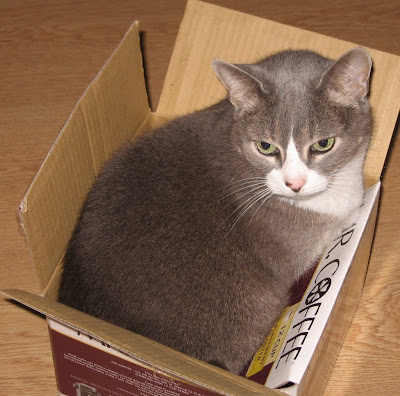
Initial Friday Cat Blogging
The first time I've added a photo to my blog. (Takes us old people time to get caught up with new-fangled ideas. Coffee is vital to me so I wear out coffee carafes. Carrie decided the box the latest one came in was just the right size for her:
How Slowly We (Govt) Adapt to Change
From the GAO on e-mail and official records (my comments in italics):
E-mail, because of its nature, presents challenges to records management.My comments, and perhaps the emotion, date from some years associated with records management. Records management was part of the rationalization of business (see Alfred Chandler's writings)--creating, processing and filing information. But it rests on the economic fact it was costly to generate a memo (or equivalent piece of paper). You had to have a specialized individual (called a clerk-typist or secretary). She (or sometimes he) had to be able to handle multiple carbon copies for the multiple files, including something called the "official record". The piece of paper had to be routed through levels of bureaucracy until it got to an approving official. Once signed, the copies would be distributed appropriately. But all that's so 20th century.Preliminary results of GAO's ongoing review of e-mail records management at four agencies show that not all are meeting the challenges posed by e-mail records. Although the four agencies' e-mail records management policies addressed, with a few exceptions, the regulatory requirements, these requirements were not always met for the senior officials whose e-mail practices were reviewed. Each of the four agencies generally followed a print and file process to preserve e-mail records in paper-based recordkeeping systems, but for about half of the senior officials, e-mail records were not being appropriately identified and preserved in such systems. Print and file makes no sense--electronic is cheaper
- First, the information contained in e-mail records is not uniform: it may concern any subject or function and document various types of transactions. As a result, in many cases, decisions on which e-mail messages are records must be made individually. Why make decisions at all?
- Second, the transmission data associated with an e-mail record--including information about the senders and receivers of messages, the date and time the message was sent, and any attachments to the messages--may be crucial to understanding the context of the record. So keep the whole thing.
- Third, a given message may be part of an exchange of messages between two or more people within or outside an agency, or even of a string (sometimes branching) of many messages sent and received on a given topic. In such cases, agency staff need to decide which message or messages should be considered records and who is responsible for storing them in a recordkeeping system. Again, why decide anything--keep the whole sequence.
- Finally, the large number of federal e-mail users and high volume of e-mails increase the management challenge.
Instead, e-mail messages were being retained in e-mail systems that lacked recordkeeping capabilities. (Among other things, a recordkeeping system allows related records to be grouped into classifications according to their business purposes.) Unless they have recordkeeping capabilities, e-mail systems may not permit easy and timely retrieval of groupings of related records or individual records. Gee--I think being able to do a Google search on a body of text is a whole lot better than relying on poorly paid clerks to perform groupings according to a subject scheme that is likely 20 years out of date.
Further, keeping large numbers of record and nonrecord messages in e-mail systems potentially increases the time and effort needed to search for information in response to a business need or an outside inquiry, such as a Freedom of Information Act request. Factors contributing to this practice were the lack of adequate staff support and the volume of e-mail received. In addition, agencies had not ensured that officials and their responsible staff received training in recordkeeping requirements for e-mail. If recordkeeping requirements are not followed, agencies cannot be assured that records, including information essential to protecting the rights of individuals and the federal government, is being adequately identified and preserved.
Food Expenditures
John Phipps links to the NYTimes graphic on living expenses (which I'd read on paper, but it's a whole lot neater on line) as a great example of presentation of complex data.
What's interesting is looking at food expenditures, which are 15 percent of total. But when you mouse around the expenditures for various foods, it looks as if we're eating pretty sensibly at home. I mean snacks, misc. foods, and frozen foods together are about 1 percent of total or about 6.5 percent of food costs. That's not too bad. Vegans will have problems with all the money spent on meat (close to 2 percent). Fruits and vegetables seem to be about 1 percent of total. Dairy about 1 percent. Alcohol a little over 1 percent. Eating out about 6 percent. Coffee, tea, other drinks about 1 percent.
A little noted item--domestic service is .2 percent. Remember in the good old pre-WWI and WWII days, everyone (i.e., upper middle class and upper) had servants; now they have permanent press and fast foods.
What's interesting is looking at food expenditures, which are 15 percent of total. But when you mouse around the expenditures for various foods, it looks as if we're eating pretty sensibly at home. I mean snacks, misc. foods, and frozen foods together are about 1 percent of total or about 6.5 percent of food costs. That's not too bad. Vegans will have problems with all the money spent on meat (close to 2 percent). Fruits and vegetables seem to be about 1 percent of total. Dairy about 1 percent. Alcohol a little over 1 percent. Eating out about 6 percent. Coffee, tea, other drinks about 1 percent.
A little noted item--domestic service is .2 percent. Remember in the good old pre-WWI and WWII days, everyone (i.e., upper middle class and upper) had servants; now they have permanent press and fast foods.
Too Good for Your Own Good
Ah, for the days of planned obsolescence. My wife will mourn this loss of the unbreakable glass from France, as reported by Mr. Beauregard.
Subscribe to:
Posts (Atom)